

It has never been fully understood how our atmosphere protects us from meteoroid impacts. It’s well recognized that meteoroids often explode. At 9:20 in the morning on February 15, 2013, the sky above Chelyabinsk, Russia, turned brighter than the Sun. Commuters shielded their eyes. Schoolchildren ran to the windows. About a minute later, those windows blew inward across six cities.
So why do meteors explode before they reach Earth? The answer begins in moments like that one. And the strange, reassuring truth buried inside it is this: the explosion was not the disaster. The explosion was the rescue. A rock weighing as much as a small ship arrived over Russia that morning and reached the ground as little more than a scattering of stones, because Earth’s atmosphere tore it apart first.
For years, scientists knew that meteors break up high overhead. What they could not agree on was the mechanism, the precise blow that kills the rock. In 2017, a team at Purdue University offered an elegant answer. In 2023, a team at Lawrence Livermore National Laboratory ran the numbers again and found something different. This is the story of a shield we cannot see, the fireball that tested it, and a scientific question that is still being settled. It is also the story of a civilization that has been keeping careful notes on falling stars for 3,000 years.
Meteoroid, meteor, or meteorite?
Three words often get used interchangeably, and the difference matters.
- Meteoroid: The object itself while it is still in space, a fragment of rock or metal ranging from a grain of dust to a boulder several meters across.
- Meteor: What we see when that object strikes the atmosphere and glows: the streak, the flash, the shooting star.
- Meteorite: The piece that survives the journey and lands.
When a meteor burns brighter than the planet Venus, astronomers call it a fireball. When it is brighter still and visibly fragments as it comes apart, as happened with the bolide that lit up the sky over Eastern Australia on May 21, 2026, it is called a bolide. This happens constantly. According to NASA, roughly 48.5 tons (44 tons) of meteoritic material falls toward Earth every single day. Almost none of it arrives. The atmosphere consumes nearly all of it before anyone notices.
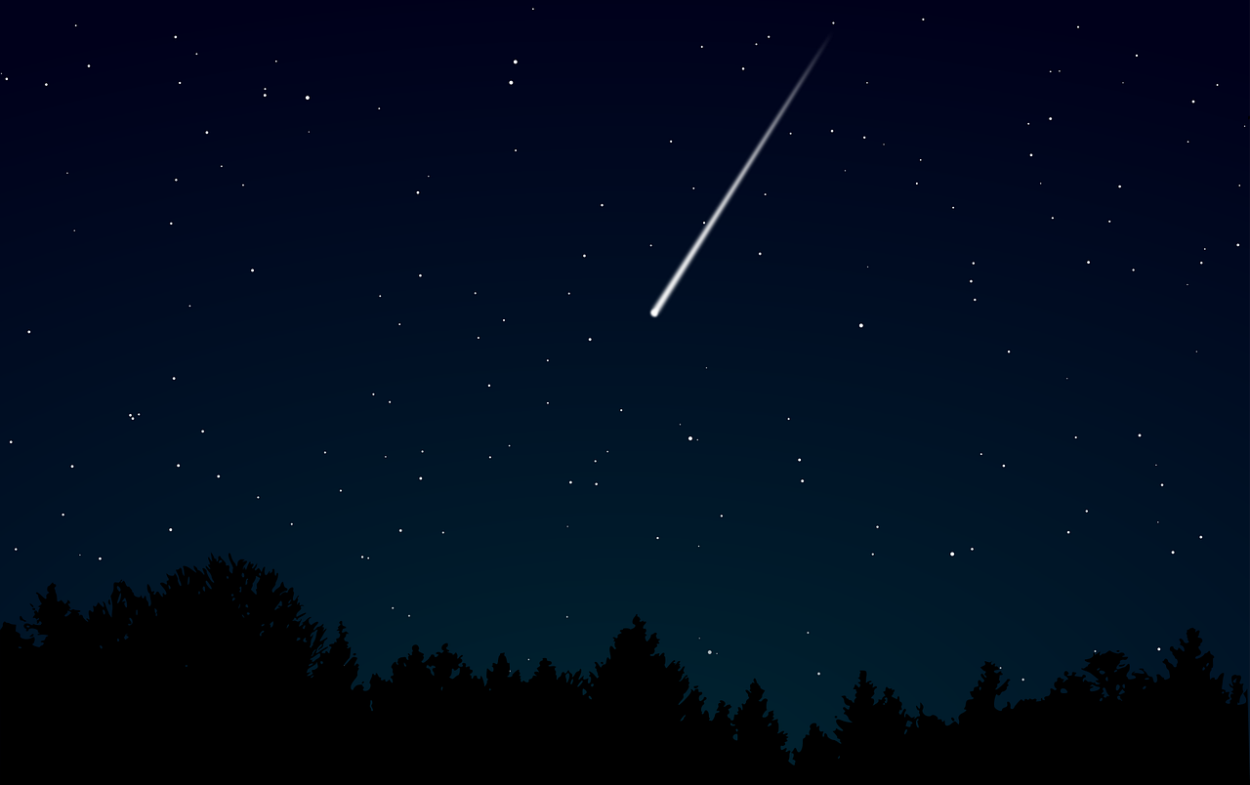
Why do meteors explode? It isn’t friction
Meteors do not explode because of friction. They explode because of pressure. As a meteoroid tears through the atmosphere at tens of kilometers per second, the air in front of it cannot get out of the way fast enough. That air is violently compressed, and once its pressure exceeds the strength of the rock, the meteoroid shatters. Most of us were taught that meteors burn up by rubbing against the air, the way a matchstick heats against a strip of sandpaper. It is a tidy image, and it is wrong.
What happens is closer to a vise than a file. At those speeds, air molecules pile up ahead of the meteoroid faster than they can flow around it, forming a shock wave. Squeezing a gas heats it, a process physicists call adiabatic compression, and the air trapped in that shock front can reach thousands of degrees. Meanwhile, behind the meteoroid, the air has been entirely pushed aside, leaving something close to a vacuum. So the rock is caught between two extremes. Enormous pressure pushes on its front. Almost nothing pushes back from behind. Scientists call this ram pressure, and it grows as the meteoroid descends into thicker air.
Every rock has a breaking point. When ram pressure crosses it, the meteoroid cracks. And here is the cruel part: each new fragment exposes fresh surface area to the oncoming air, increasing the total force and driving more fracturing. Meanwhile, the searing airflow strips material from every exposed surface, a process called ablation. The failure feeds itself. Within a second or two, a boulder becomes a cloud of debris dumping its energy into the sky all at once. That is a meteor airburst.
Chelyabinsk: The day the sky took the hit
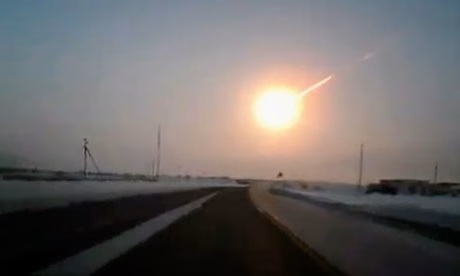
The Chelyabinsk meteoroid was roughly 17 to 20 meters across, about as wide as a six-story building. It entered the atmosphere at some 19 k/s, close to 42,000 mph. Energy rises with the square of speed, which is why a rock moving that fast carries so much of it. It weighed an estimated 10,000 to 13,000 tons. It never touched the ground. Somewhere between 23 and 30 kilometers up, well above the cruising altitude of any airliner, it came apart. The energy released was equivalent to 400 to 500 kilotons of TNT, roughly 30 times the yield of the atomic bomb dropped on Hiroshima. The flash outshone the Sun. The shock wave took about two minutes to arrive. Then it reached the city, and the glass came down.
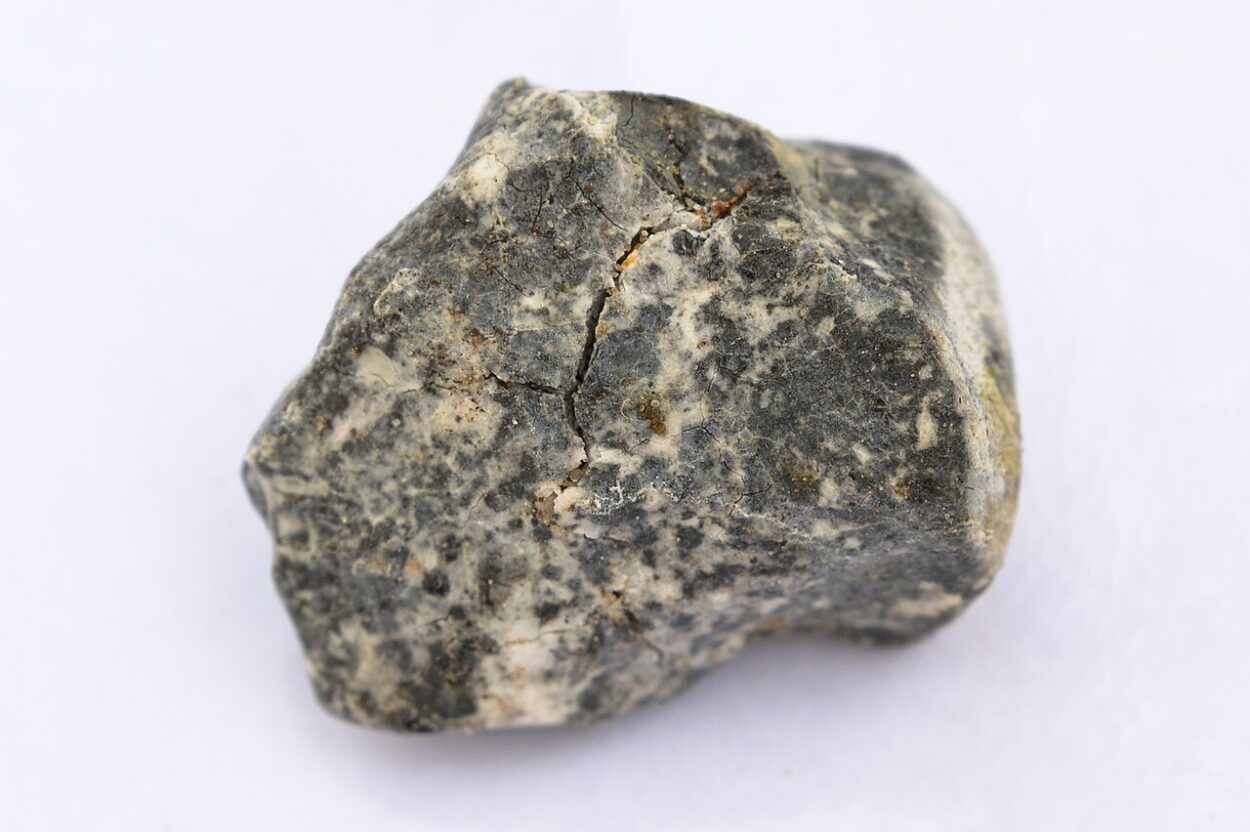
Some 1,491 people sought medical treatment, and around 7,200 buildings were damaged across six cities. Almost none of the injuries were caused by the rock. They came from windows: from people standing at them, watching the light, when the pressure wave caught up. Of the many thousands of tons that entered the atmosphere, well under 1% ever reached the ground. Searchers recovered on the order of a single ton of meteorites, the largest being a 540 kg fragment hauled from the muddy bottom of Lake Chebarkul in October 2013. Everything else had been ground into dust and vapor by the air. That is the shield, working.
The 2017 answer: Air forced into the cracks
Why did it break so completely? In 2017, Marshall Tabetah and Jay Melosh at Purdue University proposed a mechanism that seemed to explain the missing mass. Their paper, Air penetration enhances fragmentation of entering meteoroids, appeared in the journal Meteoritics & Planetary Science. They argued that meteoroids are not solid like a marble. They are riddled with pores and hairline cracks. And when high-pressure air presses against a surface full of tiny openings, it does not simply push. It gets in. “There’s a big gradient between high-pressure air in front of the meteor and the vacuum of air behind it,” Melosh explained. “If the air can move through the passages in the meteorite, it can easily get inside and blow off pieces.”
Picture water seeping into a cracked paving stone before a hard freeze. The stone is not destroyed from the outside. It is levered apart from within. In Melosh’s model, the atmosphere infiltrated Chelyabinsk’s internal flaws and pushed the rock apart from the inside out, a mechanism that would make Earth’s atmosphere a considerably better shield than anyone had assumed. It was a satisfying answer, and it traveled fast. It is still, nearly a decade later, the explanation you will find in almost every article written on this subject.
What changed in 2023: Cracks that begin at the back
Then researchers looked again. A team at Lawrence Livermore National Laboratory, working within the laboratory’s planetary defense program, built a far more detailed three-dimensional simulation of the Chelyabinsk meteor explosion using a technique called smoothed particle hydrodynamics. Their results, published in the journal Icarus in 2023, tell a different story about the fatal blow. In their model, the meteoroid does not fail because air worms into its pores. It fails because it is a solid object being crushed, and solid objects under crushing loads crack predictably.
The fracture begins at the rear of the meteoroid, where the material is stretched rather than squeezed, a load engineers call tensile stress. From there, cracks race forward through the body until it splits into three large, coherent fragments. Those fragments then disintegrate almost immediately, because each one presents a wider face to the oncoming air. “All of a sudden, you’ve got a lot more material being exposed,” said LLNL scientist Mike Owen, “which makes it break faster.” The simulation predicted the meteoroid would burst between 20 and 30 kilometers up. The real Chelyabinsk fireball reached peak brightness squarely inside that window, a striking match.
The implication is significant. If the model is right, Chelyabinsk was probably not a porous rubble pile at all. It was likely monolithic, a single coherent stone, and what destroyed it was the strength and fracture behavior of the rock itself, not air infiltrating its pores. “This is something that can really only be captured with 3D simulation,” said Jason Pearl, another of the Livermore researchers. Both teams agree on what matters most: the atmosphere destroys the rock. Where they differ is on the killing stroke, whether the air gets inside or simply squeezes until something snaps. That disagreement remains unresolved, and it should not trouble us. A field that never revises itself is not doing science. It is reciting.
How much protection does the atmosphere really give us?
The honest answer is: a great deal, up to a point that we can roughly draw.
| Size of the object | What usually happens |
|---|---|
| Under 1 meter | Vaporizes entirely. A shooting star. |
| 1 to 20 meters | Fireball and high airburst, usually no ground damage |
| About 17 to 20 meters | The Chelyabinsk case: airburst, shattered glass, injuries |
| 30 to 50 meters, dense or iron-rich | Can survive to the surface and form a crater |
| About 50 to 60 meters | The Tunguska case: forest flattened, no crater |
| Above 1 kilometer | Global consequences |
NASA notes that space rocks smaller than roughly 25 meters will most likely burn up before reaching the ground, while objects in the 30- to 50-meter range are large enough to threaten it. The upper limit of the shield has a name and a date. On June 30, 1908, an object thought to be 50 to 60 meters across exploded above the Tunguska River in Siberia with a force estimated at 10 to 15 megatons. It flattened roughly 2,000 square kilometers of forest, some 80 million trees, splayed outward from a central point like spokes on a wheel. No crater has ever been found, because there was never an impact. The object destroyed itself in the air, exactly as Chelyabinsk did, only some thirty times more violently. Composition matters as much as size. Iron meteoroids are denser and structurally stronger than stony ones, so even modest iron bodies tend to punch through and land. Some of them land spectacularly, as with the meteorite impact that may once have rained gold across Western Australia.
Three thousand years of watching the sky
Long before anyone could calculate ram pressure, people were writing down what fell from the sky. Nowhere more carefully than in China. The oldest Chinese astronomical records were scratched onto ox bones and turtle shells during the late Shang Dynasty, around 1250 to 1046 BCE. By 240 BCE, court astronomers had logged the passage of the comet we now call Halley’s. The habit never stopped. In 1988, the Chinese Academy of Sciences compiled the General Catalog of Chinese Ancient Astronomical Records. It gathers roughly 4,900 meteor sightings, 400 meteor showers, and 300 meteorite falls recorded between 770 BCE and 1991 CE. No other civilization kept a sky journal so long, or so consistently.
Why such diligence? Because in the Chinese imperial worldview, the heavens were not scenery. They were correspondence. An emperor ruled by the Mandate of Heaven (天命, tianming), and the orderliness of the sky was understood to mirror the orderliness of his reign. A comet, an eclipse, a stone falling out of a clear morning: these were read as messages about whether a dynasty still deserved to govern. Reading them correctly became a matter of state security, and officials guarded and recorded the observations with extraordinary care. You can trace that long tradition through the remarkable history of ancient Chinese astronomy.
One entry stands out. In the spring of 1490, in Qingyang (庆阳), then part of Shaanxi and today in Gansu province, chroniclers described stones falling like rain. The event appears in the official History of the Ming Dynasty and in at least a dozen local gazetteers. Several of those accounts report deaths in the tens of thousands. Modern researchers treat that figure with real caution. It has never been independently confirmed, and death tolls in premodern chronicles are notoriously unreliable. But the descriptions themselves, of a sky raining rock across a populated district, read like an eyewitness account of exactly the kind of fragmentation cascade that Livermore’s supercomputers now model. Here is the remarkable part. Those scribes were not gathering data. They were reading a warning from Heaven, with reverence and probably with fear. And in doing so they created, almost incidentally, the longest continuous record of atmospheric impacts on Earth, a document that planetary scientists still open today. Devotion left us evidence.
From omens to action: Guarding the sky today
For all of human history until recently, we could only look up afterward. That has changed within the last few years. We now occasionally see them coming. On January 20, 2024, Hungarian astronomer Krisztián Sárneczky spotted a small asteroid roughly three hours before it burst harmlessly over the countryside west of Berlin. Designated 2024 BX1, it was only the eighth asteroid in history detected before it struck. Two more followed the same year, over the Philippines and Siberia. The warnings are short, and the objects are small, but we are no longer relying on blind luck.
We also make mistakes in public, and correct them. When astronomers first spotted asteroid 2024 YR4, the early orbital math gave it a small but real chance of striking Earth in 2032. As we first reported on 2024 YR4’s impact odds, the estimate shifted as observations accumulated. Earth was cleared, but a lunar impact remained on the table at about 4.3%. Then, in February 2026, the James Webb Space Telescope precisely pinned down the orbit, and NASA ruled out the Moon impact entirely. The asteroid will pass about 21,200 kilometers from the lunar surface.
And once, we have already moved one. On September 26, 2022, NASA’s DART spacecraft deliberately slammed into a small asteroid moon called Dimorphos, shortening its orbit around its parent asteroid by about 32 minutes. It was the first time human beings purposely changed the motion of another world. China now plans its own asteroid deflection test, launching in December 2027: two spacecraft sent to a 30-meter near-Earth asteroid called 2015 XF261. An observer will study the rock first. Then, in April 2029, a kinetic impactor will strike it at roughly 10 k/s while observers watch how far it shifts. Three thousand years after the Qingyang chroniclers wrote down stones falling like rain, the sky is finally something we can answer.
So why do meteors explode? What the fireball left behind
Why do meteors explode before they reach Earth? Not because they rub against the air, but because it squeezes them. The rock is crushed between a wall of compressed gas in front and near-vacuum behind. Eventually it finds its breaking point, and the failure cascades. One question remains genuinely unsettled: what delivers the killing blow? Purdue proposed in 2017 that air is forced into the pores. Livermore’s 2023 simulations point instead to cracks opening at the rear of a solid stone. What is settled is the outcome. Earth’s atmosphere is a shield of astonishing effectiveness against everything up to roughly the size of a house, and a partial one well beyond that. It is not a wall. It is a grinder, and it does its work in the two or three seconds we would otherwise never think about.
The Chelyabinsk meteoroid arrived weighing as much as a small ship and reached the ground as a handful of stones, one of them resting quietly at the bottom of a lake until divers pulled it out. Nearly 1,500 people were hurt that morning, and not one of them was struck by the rock. The sky held. And the descendants of those Ming scribes, who once recorded falling stars as warnings from Heaven, are now building the instruments to answer them.
Follow Nspirement on Facebook, X, or Pinterest, and explore more of our space coverage for the stories unfolding above us.
Follow us on X, Facebook, or Pinterest
