

During the Tang Dynasty, Qi Qiong served as a high-ranking officer in the prestigious Imperial Guard and maintained a grand household that reflected his elevated position at court. Among his prized possessions was a pack of exceptional hunting dogs, renowned throughout the capital for their speed, agility, and keen tracking instincts. These noble hounds were not merely pets; they frequently accompanied the Emperor himself on expansive hunting expeditions across the vast imperial grounds. Because of their vital service to the realm and the pride they brought to his estate, Qi Qiong ensured they were treated with utmost care, providing them with lavish quarters and feeding them the finest cuts of meat available.
Despite this lavish treatment, one of the hounds began exhibiting a peculiar habit that baffled the household staff during the morning feedings. Instead of devouring its generous portion alongside its companions, the dog would carefully stuff its mouth with as much food as it could carry, trot away toward the dense foliage behind the estate’s bushes, and quickly return to fetch another mouthful. Qi Qiong observed this repeated behavior with growing curiosity and suspicion, wondering if the animal was hiding a stash or suffering from an unusual compulsion. Determined to uncover the truth behind his hound’s mysterious behavior, the officer instructed a trusted servant to follow the animal covertly into the far corners of the property.
A loyal imperial hunting hound secretly sustained its suffering mother
Following the hound through the thick brush, the servant made a heart-wrenching discovery in a secluded, hollow opening along the base of the northern perimeter wall. Cowering within the cold dirt was an emaciated female dog, her body covered in severe skin sores, matted dirt, and terrible filth. The imperial hunting hound had not been hoarding food out of greed, but was instead risking its own nourishment to secretly deliver life-saving meals to its ailing mother.
Upon receiving the servant’s detailed report, Qi Qiong was deeply moved by the hound’s extraordinary display of filial devotion and immediately ordered a proper rescue effort. He instructed his staff to gently place the fragile mother inside a warm wooden box, line it with soft, worn-out bedclothes for comfort, and ensure she was fed rich leftovers from the master’s own kitchen every day. Realizing that its mother was finally safe and well cared for, the hunting hound wagged its tail with immense joy and bowed its head repeatedly to Qi Qiong, expressing its profound gratitude in a manner that mirrored human intelligence.
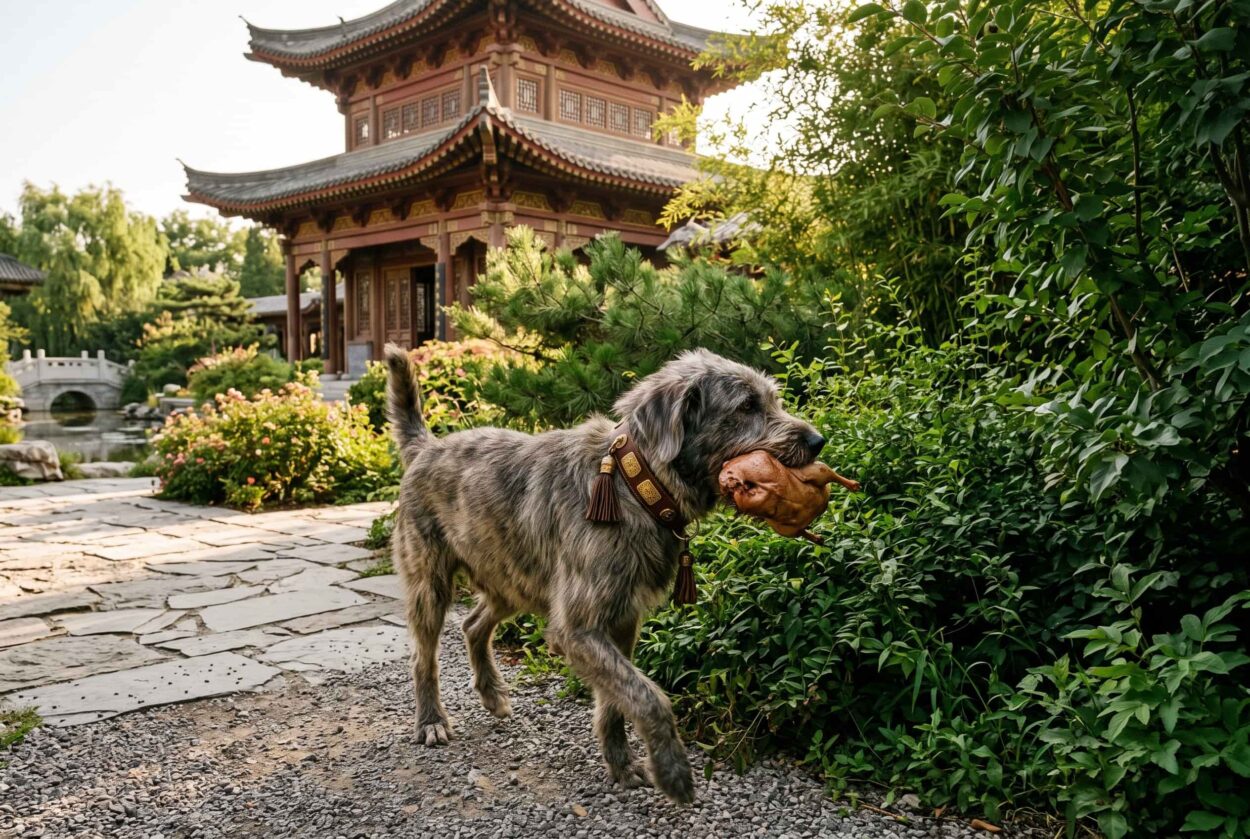
The grateful hound served its master faithfully before performing an extraordinary sacrifice
From that memorable day forward, the bond between the officer and his devoted hound grew unbreakable, leading to unprecedented success in the field. Whenever Qi Qiong brought the animal to accompany the Emperor on imperial hunts, the hound performed with unmatched vigor, chasing down and capturing numerous prey with lightning speed as if to repay its master’s benevolence. Even after the mother dog peacefully passed away a year later, the hound redoubled its efforts in the field, serving Qi Qiong with unwavering loyalty throughout the remainder of the officer’s life.
When Qi Qiong eventually passed away, the heartbroken hound fell into deep mourning, howling day and night beside the estate. A month after his passing, as the family prepared to transport Qi Qiong’s coffin to the distant countryside for burial, the hound was reluctantly left behind to guard the main house. However, on the very night the casket was lowered into the earth, the faithful animal tracked its master’s scent for miles to reach the remote grave site. There, it knelt in the mud and continuously bowed its head against the wooden coffin with such frantic desperation that it carved a hollow in the earth beneath the casket; the hound continued this relentless act of reverence until its head bled, finally collapsing and dying atop the grave before the burial crew could finish covering the coffin with dirt.
Two canine brothers demonstrated extraordinary compassion during times of hardship
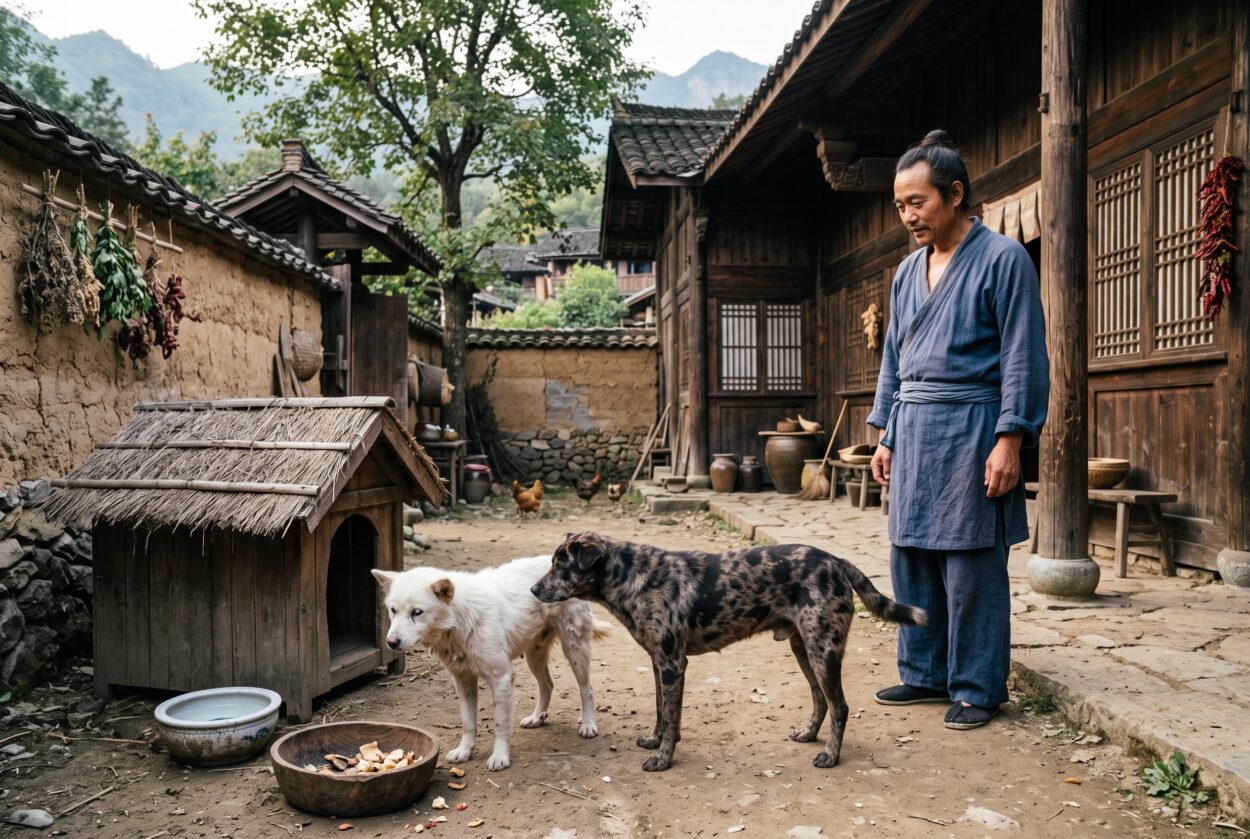
In a separate account from the Xianxi region, a man named Tong Yong shared his home with two remarkably intelligent dogs born to the same mother. One had a pristine white coat, while the other was covered in dark spots, and both showed an extraordinary capacity to understand human emotions and care for one another. Their harmonious life took a tragic turn when the white dog succumbed to disease and lost its eyesight completely, leaving it disoriented and unable to navigate its way to the feeding area or the safety of the doghouse.
Taking pity on the disabled animal, Tong Yong moved the doghouse to the enclosed yard so the blind dog could rest safely near his house. Seeing its sibling’s helpless state, the spotted dog immediately became a devoted caretaker, carrying fresh food in its mouth to feed its blind brother every day. When night fell, the spotted dog refused to sleep in its own bed, choosing instead to lie directly beside its brother to keep it warm, offer comfort, and watch over it against potential dangers.
The surviving brother honored its companion with profound morning and evening rituals
When the white dog eventually succumbed to its frailty and died, a devastated Tong Yong carried the body to the foot of a nearby mountain and gave it a proper burial. The loss weighed heavily on the spotted dog, which began a solemn, daily ritual of walking to the mountain grave every morning and evening without fail. The grieving animal would slowly circle the earthen mound several times in quiet mourning, after which it would lie prostrate in the dirt beside the grave for hours at a time before reluctantly returning home.
Reflecting on this remarkable display of canine empathy, the scholar and commentator He Zi wrote: “The love between siblings is truly precious. The spotted dog cared for the white dog by bringing it food, and after its death, the spotted dog showed the utmost devotion and respect, truly living up to the bond of brotherly love!”
Three young puppies performed a sacred act of devotion for their fallen mother
A similarly remarkable incident occurred in the city of Huai’an, where a local family committed a cruel act by slaughtering and eating their long-time family dog. Unmoved by the family’s heartlessness, the mother’s three small puppies scoured the premises to collect every remaining bone left behind after the meal. Working together in silent grief, the young animals carried their mother’s remains in their mouths, dug a shallow grave in the earth, and carefully buried the bones out of sight.
Once the burial was complete, the three puppies lay prostrate on the freshly turned soil and let out sorrowful, human-like wails that echoed through the neighborhood. Touched and astonished, nearby residents gathered to witness the mournful display, marveling at the young animals’ profound emotional capacity and agreeing that these were three extraordinary, filial dogs.
Classical philosophy underscores the universal nature of filial affection across all living creatures
Commenting on the incredible scene in Huai’an, He Zi drew a direct comparison to ancient Confucian philosophy to explain the profound instincts driving the young animals’ actions. He noted that the great philosopher Mencius once observed that if people were to see the exposed bodies of their deceased parents lying abandoned in the wild — devoured by wild foxes and swarmed by buzzing flies and gnats — they would break out in a cold sweat, turn their faces away in horror, and immediately rush to cover and bury the remains.
He Zi concluded that this instinctual horror and drive to honor one’s parents are not exclusive to humanity but are a fundamental law of nature shared by noble beasts. One can only imagine the immense grief those three young puppies endured as they held their own mother’s bones between their teeth, driven by an overwhelming urge to shield her remains from further disrespect and accord her the dignified resting place she deserved.
Translated by Elaine and reviewed by Laura Cozzolino
Follow us on X, Facebook, or Pinterest
