
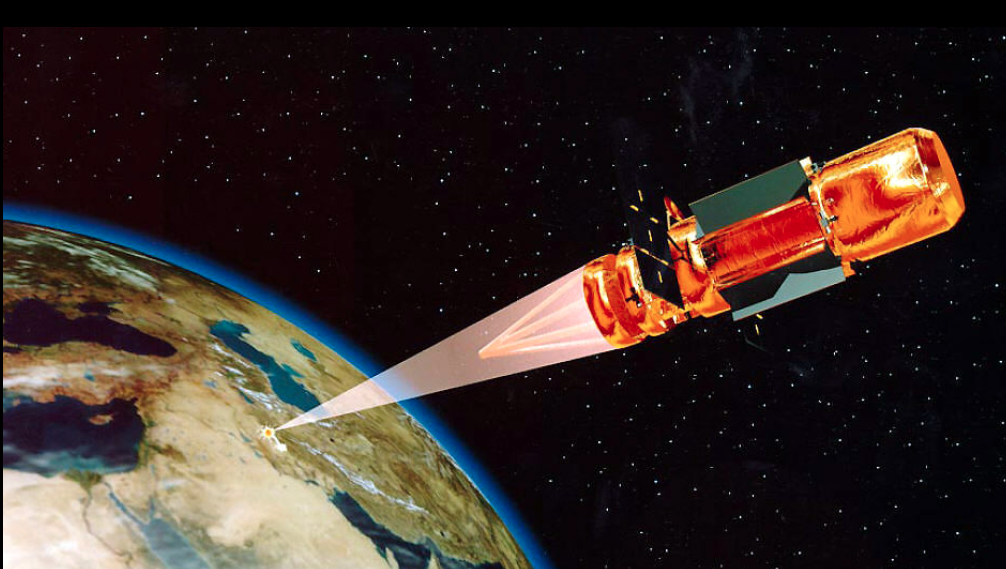
U.S. Air Force Secretary Troy Meink has announced the United States has deployed what he called “on-orbit space control weapons.”
This public statement came as a surprise to many, but not for the reasons you may think. For many years now, China, Russia and the U.S. have accused each other of weaponizing space, or of creating an arms race in space. They have all consistently denied doing so. For the U.S. now to declare it has space weapons, it seems like an admission that China and Russia’s accusations are correct.
It’s also worrying, because other countries might feel they have permission to do the same. And this would make space very unsafe, increasing the risk of attacks on satellites, which are crucial for modern militaries, as well as daily life on Earth, as we depend on those same satellites for things like GPS, Internet, phones, banking, global shipping, and transport.
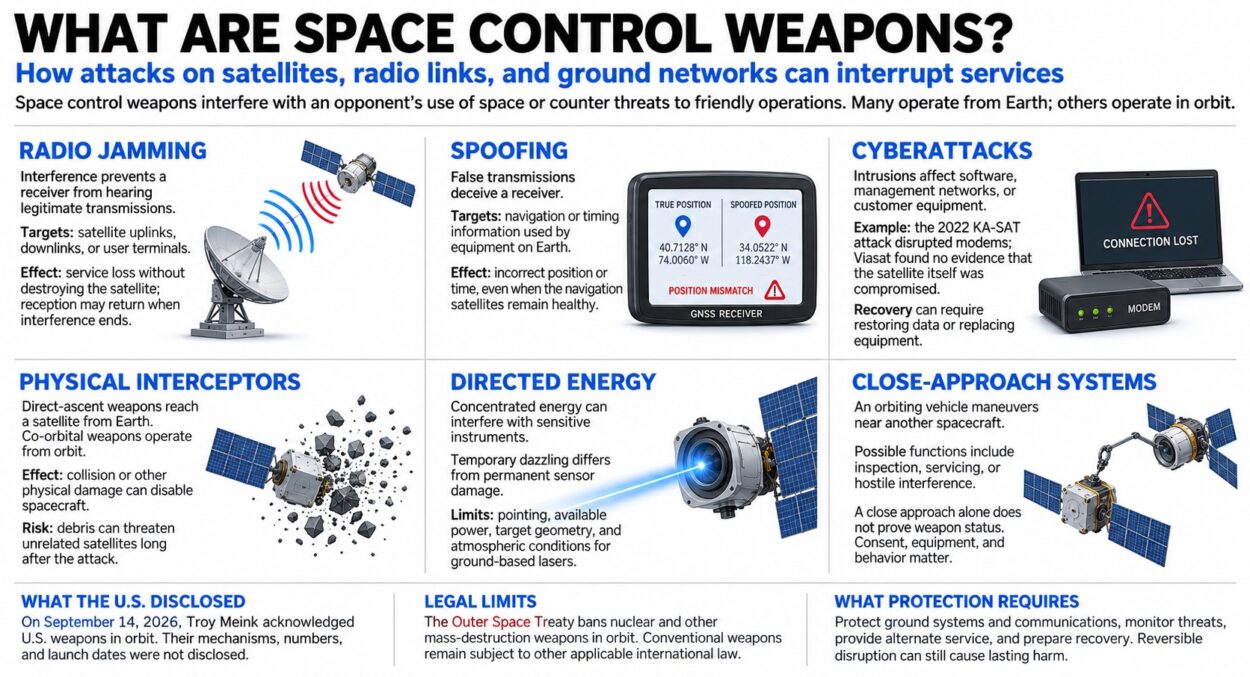
What are space control weapons?
The term “space control” may seem odd. But it comes from many years of U.S. policies and military doctrines that all state that the U.S. seeks dominance, superiority, and control in space.
In 2025, the U.S. Space Force released its Doctrine Document, which stated:
space control consists of offensive and defensive actions, referred to as counterspace operations.
Many countries already have so-called counterspace capabilities: the ability to interfere with each other’s satellites, whether by jamming a communications or GPS signal (which is happening regularly in and around Ukraine), “spoofing” a false GPS signal to confuse militaries about the whereabouts of their adversaries, cyber attacks, or electronic warfare.
None of this is Star Wars, but all of it can be worrying if it escalates.
As for what U.S. space control weapons actually are, and whether they’re any different from existing counterspace capabilities, Meink refused to provide any more details.
There are three possibilities. First, they could be nuclear weapons, or weapons of mass destruction, but this is incredibly unlikely. Under the 1967 Outer Space Treaty, it is illegal to place these weapons in orbit around Earth, or in outer space.
Americans and the Soviets both tested nuclear weapons early in the 1960s, and quickly learned their own satellites, as well as those of allies, were impacted immediately and that orbits remained radioactive over time, meaning it wasn’t in their own interests to use these kinds of weapons. It’s also nearly impossible to develop or launch these weapons without it being noticed by other countries’ intelligence gathering.
Second, the space control weapons could be some other form of physical, or “kinetic,” weapons. The Outer Space Treaty doesn’t ban other weapons, so this wouldn’t necessarily be illegal. Conventional explosives don’t work in space, but the Soviets and Americans did test small projectiles from one satellite to another in the 1960s and ‘70s. It would be surprising if this were to be the case now.
On the other hand, in 2022 China demonstrated the ability to grapple a defunct satellite and tug it about 2,000km away from its orbit. This could be used to remove space debris, but it could also be used to remove an active satellite. There is no evidence the U.S. has this capability.
The third possibility is that Meink’s statement was a rebranding of existing counterspace capabilities as “weapons,” to assert power and maybe try to deter Russia and China from interfering with U.S. satellites. We know both China and Russia have space-based jammers used to interrupt satellite signals, and it would make sense that the U.S. has this capability as well, or something similar.
If this is the case, which other global space security experts estimate to be true, it is posturing. But this is still dangerous. It gives China and Russia plenty of justification to point to the U.S. as an aggressor, and ramp up their own space weapons capabilities.
Destabilizing space
This public declaration also plays into the hands of China and Russia, which have been proposing a Treaty on the Prevention of the Placement of Weapons in Outer Space since 2008.
The U.S. and its allies, including Australia, have refused to negotiate the treaty, saying it’s too difficult to know what exactly is a space weapon and what is being launched.
The Chinese foreign ministry has pointed to Meink’s statement as evidence of the U.S.’s “weaponization of outer space, turning it into a battlefield, as well as an arms race there.” And Russia has called for space to be kept “free of any weapons.”
There has been significant progress in United Nations space arms control discussions over recent years. This statement from the U.S. undermines those efforts.
While some countries still insist the Treaty on the Prevention of the Placement of Weapons in Outer Space is the only solution, there has been some agreement on norms, rules and principles of responsible behavior in space. In particular, a new norm is emerging against ground-based missiles used as anti-satellite weapons.
Since 1981, every year, the UN General Assembly adopts a resolution on the Prevention of an Arms Race in Outer Space. Sadly, the U.S. has refused to support it since 2023. This week’s declaration fits with this move away from international efforts, which is in line with the current U.S. attitude against international collaboration in general.
Other countries should not shy away from calling out this declaration as escalatory — and should double down on their efforts to prevent an arms race in space when they meet in Geneva this November.
This article is republished from The Conversation under a Creative Commons license. Read the original article.
Follow us on X, Facebook, or Pinterest
