
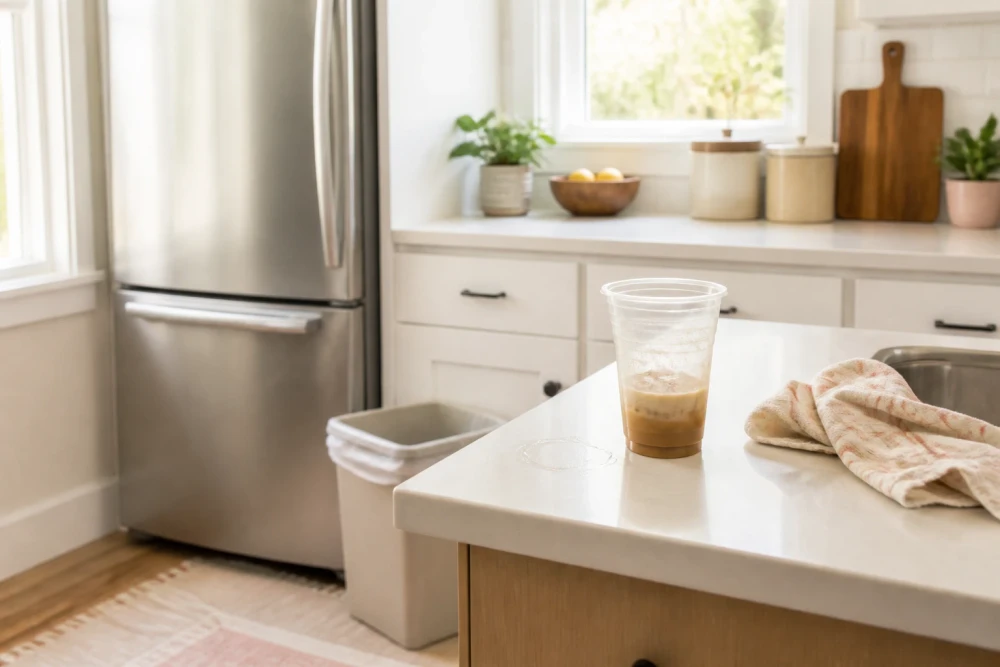
The overnight coffee sitting in your refrigerator right now probably won’t hurt you. The one that spent an afternoon on a warm desk before it went into the refrigerator is a different question — and for a man in his early thirties in Taiwan, the difference between those two cups was the difference between an ordinary week and an emergency admission that came close to dialysis.
The afternoon that mattered
Dr. Hung Yung-hsiang, a Taiwanese nephrologist, described the case publicly in early August. The patient, whom he refers to as Mr. Chen, was thrifty in the ordinary way many people are: drinks he did not finish went into the refrigerator for the following day. Nothing about the habit is unusual. Most households run on some version of it.
On the occasion in question, the drink was an iced latte. It sat out at room temperature for most of the afternoon. Then it went into the refrigerator, where it stayed for roughly a day. Then he drank it. Within hours, he was vomiting violently and could not stop the diarrhea. His blood pressure dropped. His thinking became unclear. By the time he reached the emergency department, he was severely dehydrated, his inflammatory markers and circulating metabolic waste were far above normal, and his kidneys had effectively stopped keeping pace. Treatment worked. But the margin was thin.
There is one more fact in the case, and it carries most of the explanatory weight: Mr. Chen already had chronic glomerulonephritis, a long-standing inflammation of the kidney’s filtering units. He was not a healthy thirty-year-old who drank bad coffee. He was a kidney patient who lost a great deal of fluid very quickly.
What actually happened inside him
The kidney is not simply a filter. It is a pressure-dependent filter. Blood arrives under a specific pressure range, and the filtering units — the glomeruli — depend on that pressure to push fluid across their membranes. Drop the circulating blood volume far enough, and the pressure falls with it. The filtering slows. Waste products that should be leaving the body stay in it. Clinicians call this pattern prerenal acute kidney injury, and the word prerenal is doing important work. The damage does not begin in the kidney. It begins upstream, in the volume of fluid available to perfuse it. Severe vomiting and diarrhea can strip out liters in a matter of hours, and the kidneys are among the first organs to register the loss.
In a person with two healthy kidneys and substantial functional reserve, this usually resolves. It is miserable; it may require intravenous fluids, and it passes. In a person whose filtering capacity is already reduced, there is no reserve to spend. The same insult that causes a bad day in one body can cause organ failure in another. That is why a case like this ends up in a nephrologist’s caseload rather than a gastroenterologist’s, and why the warning attached to it deserves precision.

Why overnight coffee is the wrong thing to blame
The intuitive reading of this case is that coffee left standing turns dangerous. The chemistry says something more specific, and more useful. Brewed coffee is an acidic, nutritionally sparse liquid. Cold brew falls into a range that food scientists describe as not particularly hospitable to most harmful bacteria, though acidity doesn’t restrain every organism equally. Hot-brewed coffee is more acidic still. Beyond pH, black coffee simply doesn’t offer much to grow on. It has very little protein and very little sugar — the two things a bacterial population needs to double itself.
Milk changes every part of that equation. Dairy is close to neutral in pH, rich in protein, and carries its own sugar. In plain terms, it is a growth medium. Standard food-safety guidance treats the range between roughly 4°C and 60°C as the zone in which bacteria multiply fastest, and applies a two-hour limit to perishable items held inside it. A latte on a desk in a warm room is inside that zone from the moment it cools. So the load-bearing variable in Mr. Chen’s case was not that the coffee was old. It was that the drink contained milk and sat at room temperature all afternoon before anyone thought to refrigerate it. Black coffee left covered on a counter overnight is a quality problem — flat, oxidized, tasting of nothing much. A milk drink left out for four hours is a food-safety problem. These are not the same category of mistake, and collapsing them into one rule makes the rule easier to ignore.
The practical guidance Dr. Hung gives — finish coffee within an hour, discard anything that has stood beyond two, and choose black coffee over milk drinks if your kidneys are compromised — holds up well. It simply holds up for a reason slightly different from the one usually given.
What the refrigerator can and cannot do
A common assumption is that putting something in the refrigerator resets its clock. It does not. Refrigeration slows bacterial multiplication; it does not reverse what has already occurred, and it does not remove anything a bacterial population has already produced. It also does not stop growth outright. Some organisms are cold-tolerant and continue reproducing at normal refrigerator temperatures, just more slowly. Listeria monocytogenes is the best-known example and grows near 0°C. Certain strains of Bacillus cereus and several Pseudomonas species do the same. That’s why refrigerated milk still carries a use-by date rather than an indefinite one. The honest framing is that Mr. Chen’s decision to refrigerate the latte was right, but it came several hours too late. The refrigerator was not complicity. It was damage control applied after the damage.
A related and more dangerous assumption is that heating something to steaming will make it safe again. Heat generally works against actively growing bacteria. For what some of those bacteria leave behind, it does not. Several of the toxins responsible for rapid-onset food poisoning are heat-stable. The emetic toxin produced by Bacillus cereus survives cooking temperatures, as do the enterotoxins produced by Staphylococcus aureus. This explains the well-documented phenomenon of people falling ill from reheated rice: reheating killed the bacteria but left the toxin intact. Applied to a milk-based coffee that has been sitting out, the conclusion is uncomfortable but simple. Microwaving it does not make it safe. It makes it warm.

The mould question, and where the risk actually lives
The other hazard raised in the original account is ochratoxin A, a mycotoxin produced by several Aspergillus and Penicillium species. This is a real compound and a real concern, and it deserves to be described accurately, because the popular version of the warning points at the wrong part of the supply chain. Ochratoxin A is genuinely nephrotoxic and is classified by the International Agency for Research on Cancer as possibly carcinogenic to humans. The European Commission sets maximum limits of 3 µg/kg in roasted coffee beans and 5 µg/kg in soluble coffee, while the FDA and Codex Alimentarius set none.
For anyone in their own kitchen, what matters is when and where the toxin forms. The fungi that produce it require moisture. The minimum water activity for ochratoxin production is around 0.80 to 0.85 — roughly 14 to 20% moisture — and a landmark review of coffee processing concluded that the risk of mould growth and ochratoxin production depends on how long the coffee stays above that threshold before roasting. Under experimental conditions, no ochratoxin A was detected at all at 0.80 water activity, and none was produced at 10°C regardless of moisture.
Roasted coffee sits far below that threshold. It is a dry good. The window in which ochratoxin A actually forms is upstream: cherry drying under humid tropical conditions, warehouse storage, shipping. Leaving ground coffee in an open jar overnight does not generate mycotoxin. Storing it in a jar that has been quietly taking on humidity for six months in a subtropical climate is a different matter, and that is the version of the warning worth keeping.
The claim that heat cannot destroy ochratoxin A is close to correct, if slightly overstated. Roasting reduces it, but incompletely and inconsistently: one study of naturally contaminated beans found an average reduction of about 22% across roasting profiles, and filter brewing removed a further 14%. Industrial processing has been reported to reduce levels by up to 90%. Brewing does not eliminate the toxin — it extracts it into the cup along with everything else. The reassuring part, which rarely travels with the alarming part: a probabilistic risk assessment of coffee products found the hazard quotient for nephrotoxic effects in adults well below 1 across instant, roasted, and traditionally brewed coffee, placing consumers within the safe range for non-cancer risk.
What the kidney research actually found
The original account cites a study in Kidney International Reports showing that fresh coffee reduces the risk of acute kidney injury by 15 to 23%. The study exists, and the figures are accurate. Researchers at Johns Hopkins drew on the Atherosclerosis Risk in Communities study, which followed 14,207 adults with a median age of 54 across seven surveys over 24 years and recorded 1,694 cases of acute kidney injury. Participants who drank any amount of coffee daily had a 15% lower risk than those who drank none, with the largest reduction — 22 to 23%— among those drinking two to three cups a day.
Two things should be said. First, this is an observational cohort study, which establishes association rather than causation. One nephrologist commenting on the findings noted that acute kidney injury was an uncommon outcome in the study and that the results are not a reason for anyone to change how much coffee they drink. The second is more directly relevant here. The study compared coffee drinkers with non-drinkers. It did not compare fresh coffee with day-old coffee, and it offers no evidence at all that a stale cup reverses the association. Using it as the “before” half of a before-and-after argument asks it to carry a conclusion it never tested.
Who should treat this as more than an inconvenience?
The distinction that this case really turns on is not fresh versus old. It is reserve versus no reserve. For most healthy adults, a badly kept milk drink means a wretched twenty-four hours and a resolve to be more careful. For people living with chronic kidney disease, that same episode can cross into acute-on-chronic kidney failure, because the buffer that would ordinarily absorb the fluid loss is not there. The same is true, for related reasons, of older adults, people who are immunocompromised, people on diuretics or certain blood pressure medications, and pregnant women — for whom Listeria in particular carries consequences well beyond an upset stomach. If you are in one of those groups, take the case personally. If you are not, take it seriously without using it as a reason to fear your own coffee. One piece of the original advice is worth keeping intact, because it is correct and widely ignored: coffee beans do not belong in the refrigerator.
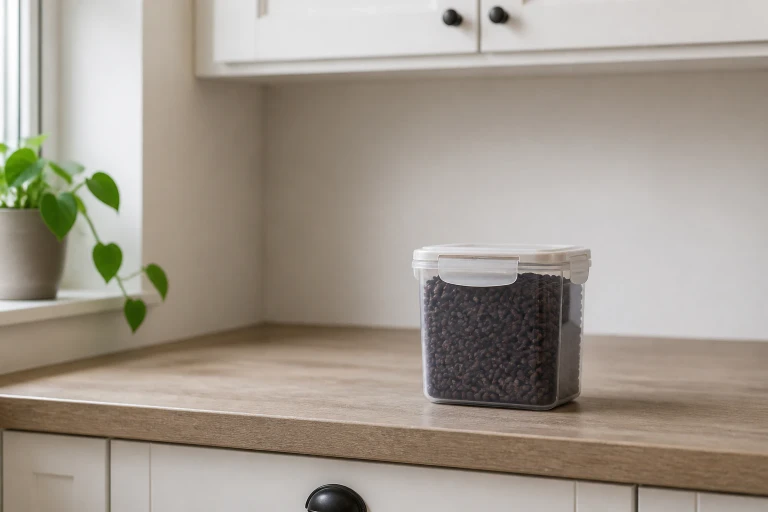
Roasting drives moisture out of the bean and leaves behind a porous, dry, highly absorbent structure. Put that into a refrigerator — a humid environment full of competing odors — and the bean does exactly what its structure predisposes it to do. It takes on moisture and smells. The National Coffee Association recommends storing coffee in an opaque, airtight container in a cool, dark place at room temperature, away from ovens, dishwashers, and afternoon sun. Freezing works for genuine long-term storage if you seal the beans in portions and thaw them only once; daily access to a freezer container introduces condensation, which is what you were trying to avoid. The rest of it is unglamorous and effective. Buy small quantities rather than stockpiling. Seal what is open. Aim to finish beans within a few weeks of roasting. And trust your nose: coffee that smells of nothing, or smells of old oil, stale wood, or ash, has stopped being coffee in any meaningful sense.
A rule simple enough to actually follow
The version of this story that travels fastest — overnight coffee damages your kidneys — is memorable, wrong in its mechanism, and easy to dismiss the next morning when you feel fine. The version that holds up is less dramatic and more useful. Milk in a warm room is on a 2-hour clock. The refrigerator slows that clock; it does not turn it back. Reheating kills bacteria, but not everything bacteria leave behind. Mould toxins in coffee are a real concern that belongs to the farm and the warehouse, not to your countertop overnight. And the reason one 30-year-old nearly ended up on dialysis was not that his coffee was old. It was that his kidneys had no room to spare when he lost more fluid than he could replace. Black coffee, brewed fresh, remains one of the least suspicious things in most kitchens. It is the cup with milk in it, sitting where you forgot it, that is quietly keeping time.
Follow us on X, Facebook, or Pinterest
