
How a tiny Khasi community in northeast India turned a 19th-century brush with death into the continent’s most disciplined village — and why it is now turning away the tourists who came to admire it.
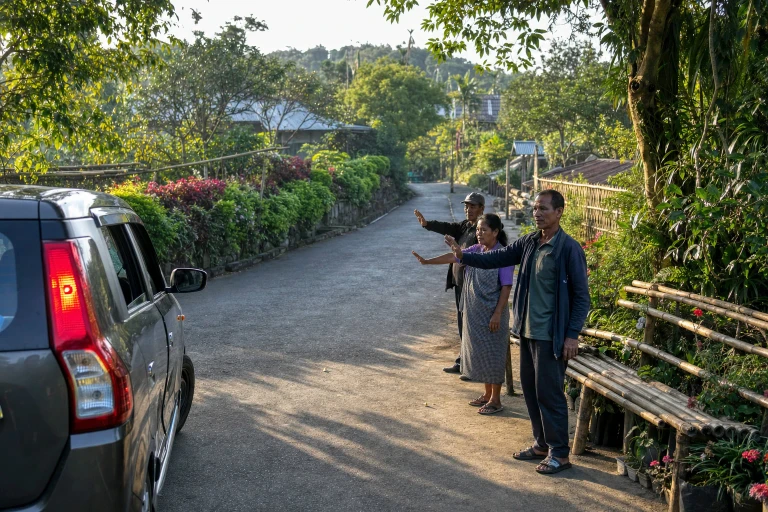
In Asia’s cleanest village, the single most profitable day of the week is now closed. Every Sunday morning in Mawlynnong — a settlement of fewer than a thousand largely Christian people tucked into the East Khasi Hills of Meghalaya, a short drive from the India–Bangladesh border — people at the village entrance politely turn day-trippers away. No buses from Shillong. No taxi convoys. No selfie crowds drifting between the bamboo benches and the flowering hedges. Sunday brings the most visitors, and the most money. That is precisely why, since January 2026, the village has decided it no longer wants them.
It is an almost unthinkable decision for a place that has built two decades of livelihood on its reputation. To understand why the villagers made it — why they would refuse the weekend windfall on purpose — you have to understand what their cleanliness has actually been all along. It was never a tourist attraction. It was the visible surface of something far deeper, and the Sunday ban is the village quietly protecting that deeper thing from the very fame it created.
How Asia’s cleanest village earned its name
The title is not official. No pan-Asian sanitation authority hands out rankings. In 2003, the travel magazine Discover India sent a writer into the lesser-known corners of Meghalaya, arrived in Mawlynnong, and called it Asia’s cleanest village. The phrase stuck. Two years later, the same village was named India’s cleanest. In 2015, Prime Minister Narendra Modi praised it on his national radio address, Mann Ki Baat — years before “Swachh Bharat,” Clean India, became a government slogan. By 2026, industrialist Anand Mahindra called it a role model for the rest of the country on X. The BBC, Condé Nast and a thousand travel blogs followed.
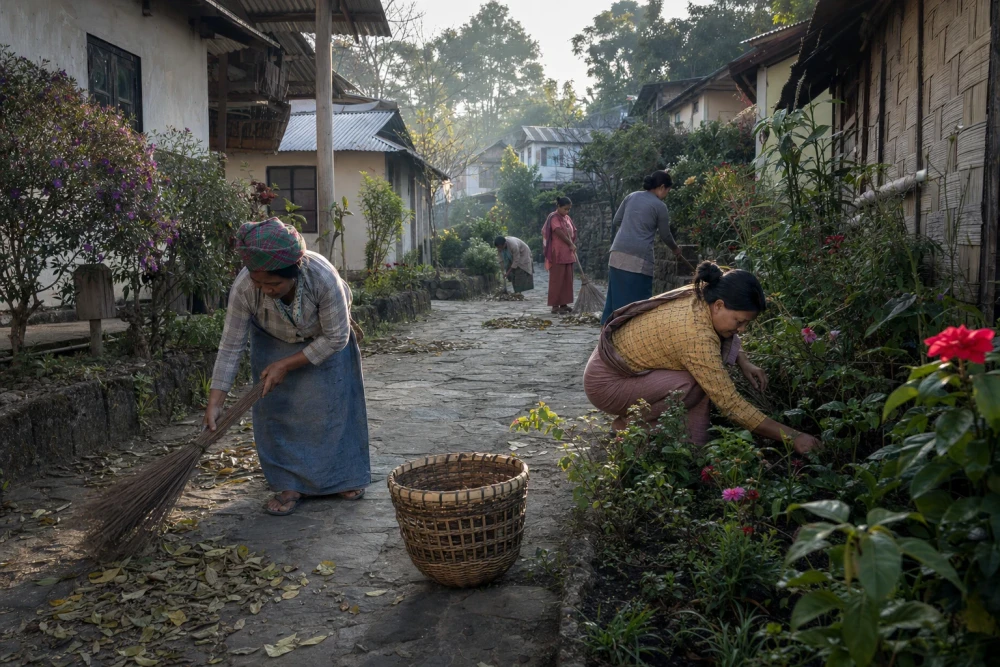
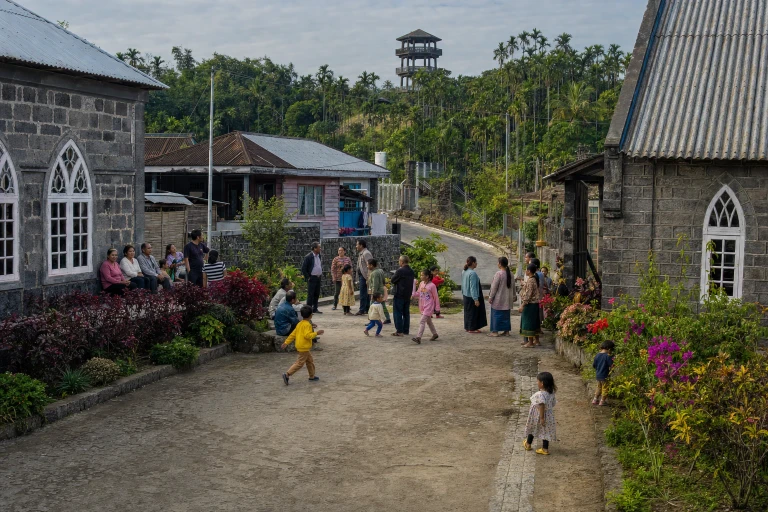
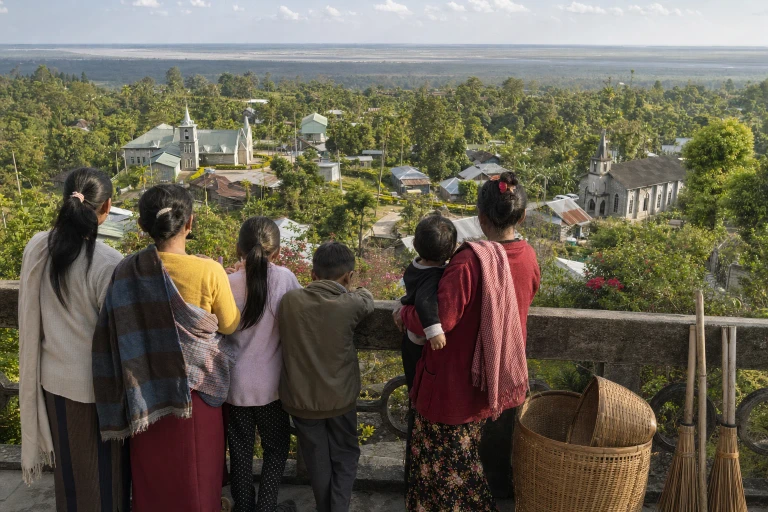
What they all found on arrival was genuinely startling, especially in a country where roadside litter is so common it becomes invisible. Streets swept smooth. Hand-woven bamboo baskets stood at intervals along every path, so no scrap of waste ever touched the ground. Flowering shrubs trimmed into shape. Two stone churches. Signs reading “God’s Own Garden.” It looks less like a village that cleans up after itself and more like a garden that happens to have people living in it.
But the recognition described a result. It said nothing about the mechanism. And the mechanism — the thing underneath the swept paths — is the only part of Mawlynnong worth genuinely studying.
The cholera outbreak that started it all
The cleanliness is old. Older than the title, older than tourism, older than anyone now living. The villagers trace it to the late nineteenth century, when an epidemic struck this corner of the Khasi Hills. Accounts differ on the disease — some say cholera, others say plague — but they agree on what it did. It frightened a community into changing how it lived.
Around the same time, Welsh Christian missionaries began moving through the region, converting members of the indigenous Khasi people to the Anglican/Presbyterian faith. Alongside the gospel, they carried a Victorian conviction that dirt carried death — that washing clothes, boiling water, and keeping the home and street clean was a defense against the sickness that had nearly emptied the village. For a people who had just watched neighbors die, this was not abstract advice. It was survival. Hygiene and faith arrived together and fused, and over generations the fusion hardened into something that no longer felt like a rule. It felt like who they were.
This is the first thing outsiders tend to miss about Mawlynnong. The cleanliness did not begin as an aesthetic preference or an environmental program. It began as a community’s response to nearly dying, carried forward long after the fear that produced it had faded from living memory.
The regimen that never stops
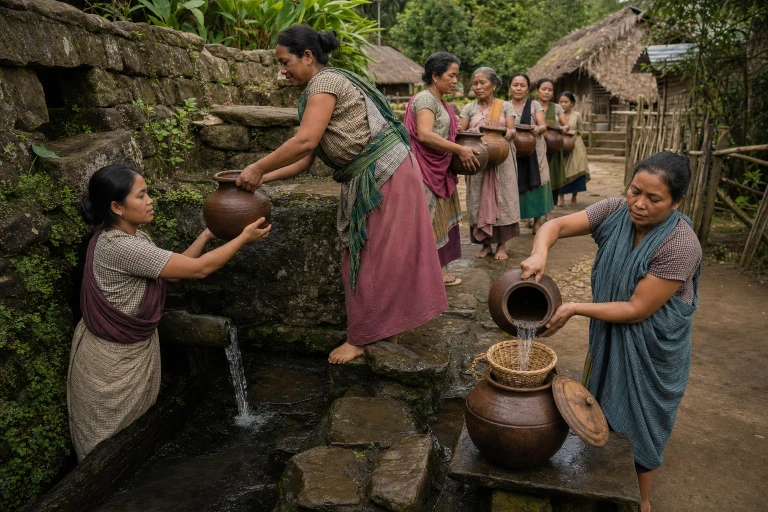
Walk through the village on an ordinary weekday, and the system reveals itself in motion. No municipality runs it. No contracted sanitation department, no fleet of trucks. The people who live there make up the entire apparatus.
The day starts early. Around half past six in the morning, before school, children take teasel brooms to the lanes and sweep away the night’s fallen leaves and debris. Each household is responsible for the stretch of public path in front of it — not as a favor, but as an expected duty, the way one is expected to show up for a meal. The cone-shaped bamboo baskets, called khoh, stand roughly every fifty meters, woven by local hands. Waste goes into them, then into a pit, where it breaks down and later becomes manure for the gardens and the betel-nut groves that have long been the village’s main crop. Nothing is squandered. The trash becomes the soil that grows the food.
The rules are strict and old. Plastic bags were banned here in the early 2000s, years before India passed any national plastic law. Smoking and chewing tobacco are restricted. Rainwater is harvested off the roofs — no hardship in one of the wettest regions on Earth. The discipline is taught deliberately to the young. Schools hold a weekly cleanliness day. Children separate waste, learn composting, tend plants, and wash their own plates after eating. By the time a child in Mawlynnong sits down in a classroom, the morning’s chores are already done, and done without being asked. A teacher in the village put it plainly: education matters, but cleanliness matters just as much.
That is the regimen. None of it is complicated. Any village on Earth could, in principle, do exactly this. Almost none do. Which means the regimen is not really the answer either. The answer lies in why it holds.
Why there are no fines
Here is the part that surprises people most. Mawlynnong has no penalty for littering. No fine, no ticket, no enforcement officer.
Instead, there is something older and, in a small community, far stronger. The sanction for breaking the rules is social. A resident who litters, who lets their stretch go untended, who flouts the plastic ban, loses standing — in the eyes of neighbors and in the village council, the dorbar, that governs communal life. In a settlement of a few hundred people, almost all of them woven together through the Khasi clan system, there is nowhere to hide from that judgment. You cannot be anonymous among people who have known your mother and your grandmother.
You cannot be anonymous among people who have known your mother and your grandmother. Reputation is the currency, and everyone holds an account.
A 2014 study of the Mawlynnong model identified what the village seems to know by instinct: cleanliness sustains itself because two forces pull in the same direction. Social pressure makes the rule binding from the inside. Tourism income — earned because of the village’s spotless reputation — rewards it from the outside. Once cleanliness became the brand, the brand became a reason to keep cleaning. The loop closes on itself.
It is worth pausing to correct two things the internet gets wrong, because Mawlynnong has become a magnet for tidy myths. First, the Khasi are matrilineal, not matriarchal — a distinction locals will gently correct you on. Lineage, property, and the ancestral home pass through women, and the youngest daughter inherits the house along with the duty of caring for the family; but public and political life, including the dorbar, remains largely in men’s hands. Second, a viral story about “an Indian village where no one locks their doors” is repeatedly pinned to Mawlynnong. It is a different place. Mawlynnong is impressive enough without the embroidery.
When cleanliness becomes identity
Step back far enough, and the real structure comes into view. Mawlynnong is not clean because it cleans. It cleans because of what it has decided it is.
This is the inversion most outside observers get backward. They see the swept lanes and imagine a heroic effort of will — a village straining, every single day, against the natural human drift toward mess. But that is not what is happening. For the people of Mawlynnong, sweeping the path is not a chore overcome by discipline. It is an expression of belonging, as automatic as the language they speak. The behavior flows from the identity. Change what a person believes themselves to be, and you change what they do without policing a single action.
This is why the habits transmit so cleanly across generations. A child does not sweep because a parent enforces it. A child sweeps because sweeping is simply what people here do, absorbed the way an accent is absorbed, before the age at which one decides anything at all. By adulthood, it no longer requires motivation. It requires no thought. The cleanliness is not maintained against the grain of the self. It runs with the grain.
Once you see that, the Sunday ban stops feeling strange.
What the Sunday ban actually protects
For years the pressure had been building. On a busy weekend, Mawlynnong — home to fewer than a thousand people — could receive anywhere from five hundred to well over a thousand visitors in a single day. Forty homestays, a handful of restaurants, a viewing tower where you can pay thirty rupees to climb up and see the plains of Bangladesh. Tourists photographing the gardeners as they worked. One widely shared video showed a Finnish man, married into the village, scolding day-trippers who had thrown plastic bottles on the ground — the precise behavior the village had spent a century training out of itself, arriving now by the busload.
So at the annual dorbar, they put forward a proposal: close the village to day visitors on Sundays. Reserve the day for church, for family, for rest — for the life the village was actually living before the world arrived to admire it. The committee consulted the households and the homestay owners first. By their account, no one objected; many already closed on Sundays anyway. Overnight guests staying in the homestays could remain. The day-trip flood would be turned back. A small sign went up at the entrance. The reasons were posted plainly online: church services, the awkwardness of visitors arriving to find everything shut, and the need to protect the village’s hard-won name from the damage the crowds were beginning to do.
Look closely at what is being protected, because it is the whole point. The village is not protecting its cleanliness. It is protecting what produces its cleanliness — the unhurried communal life, the shared Sunday, the social fabric in which a swept path is a natural gesture rather than a performance for cameras. The tourism grew out of the cleanliness; the cleanliness grew out of the community; and the community was beginning to be crowded out by its own success. Banning Sunday tourists is the village reaching back past the money to defend the source. One woman who charges tourists to climb the viewing tower — and who therefore loses income every Sunday — supports the ban without hesitation. There has to be time, she said, for church.
The village is not protecting its cleanliness. It is protecting what produces its cleanliness.
A culture that will refuse its most profitable day to keep its Sundays knows exactly what it values, and in what order.
What the West can — and cannot — copy
It is tempting, watching all this from a Western city where the streets are cleaned by people you never see and paid for by taxes you resent, to want a transplant. Take the Mawlynnong method. Apply it to a suburb in Ohio, a borough of London, a quartier of Marseille. The instinct is understandable. It is also, taken literally, doomed — and the reason it is doomed is the most useful thing the village has to teach.
The Mawlynnong system runs on conditions most Western communities simply lack. It is small enough that everyone is known. It is bound by kinship dense enough that reputation cannot be escaped. It shares a single faith that gives the week a common rhythm and the work a common meaning. Its enforcement is social rather than legal precisely because the social bonds are strong enough to carry the weight. Strip those conditions away — replace them with the anonymity, mobility and pluralism of a modern city — and the bamboo baskets become litter bins nobody feels responsible for. You cannot shame a stranger into civic pride. There is no stranger to shame.
So the literal lesson fails. But the structural lesson is real: behavior follows from belonging, and belonging follows from scale. Mawlynnong did not produce its cleanliness through campaigns, fines, or technology. It produced it by being a community small enough, and bound tightly enough, that caring for the shared space felt like caring for one’s own home — because, in a real sense, it was. The transferable insight is not the broom or the basket or the plastic ban. It is that civic behavior is downstream of civic identity, and civic identity is downstream of a community that is actually a community, at a human scale, where people are seen.
The West already half-knows this. The cleanest, most cohesive corners of any Western city tend to be the small, stable ones — the village high street where the shopkeepers know one another, the block where neighbors have lived for decades. We have simply built most of our world at a scale where those bonds cannot form, and then wondered why no campaign for civic pride ever quite takes. Mawlynnong is not a magic regimen to import. It is a mirror held up to that question. What it asks is harder than “why don’t we sweep our streets?” It asks whether we still live anywhere small enough to want to.
On a Sunday in Mawlynnong now, the gate stays shut to the day-trippers, and the village returns to itself. Children who are not sweeping for an audience. Two churches filling and emptying through the day. The plains of Bangladesh visible from the tower, with no one paying to look. The cleanest village in Asia spends its quietest day doing the one thing cleanliness was always in service of—simply being a place where people belong to each other. The brooms can wait until Monday. The belonging cannot.
Follow us on X, Facebook, or Pinterest
