
During the Qing Dynasty, a renowned martial artist named Liang Yuanxing lived in Wuchang. He had mastered Shaolin boxing and was especially skilled with the staff. Among the disciples of the Liang school in Hubei, he was known as “Liang the Invincible.”
Liang Yuanxing had a son named Liang Zhixiang. Blessed with the family’s natural strength, Zhixiang began training with stone locks under his father’s guidance when he was still a child and soon showed considerable ability.
As he grew older, however, his interests shifted from the training ground to the study. When his father tried to teach him swordsmanship, Zhixiang returned the sword to its rack and slowly shook his head.
“A sword can defeat only one man,” he said. “It is not worth studying.”
His father glared at him. “Then what do you intend to study?”
Zhixiang’s eyes brightened.
“I want to learn how to contend with thousands,” he replied. “I will pursue the imperial examinations and write about government and affairs of state.”
Although Liang Yuanxing was somewhat disappointed, he was broad-minded enough to allow his son to choose his own path.
From martial arts to scholarship
Zhixiang proved exceptionally gifted in his studies. Only a few years after abandoning martial arts for scholarship, he had acquired a considerable literary reputation. By the age of 20, his forceful essays and elegant compositions impressed even the most respected elderly scholars in the region.
“The younger generation is indeed formidable,” they said. “This young man has the mind of a strategist.”
One winter, Zhixiang prepared to travel north to the capital to take the metropolitan imperial examination. Several classmates agreed to accompany him, and together they hired a horse-drawn carriage.
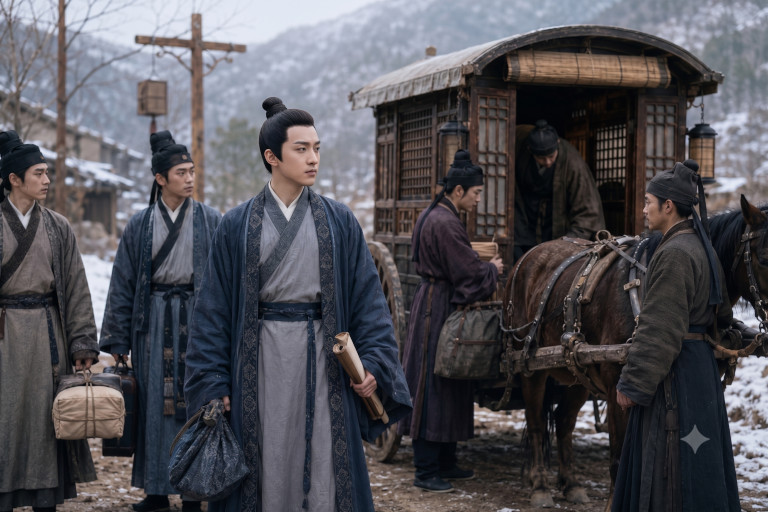
While passing through Shandong, their inexperienced driver lost his way among the overgrown fields and desolate countryside. Night was falling, and not a single house could be seen. Zhixiang’s companions grew increasingly anxious.
What would happen if they encountered bandits?
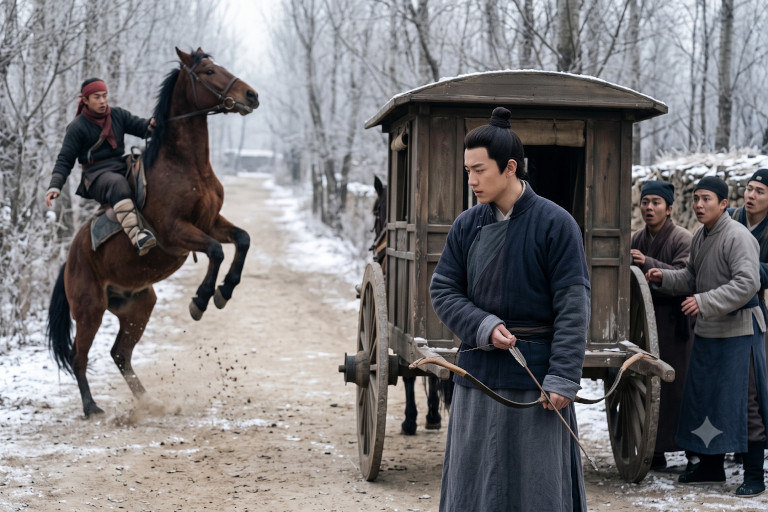
As if in answer to their fears, a young man appeared on horseback. He looked to be in his early 20s and wore a red scarf around his head. Riding up to the carriage, he called out to the travelers.
“Leave everything in the carriage, and I will spare your lives.”
The scholars were terrified. Some began trembling as they opened their bags, preparing to surrender their savings and travel money.
Only Zhixiang remained calm.
“How many men do you have?” he asked with a smile. “Why are you not afraid of being outnumbered?”
The young man gave a contemptuous snort but did not answer. Instead, he pulled the longbow from his back and fired three arrows in rapid succession.
The arrows streaked toward Zhixiang’s face with a piercing whistle. Zhixiang calmly caught all three between his fingers.
“Is that the extent of your ability?” he asked.
Realizing that he was outmatched, the young man turned his horse and fled.
Zhixiang had no intention of letting him escape unpunished. He took a small folding bow from his waist and fired an arrow into the rump of the man’s horse. The animal reared and neighed in pain, throwing its rider to the ground.
“You are nothing but a petty outlaw,” Zhixiang said. “You are not worth fighting. Now go.”
That night, Zhixiang ordered the driver to stop beside a grove of trees. They hung a red lantern from the carriage, and Zhixiang remained awake to guard his companions until morning.
A challenger arrives in the night
Around midnight, the urgent pounding of hooves sounded once again in the distance. The outlaws had evidently refused to accept defeat, and their leader was coming to confront him personally.
Zhixiang’s companions began trembling again.
“Do not worry,” he told them.
He stepped down from the carriage and waited beside the road.
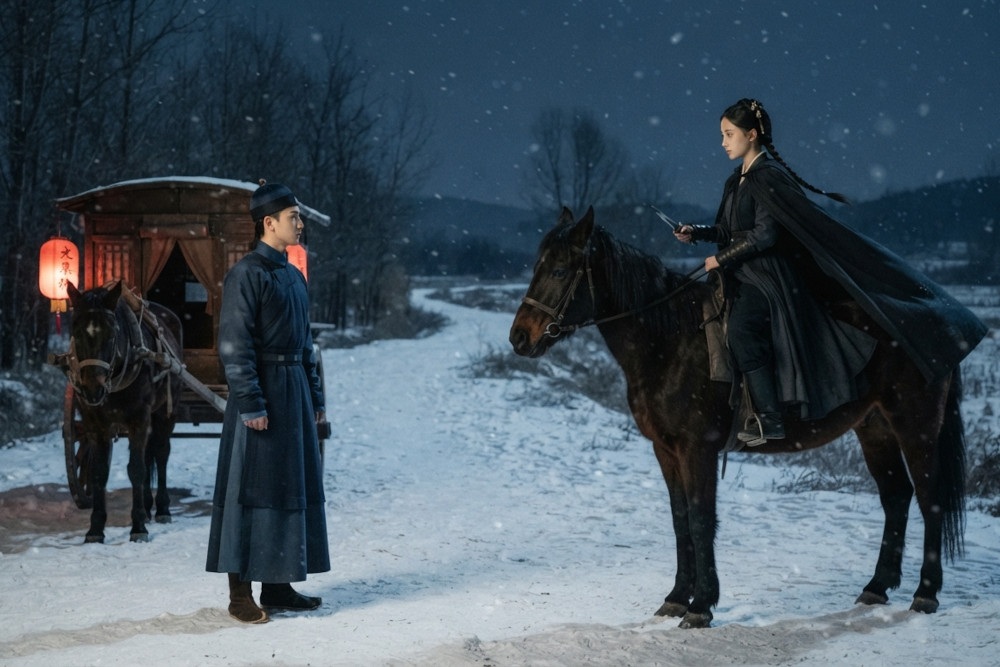
As the rider approached, Zhixiang expected to see a large, bearded man. Instead, the newcomer was a graceful young woman of 17 or 18. She brought her horse to a halt and looked coldly at him.
“Are you the one who injured my brother?” she asked. “Since you believe yourself so capable, let us see what you can do.”
“Very well,” Zhixiang replied.
He knew that any woman who dared to return alone must possess extraordinary skill. Taking several steps backward, he used an archery technique he had learned in childhood and fired nine arrows in rapid succession.
The short arrows flew through the air like pearls strung along a single thread.
The young woman showed no alarm. She caught each arrow with her hands. As the final arrow reached her face, she waited until its point nearly touched her lips, then opened her mouth slightly and caught it between her teeth.
Zhixiang was stunned. Even his father might not have handled the attack so effortlessly.
He rushed to the carriage, pulled out an iron staff that had been passed down through his family, and charged forward with a powerful sweeping strike.
The woman flicked a 3-inch dagger from her sleeve.
There was a sharp clang, and sparks scattered through the darkness. The small dagger sliced cleanly through the tempered iron staff, cutting it in half.
The woman did not stop. Her dagger flashed around Zhixiang from both sides. Realizing that his life was in danger, he dropped to the ground and begged for mercy, offering all their possessions in exchange for their lives.
The travelers placed their luggage in front of the woman. She raised a horn and blew a signal, summoning the other outlaws, who arrived and carried everything away.
An unexpected connection
Zhixiang sat dejected beside the road, prepared to remain there until dawn. Before long, however, the sound of hooves returned.
The young woman had come back.
“Are you Liang Yuanxing’s son?” she asked.
“Yes,” Zhixiang replied.
The woman was startled. She immediately dismounted and bowed deeply, her face filled with regret.
“So you are my senior brother,” she said. “I failed to recognize you and have gravely offended you. Please forgive me.”
She ordered her followers to return every item they had taken. Nothing was missing. She also presented Zhixiang with 100 taels of silver for his traveling expenses.
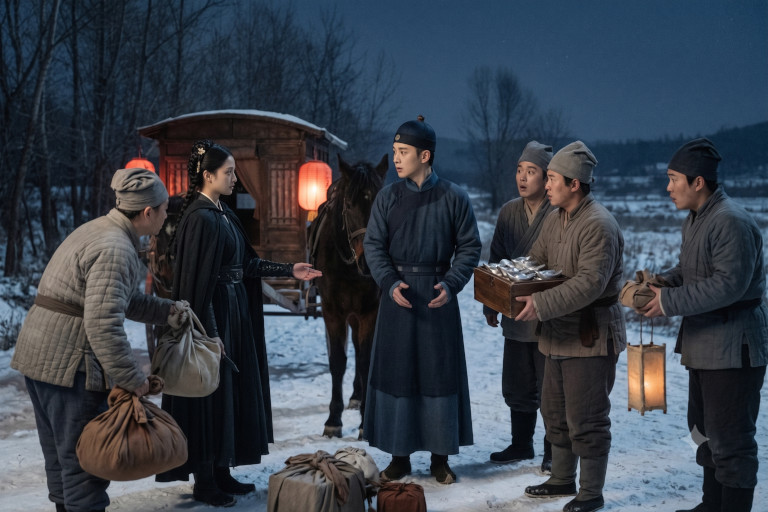
The woman then explained that her father had once been rescued by Liang Yuanxing. In gratitude, Liang had privately taught him several martial arts techniques. According to the traditional relationship between members of a martial lineage, the woman was therefore correct to address Zhixiang as her senior brother.
Early the next morning, she personally guided the travelers to the border of Shandong.
Unfortunately, Zhixiang remained so discouraged by his defeat that he neglected to ask the woman’s name or where she lived.
As they parted, she waved to him from horseback.
“Senior Brother, when you return home, please come and visit my family,” she said. “I have something important that I wish to give you.”
A name lost to history
That year, Zhixiang successfully passed the imperial examinations and received the prestigious jinshi degree. He remained in the capital and began a career as an official.
His new responsibilities, social obligations, and the changing fortunes of official life kept him occupied. He never found an opportunity to visit the young woman’s home.
As the years passed, the snowy night and the remarkable woman who had caught his arrows and severed his iron staff gradually faded into a distant memory. Her name was never passed down to later generations.
People remembered only the story of the young scholar from the Liang family of Wuchang who, while traveling to the imperial examination, encountered an extraordinary female martial artist in the snowy wilderness of Shandong.
Translated by Joseph Wu
Follow us on X, Facebook, or Pinterest
