

Xiang Yu and Liu Bang both returned home at the height of worldly success. Xiang Yu seemed determined to prove himself, while Liu Bang’s return carried more of a sense of honoring an old bond. The homecoming of another famous figure, however, exposed one of the colder sides of human nature.
Su Qin and the fickleness of human affection
Su Qin lived during China’s Warring States period. Before achieving success, he knew poverty and failure all too well.
He traveled from state to state trying to persuade rulers to adopt his political strategies, but his efforts initially came to nothing. When he finally returned home defeated and penniless, even his own family treated him with contempt.
His wife remained seated at her loom and did not rise to greet him. His sister-in-law refused to cook for him. His parents would not even speak to him.
Deeply wounded by their treatment, Su Qin shut himself away and devoted himself to study. According to the traditional account, whenever exhaustion overcame him and he began to fall asleep, he would prick his thigh with an awl to force himself awake.
Years later, everything had changed. Su Qin succeeded in persuading six rival states to form an alliance against Qin, and he came to hold high office on behalf of all six.
When his enormous procession of carriages and horses passed through his hometown, even the Zhou ruler sent men to sweep the roads and welcome him outside the city.
His family’s behavior changed just as dramatically. The relatives who had once treated him with disdain now dared not even raise their heads before him. His sister-in-law — the same woman who had once refused to prepare him a meal — prostrated herself and crawled forward to attend to him.
Su Qin found the transformation almost amusing.
“You were so arrogant toward me before,” he asked her. “Why are you so respectful now?”
With her face lowered to the ground, she answered that it was because her younger brother-in-law now occupied a high position and possessed great wealth.

Su Qin sighed. He was still the same man. Yet when he was rich and powerful, even his own relatives respected and feared him; when he had been poor and unsuccessful, they had despised him. If one’s own family could behave this way, he reflected, what could one expect from outsiders?
The scene gave rise to a Chinese expression describing someone who is arrogant toward a person when he is down, but exceedingly respectful once his fortunes change. The household was the same. The relatives were the same. Only Su Qin’s rank and wealth had changed.
Behind the brilliant spectacle of a triumphant return lay a sobering glimpse of the fickleness of human affection.
A vow made in poverty
For some, returning home in splendor meant keeping a promise made in youth.
Sima Xiangru, an ambitious scholar of the Han Dynasty, had once lived in great poverty, his ambitions far exceeding his circumstances.
When he left his hometown in search of a better future, he passed a bridge outside the city. There, according to tradition, he wrote a sentence on one of its pillars:
“Unless I return in a red carriage drawn by four horses, I shall never pass beneath this bridge again.”
It was an audacious vow. He was declaring that he would not return as the same unsuccessful man who had left.
In time, his remarkable literary talent attracted imperial attention and brought him fame. He eventually received high office.
When Sima Xiangru returned home as an imperial envoy, his circumstances could hardly have been more different. Even the local magistrate went ahead of him, carrying bow and arrows and personally clearing the road for his procession.
And Sima Xiangru did indeed return in a grand carriage drawn by four horses, passing once again by the bridge where he had written his youthful vow. That bridge later became known as “Four-Horse Bridge,” and generations of writers celebrated it in poetry and prose.

The boast of an impoverished young man had become reality.
Han Xin: Remembering kindness, letting go of humiliation
Of all these stories, however, perhaps none gives greater moral weight to the idea of returning home in splendor than that of Han Xin.
In his youth, Han Xin was so poor that he often went hungry. He endured ridicule and contempt from those around him.
On one occasion, a young man from a butcher’s family publicly blocked his path and humiliated him. If Han Xin was truly brave, the young man taunted, he should draw his sword and kill him. Otherwise, he should crawl between his legs.
With people in the street watching and laughing, Han Xin bent down and crawled beneath him without saying a word. To those watching, it looked like cowardice. But Han Xin understood that killing a man merely to defend his pride would serve no good purpose.
During those same difficult years, an elderly woman who washed silk beside the river noticed that he was starving. Day after day, for dozens of days, she shared her food with him.
Han Xin was deeply grateful and promised that one day he would repay her generously. The woman became angry. A grown man who could not even support himself, she told him, should not speak so grandly of repayment. She had fed him only because she pitied his hunger.
Years passed. Han Xin went on to become one of the greatest generals of his era. After helping Liu Bang defeat his rivals and establish the Han Dynasty, he was made King of Chu.
Then he returned home in glory.
What he did next revealed more about him than his new title or the splendor of his position.
He did not begin by looking for those who had insulted or mocked him. Instead, he sought out the old woman who had fed him when he had nothing and rewarded her with a thousand pieces of gold.
From this story came an expression meaning “a thousand pieces of gold for the kindness of a single meal” — a reminder that even a small act of kindness should not be forgotten.
And what of the young man who had once humiliated him before an entire street?
Han Xin did not take revenge on him either. Instead, he gave him a military appointment.
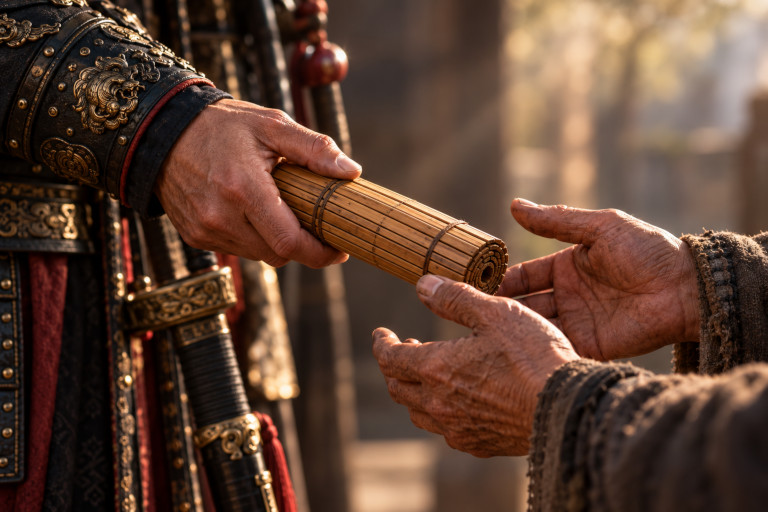
Explaining his decision, Han Xin said that he could easily have killed the man back then. But he would have had no just cause to do so. So he endured the humiliation. And because he endured it, he lived to accomplish what he later did.
The insult that once seemed enormous had become something he could let go. The meal that might have seemed small had never been forgotten.
The true meaning of returning home
From Xiang Yu to Han Xin, the same symbolic robe of brocade took on many different meanings.
One man returned home to prove himself. Another came back carrying gratitude toward the people who had known him before he became emperor. One discovered through his success how quickly people change their treatment of the rich and powerful. Another fulfilled a promise he had made while still poor. And Han Xin, after reaching the heights of worldly success, remembered kindness while letting humiliation go.
Perhaps that is why the idea of “returning home in splendor” has held such a powerful place in Chinese culture for so long.
A hometown is more than a place on a map. It is where a person’s roots lie — where parents and teachers, relatives and neighbors watched him grow from childhood. Traditionally, returning after achieving success was therefore about more than displaying wealth or rank. It also carried the desire to honor one’s ancestors and to show that, however far one had traveled, one had not forgotten where one came from.
But worldly splendor alone cannot reveal the true measure of a person. Character is shown more clearly in what one remembers after attaining success.
Han Xin remembered the woman who fed him when he was starving and repaid her kindness many times over. He also remembered the man who had humiliated him — but chose not to repay humiliation with humiliation.
To remember a meal and let go of an insult: therein lies a measure of character.
When someone finally puts on robes of brocade, looks back along the road he has traveled, and still remembers who handed him a bowl of food when he was at his lowest, returning home has become something greater than a display of glory. It has become an expression of gratitude, magnanimity, and a heart that has not forgotten its roots.
See Part 1 here
Translated by Audrey Wang
Follow us on X, Facebook, or Pinterest
