

In the winter of 910, a stretch of road outside a village near present-day Hangzhou was transformed overnight.
The old trees lining the road were wrapped one by one in colorful brocade. Field ridges, house corners, and even the open spaces where children played were draped in costly silk. Seen from a distance, the entire village seemed to shimmer with light.
Qian Liu, founder and King of the Wuyue Kingdom, was behind this extraordinary display.
Born into a poor family, Qian Liu possessed courage and military ability from an early age. During a period of great rebellion, as regional military powers rose across the land, he entered the army. He could hardly have imagined where that decision would lead. Step by step, he rose to control southeastern China, was invested as a king, and eventually founded his own kingdom.
Yet after reaching the height of power, the little village where he was born and raised remained constantly on his mind. He wanted to return and share his glory with the elders and neighbors who had known him before he became a king.
So he held a magnificent banquet.
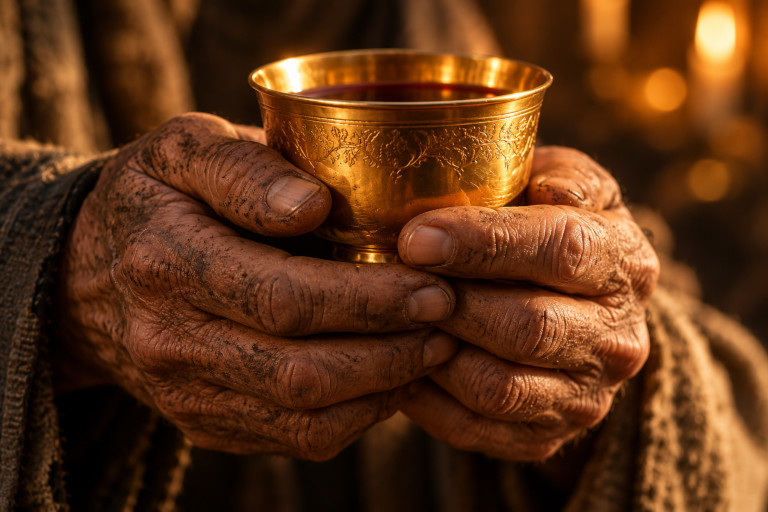
Qian Liu invited all the villagers aged 80 and above and presented them with gold cups. Those over 100 received jade cups. He also composed a “Song of Returning Home,” written in an elevated, ancient poetic style:
“I return bearing the honors of three military commands, clad in robes of brocade;
Beneath the clear blue sky, how dear is the warm sunlight of home.”
But the elderly villagers could make little sense of such refined literary language. Seeing this, Qian Liu abandoned the ornate phrasing and switched to his native dialect, improvising several plain verses in the style of a local folk song.
Only then did the gathering erupt in applause. For a moment, a king and a group of old farmers simply laughed together as people of the same village.
Qian Liu’s hometown was later elevated by imperial decree and came to be known as “Brocade-Clad City.”
The Chinese expression yijin huanxiang, commonly rendered as “returning home in splendor,” captures this longing precisely. The image is of someone dressing in magnificent brocade and returning to the place that watched him grow up, so that those who knew his humble beginnings might now witness his success.
The desire runs deep in Chinese culture. How deep? Deep enough, at times, to influence a dynasty’s fate.
The origin of ‘returning home in splendor’
To trace the expression’s earliest origin, we must return to the fall of the Qin Dynasty and a palace fire said to have burned for three months.
The rebel leader Xiang Yu fought his way into the Qin capital. His forces plundered the city, killed the surrendered ruler of Qin, and set fire to the imperial palaces.
At the time, the rebel forces fighting Qin were competing with one another as well as with the dynasty they hoped to overthrow. They agreed that whoever first defeated Qin and entered the capital would be made king.
Liu Bang reached the capital region first. Xiang Yu arrived later, having first defeated the main Qin army before marching west with his enormous force.
After Xiang Yu took the capital, an adviser urged him to stay there. Mountains and rivers protected the surrounding region, strategic passes guarded it, and fertile land blessed it. It was an ideal place from which to rule. Why not establish his capital there?
But Xiang Yu looked upon the ruined palaces and thought instead of the people back home.
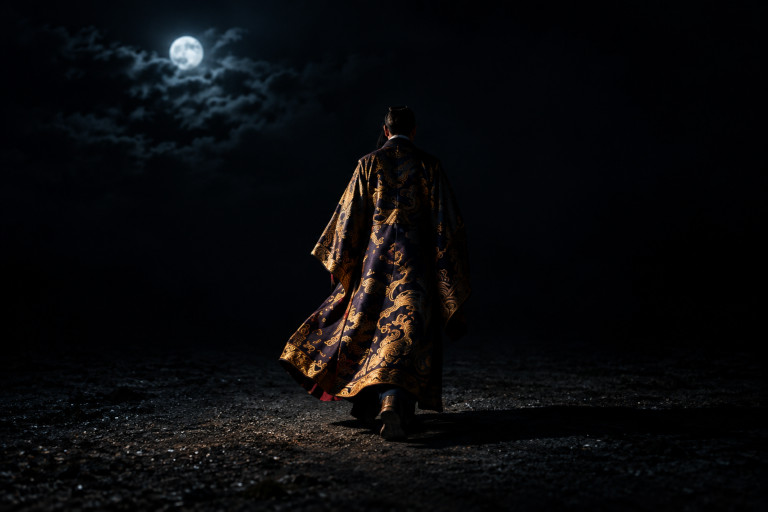
“To attain wealth and honor and not return to one’s hometown,” he replied, “is like walking at night in embroidered robes. Who would know of it?”
What good were magnificent clothes if no one could see them? What good was glory if the people who had known him in his youth never witnessed it?
After leaving Xiang Yu’s presence, the adviser reportedly mocked him, comparing the people of Xiang Yu’s native Chu to “monkeys wearing caps” — an insult suggesting that an impressive outward appearance could not hide a lack of refinement. When Xiang Yu heard what he had said, he had the man boiled alive.
Xiang Yu then insisted on leading his forces eastward and established his capital near his native region.
His remark about “walking at night in embroidered robes” became the earliest source of the idea later expressed as “returning home in splendor.” For Xiang Yu, success was not complete until the people back home saw it.
Liu Bang’s return home
Xiang Yu was eager to return home and prove what he had become. Another man from humble beginnings turned his own homecoming into one of the grandest celebrations recorded in Chinese history.
After Liu Bang unified the realm and founded the Han Dynasty, he personally led a campaign to put down a rebellion. On his victorious return, he made a special detour to his hometown.
There, the emperor held a great banquet. He invited the local elders, old neighbors, and childhood companions, and for more than ten days they feasted and drank together.
As the wine flowed, Liu Bang took up an ancient stringed instrument and began to sing and dance. The song he performed became one of the most famous poems of the Han Dynasty:
“The great wind rises, and the clouds fly;
My might extends across all within the seas, and I return to my homeland.
Where shall I find brave men to guard the four quarters?”
The words were triumphant, but beneath the triumph lay unease. Liu Bang had conquered the realm and returned home as emperor, yet he was already thinking about how difficult it would be to preserve what he had won. As he sang, he became so moved that he wept openly.
He then announced that the people of his home county would be exempt from taxes and compulsory labor for generations, and he designated his hometown as an imperial private estate.
If returning home in splendor was meant to bring honor to one’s native place, Liu Bang could scarcely have bestowed greater honor upon his.
Xiang Yu and Liu Bang both returned home at the height of worldly success. Yet the spirit behind their homecomings was not quite the same.
Xiang Yu seemed determined to prove himself.
Liu Bang’s return carried more of a sense of honoring an old bond.
Translated by Audrey Wang
Follow us on X, Facebook, or Pinterest
