
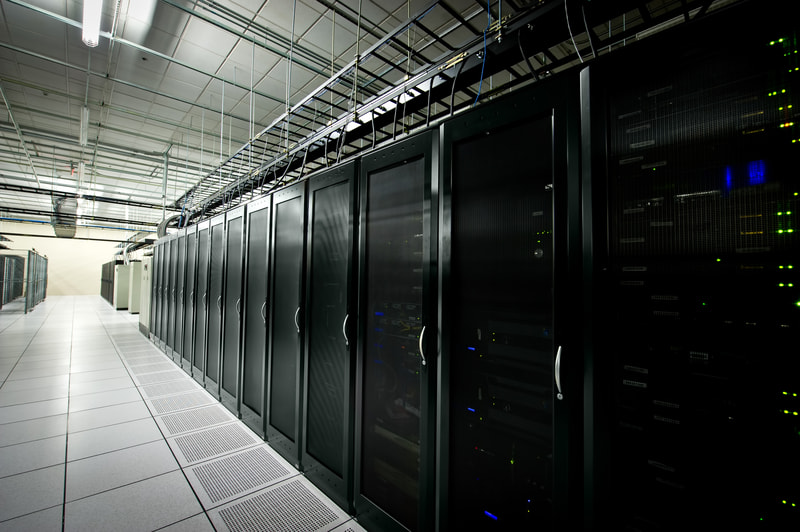
Until recently, data centers attracted relatively little public attention. They were largely treated as invisible pieces of digital infrastructure: essential but rarely discussed outside technical and industry circles.
But over the past 12 months across Australia, data centers have become the subject of intense political debate, community opposition, planning disputes and parliamentary inquiries.
Questions are being raised about how much electricity and water they use, where they should be built, who should pay for the infrastructure needed to support them, and whether Australia benefits from their continued expansion.
These questions are feeding into government policy. Following Prime Minister Anthony Albanese’s speech at the University of Sydney in July, a National Cabinet meeting in August reaffirmed plans to legislate nationally consistent mandatory standards for large data centers by early next year. These will include requirements around their energy, water and land use.
So how did a piece of digital infrastructure that once attracted relatively little public attention become such a prominent policy issue? Data centers themselves are not new. What has changed is their scale, purpose and the resources required to support their growth.
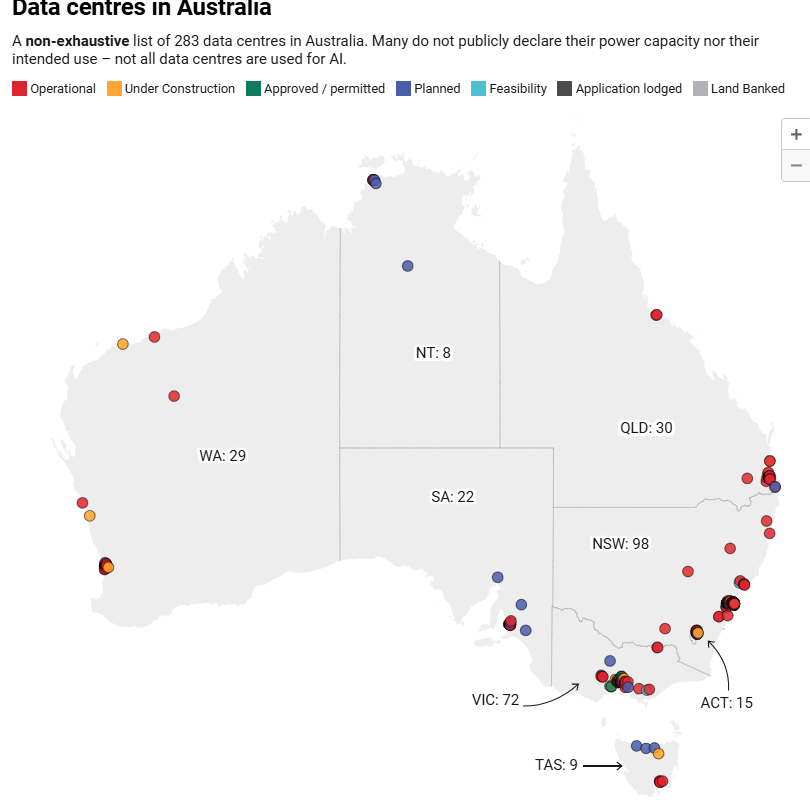
Note: Some data centers are co-located in the same building. For ‘campus’-style data centers, such as those with multiple wings or halls, we’ve condensed the location to a single marker. (Map: via The Conversation)
The evolution of data centers
Data centers are specialized physical facilities that house servers, networking equipment, and data storage systems. They are foundational infrastructure for the modern digital economy, supporting a wide range of services such as streaming, social media, banking, emergency response systems, and artificial intelligence (AI).
The origins of data centers can be traced to the 1940s, when early computers were so large they needed dedicated spaces to house them. As computers became smaller, more powerful and more accessible, governments and businesses increasingly adopted their own IT infrastructure. They often operated on-premises server rooms to manage email, file storage, and other internal systems.
The internet then drove a shift towards larger co-location data centers in the 1990s, where multiple customers could rent space for their servers in a single shared facility.
Then came cloud computing. This provided customers with on-demand access to computing resources over the internet, and further accelerated the growth of data centers. In 2006, Google opened its first hyperscale data center. Amazon Web Services also launched its first cloud computing services in the same year. Cloud service providers subsequently built increasingly large facilities to meet growing demand for these services.
What was once a room or floor serving a single organization evolved into massive dedicated facilities — often called hyperscale data centers — capable of supporting millions of users. Today, the scale of a data center is often measured by its power capacity, in megawatts or gigawatts. This reflects how much electricity the facility can draw at any one time.
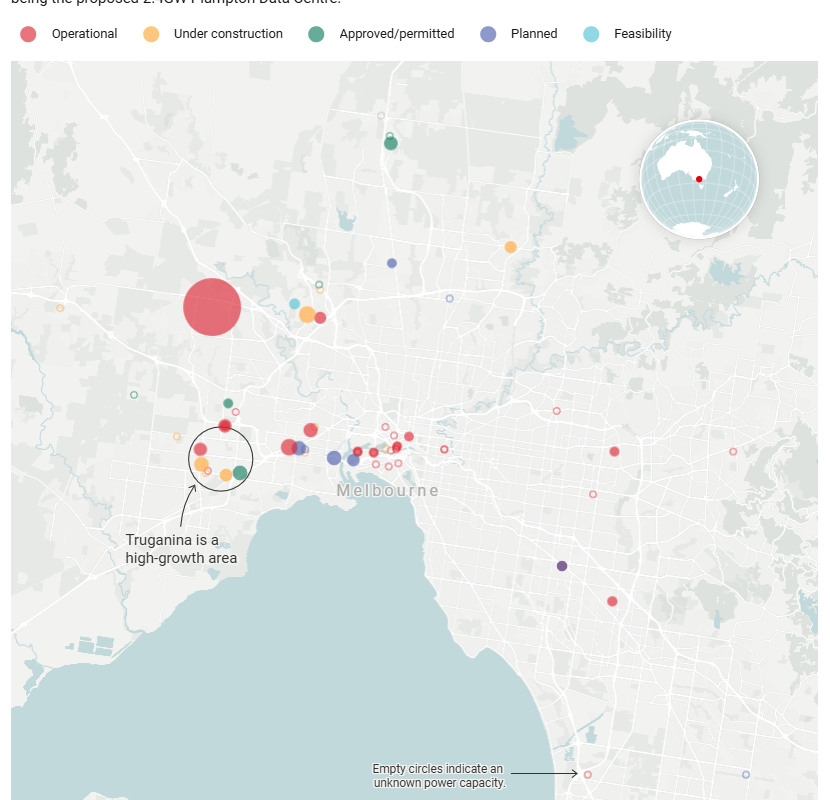
Note: Some data centers are co-located in the same building. For ‘campus’-style data centers, such as those with multiple wings or halls, we’ve condensed the location to a single marker. (Map: via The Conversation)
Australia’s data center boom
Australia’s own data center market reflects this shift in scale.
Australia currently has over 160 operational data centers, with most located in New South Wales and Victoria. There are at least another 90 facilities in the development pipeline.
The data centers now being proposed are also considerably larger than many existing data centers.
For example, the proposed 1.2 gigawatt Mamre Road Data Center in Sydney would cover an area equivalent to the size of 52 rugby fields.
If built to its maximum capacity, it would become Australia’s largest single electricity user.
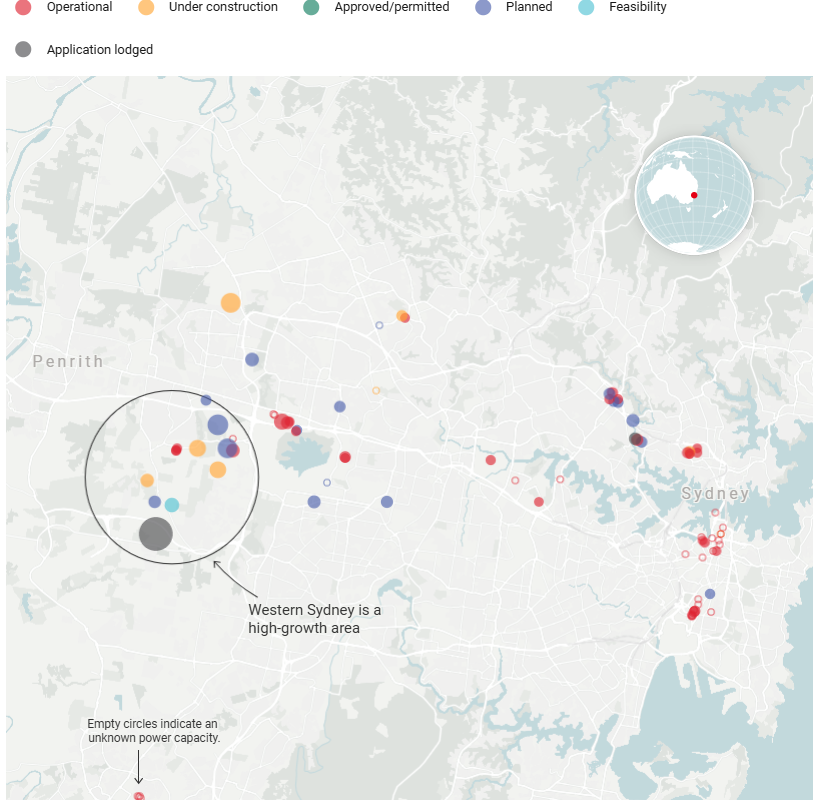
Note: Some data centers are co-located in the same building. For ‘campus’-style data centers, such as those with multiple wings or halls, we’ve condensed the location to a single marker. (Map: via The Conversation)
Why AI is driving bigger data centers
Hyperscale data centers typically contain at least 5,000 servers, occupy at least 10,000 square feet of physical space, and can draw over 100 megawatts of power. That’s enough to meet the annual electricity needs of more than 50,000 households.
In 2025, hyperscale operators accounted for 48% of global data center capacity.
Cloud computing and the growth of everyday digital activity initially drove the expansion of these large, centralized facilities. But since OpenAI launched ChatGPT in late 2022, AI has rapidly accelerated this growth.
AI workloads are far more computationally intensive than traditional digital services. They are expected to account for approximately 70% of data center demand by 2030.
Training advanced AI models requires dense arrangements of specialized chips working simultaneously to process large volumes of data. This can run continuously for weeks or months.
Once trained, AI models also require computing power to respond to users. This process is known as inference. While a single interaction requires considerably less computing power than training a model, that demand adds up across millions of users.
This article is republished from The Conversation under a Creative Commons license. Read the original article.
Follow us on X, Facebook, or Pinterest
