

A complete fly brain map went public on September 3, 2026, and within 72 hours somebody had wired it into the first-person video game Doom. The fly brain map is real, the Doom project is real, and much of what has been said about both since is not. Somewhere between the electron microscopes and the screenshots, a genuinely extraordinary piece of science acquired a set of claims it never made — that a mapped insect brain taught itself to beat a notoriously difficult video game, that it does something no language model can do. One of those claims falls apart the moment you open the repository. The other one is worth taking seriously, and it has almost nothing to do with games.
What the fly brain map actually contains
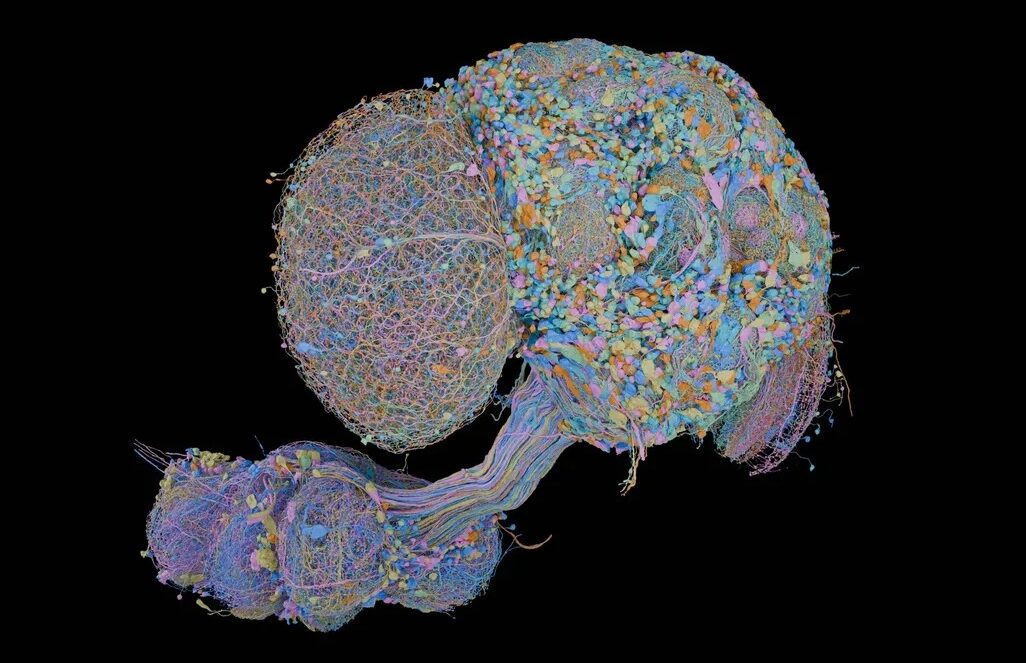
On September 3, 2026, HHMI Janelia Research Campus of the Howard Hughes Medical Institute, Google Research, and their collaborators released MaleCNS v1.0: a complete wiring diagram of the brain and central nervous system of an adult male Drosophila melanogaster, or common fruit fly. More than 166,000 neurons. Roughly 125 million synaptic connections. The central brain, both optic lobes, and the ventral nerve cord, which is the insect equivalent of a spinal cord. It is the largest brain map by neuron count assembled to date; it was published in Cell as a study of sexual dimorphism, and it is the result of a decade of work. Every neural shape in it was reconstructed by AI from millions of thin electron-microscope slices, then verified by human proofreaders.
It complements the female fly brain map released earlier, which means that for the first time two complete nervous systems from the same species can be laid side by side and compared — not only where the sexes differ, but in the regions where they do not, which is where researchers will begin to see how much natural variation exists between individuals at all. Now the part that the coverage tends to skip. A connectome is a map of neurons and the synapses that link them. That is all it is. It records that neuron A contacts neuron B, and how many times. It does not record how strongly that contact drives B inside a living fly. It does not directly measure whether the connection excites or inhibits — neurotransmitter identity is annotated and in places predicted, not read off the image. It carries nothing about hunger, arousal, or any of the neuromodulatory states that change what a circuit does from minute to minute. And it contains no time at all. Google’s own write-up describes the connectome, accurately, as a static resource.
The map records every wire in the animal. It records nothing about the voltages. So the honest description of what was released is a complete circuit diagram with no component values and no power supply. That is still a monumental achievement. It is simply not a brain you can switch on.
The Elden Ring story, checked against the repository
The most widely repeated version of the story goes like this: someone connected the fly-brain model to Elden Ring, and after a short gameplay session, it climbed up several levels in Doom. There is a public project. It is called Eldenfly; it describes itself as a fly-inspired neural control project for Elden Ring, and its own README is unusually candid. Status: controller integration pending. Autonomous gameplay has not been demonstrated. The neural core that does exist is a 96-unit, fixed-weight leaky integrate-and-fire network, which the documentation explicitly states is a starting component, not a biological fly connectome. The component table lists the live observation adapter, sensory encoder, motor decoder, keyboard controller, and closed-loop evaluation as not implemented. The repository has one star.
The fly did not beat Elden Ring. At the time of writing, it contains no fly. What does exist is more interesting than the rumor. A software engineer, Alex Wormuth, launched DOOMFLY on 3 September, running the full MaleCNS v1.0 dataset: 166,700 neurons, some 25.5 million connections, more than 124 million synaptic contacts. Each Doom frame is converted into 3,335 brightness signals and 811 color signals and delivered to the model’s photoreceptors. The resulting neural activity is decoded into movement, turning, and firing. When the character takes damage, the simulation stimulates two PPL101 dopamine cells as a reinforcement signal. The project frames itself as a question — will the fly learn to survive? — rather than as an announcement that it has.
Others followed within days. A developer wired the same model into Super Mario 64 and posted footage of Mario cheerfully jumping into walls, describing the code as something she had assembled with a language model for fun. Another put a connectome-driven fly into Minecraft, where it forages, responds to light, and avoids players. Someone gave one a hundred dollars and let its dopamine neurons fire from trading profit.
These are closed sensorimotor loops, built in a weekend, on a dataset that had been public for three days. As engineering theatre, they are delightful. As evidence of anything, they are close to silent, because none of them demonstrates competence at the task — and, to their builders’ credit, none of them claimed to. The exaggeration was added downstream, by people repeating the story.
How a wiring diagram is turned into a computation
It is worth walking through exactly what has to be added to a connectome before it can run anything at all, because the gap is where all the interesting arguments live.
First, the map becomes a graph: neurons are nodes, synapses are edges, and the number of contacts between two neurons stands in for connection strength. Second, each edge is given a sign — excitatory or inhibitory — from predicted or annotated neurotransmitter identity. Third, a neuron model supplies the physics the microscope could not see: most commonly a leaky integrate-and-fire unit, which accumulates incoming current, leaks it away over time, fires when it crosses a threshold, and resets. Fourth, sensory neurons are driven by whatever input you have, in this case game frames pushed into photoreceptors. Fifth, motor-neuron activity is decoded into actions.
Only the first step comes from the map. Everything after it is a modeler’s assumption. That is not a flaw in the enterprise — it is the enterprise. But it means every viral demo is a hypothesis about how flies work, wearing a fly’s anatomy. You cannot train a connectome. You can drive it, and decode whatever comes out the other side. The rigorous version of this already exists in the literature. Connectome-constrained models instantiate the measured wiring as a fixed sparse connectivity operator and then learn the remaining per-neuron parameters, so the anatomy acts as an architectural prior and training fills in what electron microscopy cannot reach. That is the sober and genuinely powerful use of a map like this: it tells you the shape of the computation, not its coefficients. Which reframes the question. The thing to ask is not whether a connectome can be made to play Doom. It is which circuit motifs evolution actually settled on. And on that question, the fly has something very specific to show.
The circuit that has AI researchers paying attention
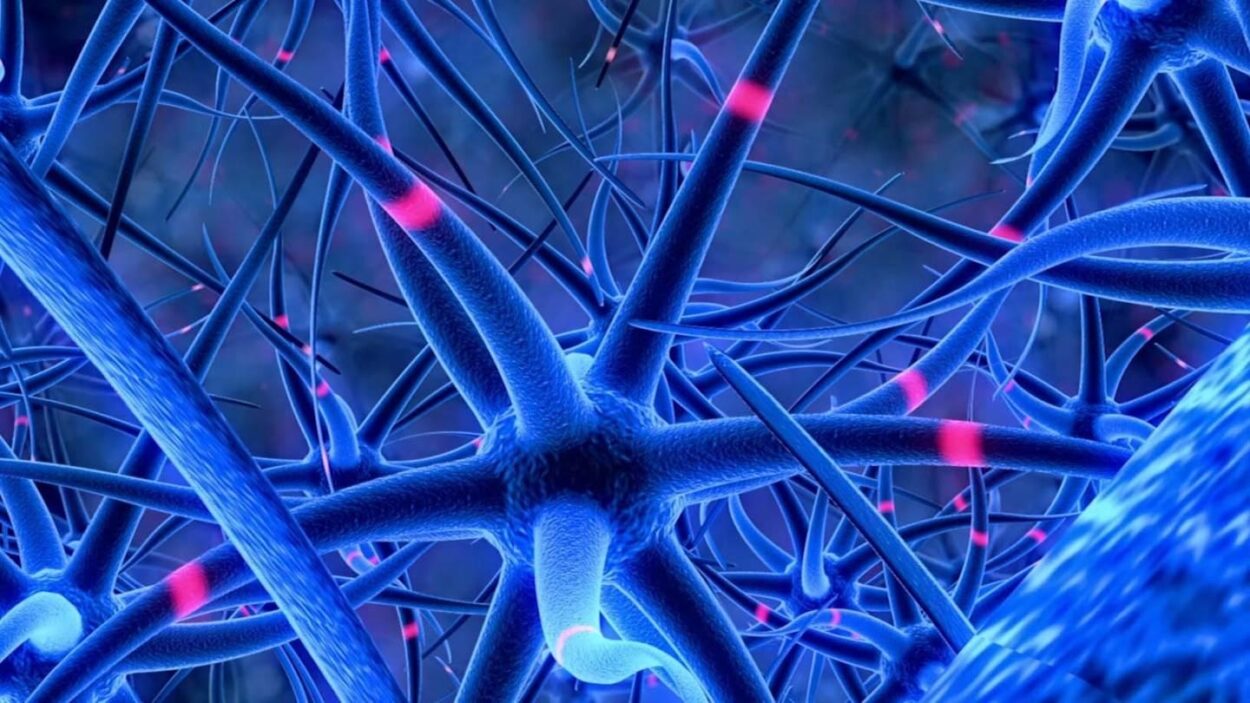
In the middle of the fly’s brain sits a structure called the central complex, and it is involved in navigation. In one part of it, the ellipsoid body, a bump of neural activity moves around a ring; its position encodes the direction the fly is facing, updated by both visual landmarks and the fly’s own turns. It is a compass built from a few dozen cells.
Downstream, in the protocerebral bridge and the fan-shaped body, columnar neurons inherit a smooth sinusoidal activity profile spread across columns. Here is the part that makes engineers sit up. The phase of that sinusoid encodes a direction. The amplitude encodes a magnitude. Each population is therefore a vector, held in the firing rates of a handful of neurons, in a form researchers compare directly to the phasor notation used in physics and engineering.
The hΔ cell types in the fan-shaped body take several of these populations as basis vectors and add them together. Left and right populations of one class rotate their contribution by forty-five degrees in opposite directions; another class rotates by a hundred and thirty-five. Summed, they yield the direction the fly is actually traveling, expressed in world coordinates rather than body coordinates. Further downstream, another set of cells compares the current heading against a goal direction and converts the difference into a steering command.
Read that again as a specification rather than as biology. Vector addition. A coordinate transformation from an egocentric frame to an allocentric one. A difference operation driving a motor output. Implemented in a few hundred cells, running on an insect’s power budget, and now fully addressable and downloadable by anyone with a laptop. That is the headline an engineer should have taken from September. Not the games.
Memory in the wires, not in the activity
The second viral claim is the one that deserves care. Two researchers posted on X that they had run the connectome and identified a group of fan-shaped body cell types — hΔH, hΔA, hΔI and hΔG — that could allow the fly to navigate through fast updates to synaptic weights rather than through patterns of neural activation. They called it fast-weight continual learning in a fly, and added that current language models do not do this.
The status of that claim needs stating plainly: it is a hypothesis posted to social media, inferred from connectivity, without accompanying physiological measurement or peer review. It is a proposal, not a result. It is also not invented. It builds on a real, partially evidenced literature. Computational models of the central complex have for years predicted that goal learning occurs through plasticity between the fan-shaped body’s layered inputs and its columnar cells.
And a recent study from the Max Planck Institute for Neurobiology of Behavior found something stranger and more concrete: neurons in the fan-shaped body that track walking direction continue to drift while the fly is at rest, and the distribution of that drift sits a hundred and eighty degrees away from the direction the fly had been walking. Stimulating those neurons during rest changes which direction the fly chooses when it moves again. The authors propose anti-Hebbian plasticity that weakens the columns opposite those active during walking, and note that a 180-degree offset is exactly how a home vector is thought to be encoded.
Put less formally: the fly appears to consolidate a navigational goal while it is doing nothing at all. The state survives the pause. This is why the distinction between activation memory and weight memory matters, and it matters far beyond flies. Activation memory is a pattern you have to keep alive. It burns energy continuously; it drifts, and when the activity stops, it is gone. Weight memory changes the substrate itself. It costs energy once, it survives silence, and it does not need rehearsing. An animal that can only remember by keeping neurons firing cannot afford to rest. A synapse simply stays changed.

What large language models actually do
Now the comparison, stated precisely, because the popular version is half right in a way that obscures the real lesson. A deployed language model’s parameters are frozen at inference. Everything it appears to learn during a conversation lives in activations — the context window, the cached attention state. That mechanism is remarkably capable and completely volatile. Close the session and the adaptation evaporates. It is activation memory, precisely the kind the fly seems not to rely on for its goals.
So the claim is correct about what ships. It is wrong about what the field knows. Fast weights are among the older ideas in neural network research: researchers proposed a network that rapidly generates temporary changes to another network’s weights in the early nineties, and the idea returned when they recognized that linear attention is a form of it. Test-time training updates a subset of parameters during deployment. Memory architectures now learn at inference what is worth memorizing. Google’s own continual-learning research treats memory as a spectrum of modules updating at different rates, and says openly that the motivation is the gap between models that forget and brains that do not. Fast-weight memory layers, in-place test-time training schemes, and frameworks treat the model’s parameters as slow weights and an optimized context as the fast ones.
The reason none of this is in the chat window in front of you is not ignorance. It is operational. Frontier weight updates remain offline because every update needs evaluation, safety review, and a rollback path. A gradient step taken from a single example on a very large base model is noisy. Continuous updating also invites catastrophic forgetting, where learning the new thing quietly destroys the old. The fly does not have this problem, and the reason is architectural rather than algorithmic. Its plasticity is local. Neuromodulatory signals gate it and determine when writing is permitted. And it is confined to a circuit with one job: where am I, and where do I want to be? The animal is not rewriting itself to remember a direction.
That is the transferable lesson, and it is not “copy the fly.” It is: scope the writable memory. A system that can update its weights everywhere, all the time, will eventually erase itself. A system with a small, bounded, purpose-built set of weights that can change, behind a gate that decides when a write is allowed, gets continual learning without paying for it with everything else it knew. Anyone who has built an agent that carries state across sessions has arrived at this from the other direction — you end up inventing the gate, the scope, and the place where writes are legal, because nothing works without them. The fly reached the same answer some hundreds of millions of years ago and wrote it into anatomy that we can now, finally, read.
The quiet result that matters more than the games
The same announcement includes a finding that received almost no attention. Working with a Columbia-led team, the connectomics group mapped part of the hindbrain of the elephantnose fish and combined that static map with other evidence to study plasticity directly — producing, by their account, the most complete mechanistic model of learning in a vertebrate brain so far.
That is the template. Connectome, plus recorded activity, plus a plasticity rule. The trajectory is already visible: the female fly brain and nerve cord; now the complete male central nervous system; a whole zebrafish brain that pairs structure with activity measured in the same animal; and a portion of a mouse brain in progress. The field is moving from static maps to dynamic maps, which is the only form in which a wiring diagram becomes an explanation.
And the games? The reflex is cultural. Any sufficiently impressive new technology gets made to run Doom, and it always has. It is a way of saying this is real now; I can touch it. There is nothing wrong with that. It simply is not the result. The fly brain map did not beat Elden Ring. What it did is harder to screenshot: it made an entire nervous system searchable. And the first thing worth searching for is not how to win a game, but how a creature the size of a grain of rice holds on to where it wants to go while sitting perfectly still.
Follow us on X, Facebook, or Pinterest
