
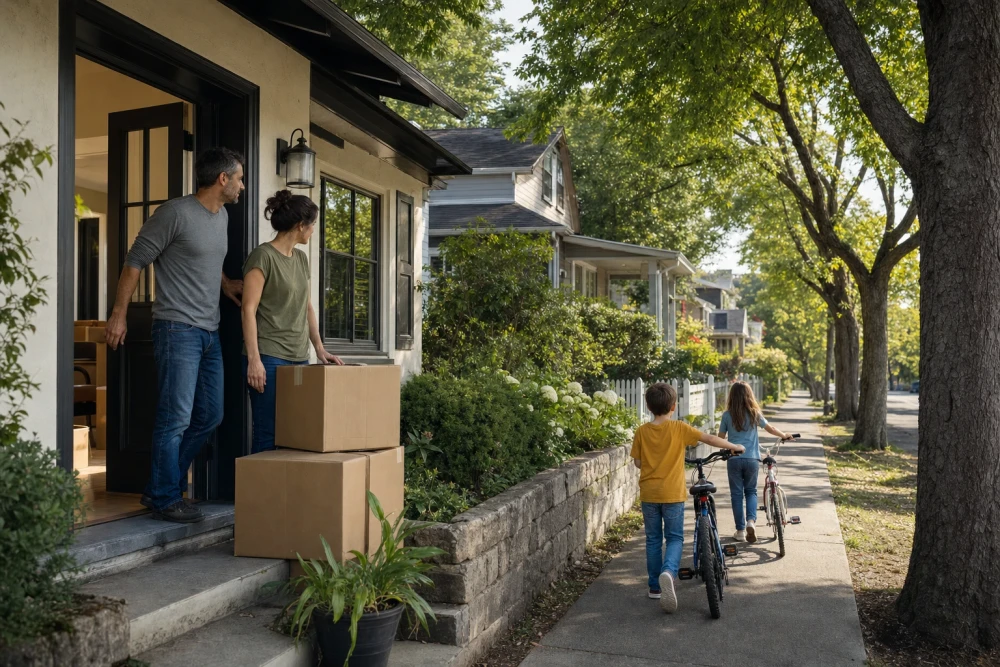
A field guide for expats and digital nomads who want somewhere that stays mild, safe, solvent, and good for raising children — not for a holiday, but for the ten years that are coming. Plus the one country everyone will tell you to add, and the research that argues against it.
A moderate climate used to be the least interesting thing you could say about a place. It is quietly becoming the most valuable. The proof turns up every summer now, in a particular kind of message: a friend in Lisbon or Athens or the Provençal back-country writes to say they have left — not on holiday, but for real, driving north at midnight because the bedroom would not fall below thirty-three degrees and the air smelled of someone else’s wildfire.
For almost all of human history, climate was the one variable nobody chose. You were born somewhere, the weather was whatever it was, and you adapted. What is happening now is stranger and quieter than catastrophe. The map of where a person can simply be comfortable — outdoors, year-round, without engineering their way around it — is being redrawn in a single lifetime. The first people to act are those who can: remote workers, expat families, anyone whose income is no longer nailed to a postcode.
So here is the question, asked as plainly as it deserves. If you wanted five places on Earth that look set to stay temperate over the next decade, while also offering real safety, a working economy, and schools you would trust with your children, where would you actually go? Not the cheapest. Not the trendiest. The most durable.
Why a moderate climate became a scarce resource
Start with the measuring sticks, because the answer is only as honest as its method. Three things separate a place that feels good on a long weekend from one that holds up for a decade. The first is climate stability — not warmth, but the absence of extremes, and a fair chance of keeping it. The second is institutional quality, which quietly reduces to safety, a functioning economy, and a school system. The third is access: a legal, repeatable way for a foreigner to live and work there without pretending to be a tourist.
On climate, the geography is unglamorous but reliable. Three features buffer a place against the worst of a warming world: a nearby deep ocean, which refuses to swing in temperature the way land does; altitude, which trades latitude for a permanent cool; and distance from the equator, which keeps the heat ceiling lower. The Notre Dame Global Adaptation Initiative, which scores countries on both exposure and readiness to cope, keeps surfacing the same kinds of places near the top — maritime nations, high-latitude democracies, islands with money and rule of law. None of this is prophecy. It is a bet on physics and governance, which is the only honest kind of bet available.
No place on this list is guaranteed. Buying 10 good years of stability is not the same as outrunning the weather. It is the difference between a plan and a hope.
On safety and schooling, the data is plainer still. The Global Peace Index ranks the safest societies, and the OECD’s PISA tests measure how fifteen-year-olds actually think. Where a country sits on both tells you more about the next decade than any brochure. With that frame, five places earn their way onto the map — each for a different reason, and each with a flaw worth naming.
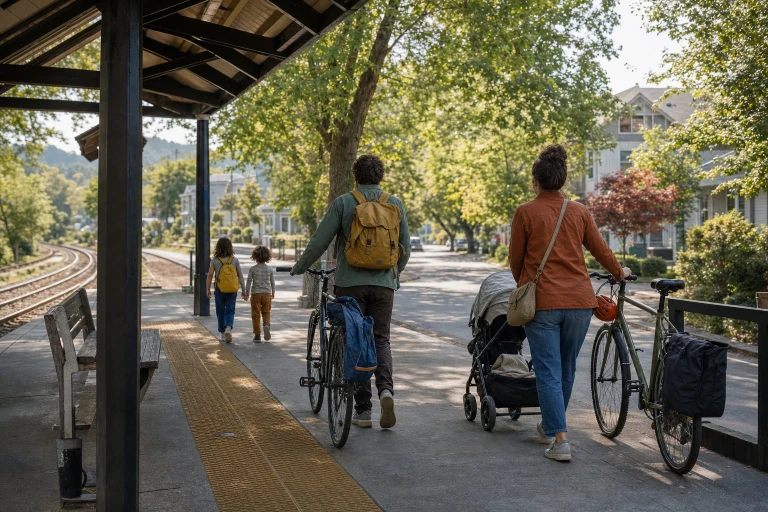
Madeira, where the Atlantic does the temperature control
Madeira is the cleanest case on the list. The Portuguese island sits in the Atlantic off the coast of North Africa, and the surrounding ocean behaves like a thermostat that never gets unplugged. Temperatures hover between roughly 16°C and 25°C all year — the locals call it the Isle of Eternal Spring, and for once the tourism copy is accurate. While mainland Iberia bakes under heat domes that now routinely break records, the water keeps Madeira honest.
It is also one of the few places engineered, almost on purpose, for the remote worker. Ponta do Sol, a small town on the sunny south coast, became the world’s first official Digital Nomad Village in 2021, built by a local advocate with backing from the regional government and Startup Madeira. It offers a free coworking space, fiber Internet, and a community that meets most evenings. Portugal’s D8 visa gives non-EU citizens a legal route to stay, and as an autonomous region of an EU country, Madeira comes with European healthcare and schooling attached. Portugal itself has climbed steadily into the top tier of the Global Peace Index, one of Europe’s genuine success stories of the last decade.
The flaw is mostly logistical. Housing demand has outrun supply, visa processing can back up, and the island is, in the end, an island — three hours from the mainland, with weather that turns cool and damp in winter inside houses never built to hold heat. None of that unmakes the core advantage. For a family that wants mild air, fast Internet, and an EU passport’s worth of stability, Madeira is the closest thing to a sure thing here.
New Zealand, the temperate refuge that stopped pretending
New Zealand has spent years as the punchline of a particular story — the place the very rich quietly buy land in case the world goes wrong. The uncomfortable part is that they were reading the same map. A temperate maritime climate, no land borders, a stable democracy, and abundant fresh water make the country one of the planet’s most defensible bets. It ranks second or third on the Global Peace Index most years, scores above the OECD average in reading, maths, and science, and runs health and education systems that rank it among the world’s most liveable countries.
The billionaires were not wrong about the geography. They were only early, and a little embarrassed about it.
Until recently, the catch was that New Zealand made remote work legally awkward. That changed in January 2025, when the government rewrote its visitor rules so that anyone on a visitor visa can work remotely for an overseas employer, with no income floor and the option to bring family. A single-entry visitor visa can last up to nine months, and if you pay tax at home, you generally owe nothing locally for shorter stays. It is not a residency path, and that is the honest limit.
The other trade-offs are real. New Zealand is expensive, housing especially so. It is a long flight from almost everywhere, with time zones that fight most of the Northern Hemisphere. And it is seismically active — the trade-off for climate calm is the occasional reminder that the ground is not. For an expat family prioritizing safety and schooling over cost and convenience, few places score higher.
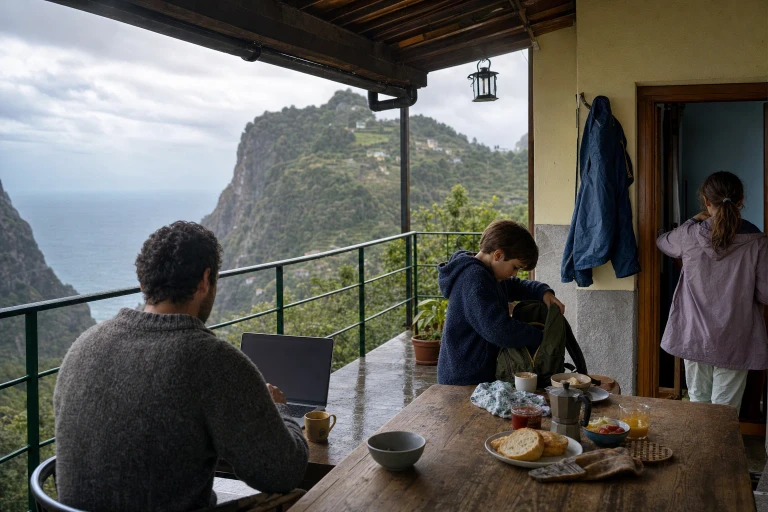
Uruguay, South America’s quiet constant
Uruguay is the pick that surprises people and rewards a second look. Wedged between Argentina and Brazil, it has earned the nickname Switzerland of South America by being almost defiantly stable: a full democracy, the least corrupt country in the region, strong property rights, and a courts-and-press record that outranks much larger nations. The climate is genuinely temperate — four seasons, no tropical extremes, and the rare distinction of sitting outside the usual paths of earthquakes, hurricanes, and volcanoes. The Río de la Plata and the Atlantic keep Montevideo’s edges soft.
For a relocating family, the structural perks are unusual. New residents get an eleven-year tax holiday on foreign income, straightforward residency that leads to permanence, and a hybrid digital-nomad permit that offers a comfortable runway before the paperwork deepens. Montevideo’s leafy Carrasco district, minutes from the airport, is built around international schools and embassies — the natural landing pad for expats with children. On the regional peace index, Uruguay ranks first in South America and around thirty-fifth worldwide.
The asterisks are worth stating clearly. Homicides have crept up to roughly 11 per hundred thousand, driven by drug-trafficking disputes concentrated in specific peripheral neighborhoods rather than anywhere an expat would live — but the trend is real, and locals feel it. Winters are cold, wet, and surprisingly biting in houses built without insulation. And the country isn’t cheap by Latin American standards, and its English-speaking social scene is thin. Instead, it offers predictability, a luxury in this region.
Slovenia, small, central and almost suspiciously stable
Slovenia is the European dark horse. A country of 2 million people tucked where the Alps meet the Adriatic, it ranks inside the top ten of the Global Peace Index — the only Central or Eastern European nation to manage it — and inside the top twenty-five of Yale’s environmental performance index, with clean air and some of the best tap water on the continent. Its students score above the OECD average in maths and science. From the capital, Ljubljana, you can reach a ski slope or a swimmable sea within an hour, which tells you most of what you need to know about the place.
The access piece arrived late but arrived well. In November 2025, Slovenia launched a dedicated digital-nomad residence permit: twelve months for non-EU remote workers, with an unusually generous rule that lets families reunite immediately rather than after a qualifying wait. The cost of living undercuts neighboring Italy and Austria, fiber Internet is fast and near-universal, and full Schengen access turns the rest of Europe into a weekend. Ljubljana’s car-free center and café culture make it quietly addictive.
Be clear-eyed about two things. Slovenia’s climate is continental, not eternal spring — it has genuine winters and warm summers, and its appeal is stability and the absence of extremes rather than year-round mildness. The nomad permit is capped at 12 months and cannot be renewed without spending six months elsewhere first, making it a superb medium-term base but not, by itself, a path to settling. For temperate calm backed by European institutions, the value is hard to beat.
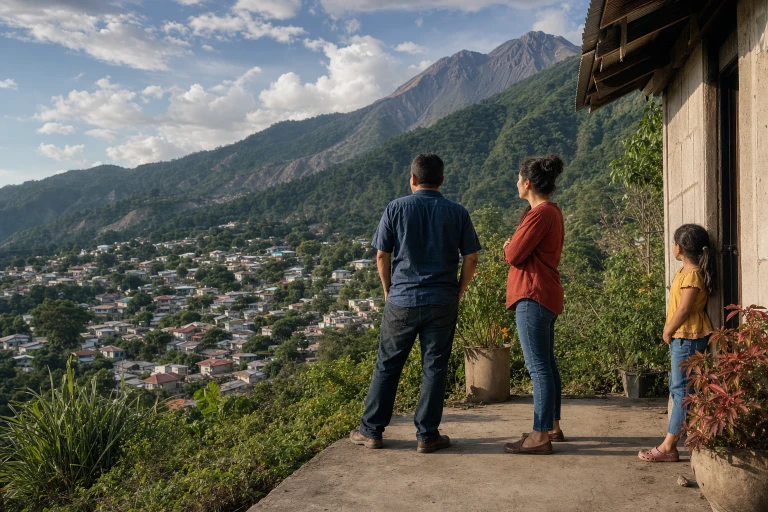
Costa Rica, the highland exception with an honest asterisk
Costa Rica earns its place on a technicality of geography. The coasts are hot, but most expats never live on them. The Central Valley around San José sits around 1,000 meters, and altitude does what latitude cannot: it keeps temperatures near a permanent 20°C to 26°C, an eternal spring of a different kind. Since 1948, the country has been a stable democracy with no standing army, posts solid economic growth, attracts heavy foreign investment into a maturing tech sector, and lets remote workers keep foreign income tax-free under a digital-nomad visa with a dedicated family option.
Costa Rica is the only place here where the honest answer to ‘is it safe?’ is ‘it depends where, and it used to be safer.’
That asterisk is large. After decades as Latin America’s poster child for peace, Costa Rica’s homicide rate has climbed into record territory — hovering near 16 to 17 per hundred thousand — as the country became a transit hub for cocaine. The violence is concentrated around trafficking corridors and poorer urban pockets, far from where most foreign families settle, but the national trend is the wrong direction. Public schools are weak by expat standards, so budget for private or international education from the start.
So why include it at all? Because on the axes this question actually asks — a moderate climate, a real economy, a working democracy and a legal door for nomads — the Central Valley still clears the bar, and few warm-weather options anywhere combine those four as cleanly. It is the highest-variance pick on the list. It belongs on the map precisely because the trade-off is visible, not hidden.
The contradiction: The one country everyone will tell you to add
El Salvador ought to be on this list and isn’t; the reason is the whole argument in one country. Name the most improved nation on Earth and many people, with cause, will say this one. A decade ago it carried the highest homicide rate in the world outside an active war; today, by official figures, its streets are among the safest in the hemisphere — the result of a security crackdown that jailed tens of thousands and made President Nayib Bukele the most popular leader in Latin America. If you read safety as the first criterion of a place to live, the logic looks airtight: surely the country that broke its gangs belongs anywhere serious.
This is where the map argues back. What makes the other five durable is not their politics but their geography — ocean, altitude and latitude doing the buffering. El Salvador’s geography does the opposite. That contradiction sharpens the entire thesis: a country can rebuild its institutions in a few years and still sit on ground no institution can move.
Lead with safety and El Salvador tops the list. Lead with the next decade, and it falls to the bottom — not for anything its government did, but for where it sits on the plate and in the rain.
Begin with what is underneath it. El Salvador sits squarely inside the Pacific Ring of Fire, where the Cocos Plate grinds beneath the Caribbean Plate and pushes up the chain of volcanoes that runs the length of the country. The U.S. Geological Survey counts roughly forty destructive earthquakes since 1520 — an average of one every 11 years. The most recent reminder came in 2001, when two large quakes weeks apart triggered thousands of landslides; one buried the Las Colinas neighborhood of Santa Tecla and killed around 600 people in minutes. The capital, home to some two million, sits beneath the San Salvador volcano, which has erupted violently before and will again. None of this runs on a human schedule, which is exactly the problem: it is a standing condition, not a forecast you can wait out.
Then there is the climate, the part most relevant to the next decade and the one that should give a relocating family the longest pause. El Salvador lies in the Central American Dry Corridor, which climate scientists rate among the planet’s most exposed regions on the planet — a belt of widening drought broken by violent rainfall, the worst of both extremes at once. It is the most water-stressed country in Central America: aquifers have dropped by meters, and by the environment ministry’s own account, more than 90% of surface water is contaminated. Decades of deforestation stripped the hills that once held the rain, so the storms that now arrive more often do more damage. The cruel detail is already in the migration data — failed harvests in the Dry Corridor have been, alongside poverty, one of the leading reasons Salvadorans have left. People were fleeing the climate even as the gangs were being beaten.
So El Salvador is not a cautionary tale about Bukele, whose security record is real, whatever one concludes about its methods and its cost to due process. It is a cautionary tale about criteria. Lead with safety, and it tops the list. Lead with the question this piece actually asked — where will it still be temperate, stable, and liveable in 10 years — and it sinks to the bottom, not for anything its government did or failed to do, but for where the country happens to sit on the plate and in the rain. The risks good governance can erase, and the risks geography guarantees, are not the same. That distinction is the most useful thing on this map.
What the five share, and what no list can promise
Notice what the five have in common, because the pattern is the real advice. Not one of them is comfortable by luck. The ocean buffers Madeira and New Zealand; altitude buffers Costa Rica’s Central Valley; and temperate latitude buffers Uruguay and Slovenia, which simply never had far to fall. Climate stability, it turns out, is mostly geography — and geography is the one input that doesn’t change when an election does.
Safety, the economy, and the schools follow a different rule. Those track institutions: courts that work, police that function, budgets that balance, a social contract that holds. El Salvador makes the point from the other direction — a country can rebuild its institutions in a few short years and still be unable to move off a plate boundary or out of the Dry Corridor. That is why the safest, best-educated, most durable places cluster so tightly on every index, and why a beautiful coastline alone is never the answer. You are not really choosing weather. You are choosing whether the system around the weather is sound, and whether the ground it stands on will hold.
And then the limits, stated without flinching. Visa rules change, sometimes within a year of being written — every program named here should be checked against its government’s own pages before anyone packs a box. Safety trends move; Uruguay’s and Costa Rica’s are worth watching. Costs are real, and the mild places are rarely the cheap ones. Most of all, none of this outruns a warming planet. It buys time and steadiness, which, for a family with school-age children, may be exactly what’s worth buying.
The friend who drove north at midnight did not find paradise. They found a town where the air behaved, the school was good, the streets were safe, and the rules let them stay a while. That is the whole of it. In a decade when comfort stops being the default and becomes a decision, the people who choose well will not be the ones who chased the sun. They will be the ones who, quietly and a little early, went looking for places the sun would never ruin.
Follow us on X, Facebook, or Pinterest
