
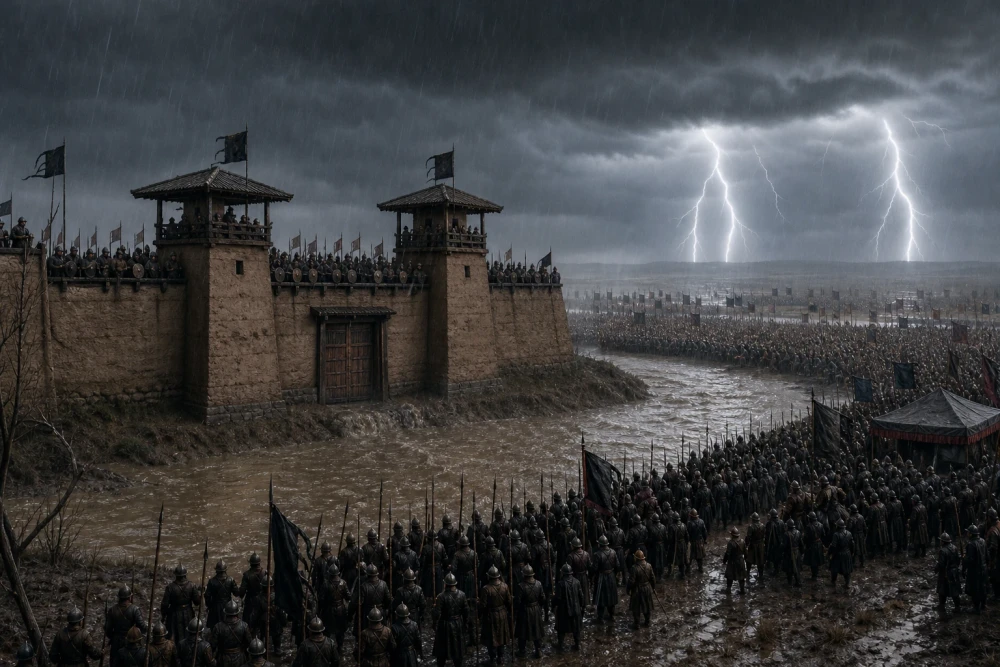
The Battle of Kunyang, fought 2,000 years ago in A.D. 23 after Wang Mang usurped the Han throne, stands as one of the most extraordinary military clashes in ancient Chinese history. It is a legendary conflict in which an outnumbered rebel garrison broke a massive imperial siege through sheer tactical brilliance and the luck of the terrain. This pivotal battle occurred at a moment when the empire stood at a precarious crossroads: the political structure of the Western Han Dynasty had completely collapsed, the newly proclaimed Xin Dynasty had failed to establish stability, and widespread famine, economic chaos, and roving bands of desperate insurgents swept across the provinces. In such a chaotic landscape, the modest, heavily fortified city of Kunyang transformed into the ultimate battleground where the destiny of an entire imperial line would be decided.
Wang Mang’s radical reforms triggered widespread unrest across the provinces
Wang Mang’s well-intentioned but ill-conceived domestic reforms — ranging from frequent re-coinage of the currency and radical land redistribution to the renaming of administrative titles and government monopolies — spread confusion and bitterness across every stratum of society. While a few intellectuals initially welcomed the ideological return to Confucian principles, most of the population resisted. Local officials enforced imperial decrees unevenly and corruptly, fueling deep-seated resentment among peasants and aristocratic families alike.
From this widespread discontent emerged the Green Forest Army, a formidable coalition of rebel factions united primarily by their shared desire to overthrow the Xin regime. The army drew strength from diverse regions: the south provided hardened woodsmen skilled in guerrilla tactics, the north contributed swift horsemen capable of lightning strikes across open plains, the west brought trade connections and unusual armor, and the famine-stricken east sent hundreds of thousands of ruined farmers driven to arms by starvation.
The Xin Dynasty dispatched a massive force to crush the rebellion
Determined to crush the rebellion and enforce imperial authority, Wang Mang dispatched his grandest military host under the joint command of Commander Wang Yi and General Wang Xun. Ancient chroniclers in the Book of the Later Han noted that this gargantuan force was “unprecedented since the Qin and Han dynasties,” numbering well over 400,000 men. The imperial army marched across the plains like an unstoppable wave, darkening the horizon with countless banners and shaking the surrounding river valleys with the thunderous beat of their war drums.
Among the ranks was Ju Mu Ba, a physical giant described in historical accounts as towering at around 2.3 meters. He commanded a specialized vanguard of exotic war beasts: ferocious tigers bound in heavy iron chains, leopards trained to leap over defensive shields, armored rhinoceroses clad in bronze plate, and massive war elephants bearing high wooden platforms occupied by archers.
| Aspect | Imperial Xin Forces | Green Forest Rebels |
|---|---|---|
| Commanders | Wang Yi, Wang Xun, Ju Mu Ba | Liu Xiu, Rebel Commanders |
| Troop Strength | ~430,000 men | ~8,000 to 10,000 inside the city |
| Special Units | Exotic war beasts, heavy siege engines | Mobile shock cavalry |
| Fortifications | Extensive encirclement trenches & siege camps | Compact rammed-earth walls (Xiancheng) |
The defenders stood their ground behind formidable defenses
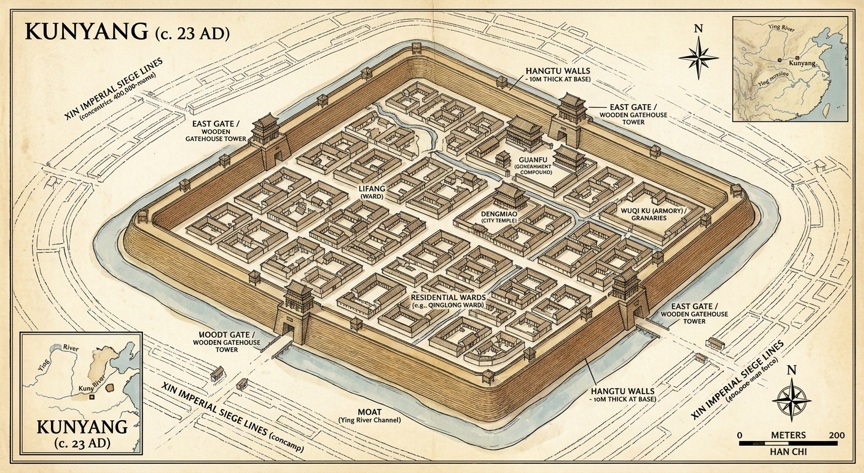
When the rebel defenders inside Kunyang — numbering barely 10,000 men — gazed upon the endless rows of imperial tents, widespread panic took hold. Many officers advocated abandoning the town to save themselves, but Liu Xiu, then a minor official serving as Deputy General of the Grand Master of Rites, stepped forward to rally their spirits. He argued that scattering across the open country would invite immediate slaughter by imperial cavalry, while holding the city together offered their only real chance of survival.
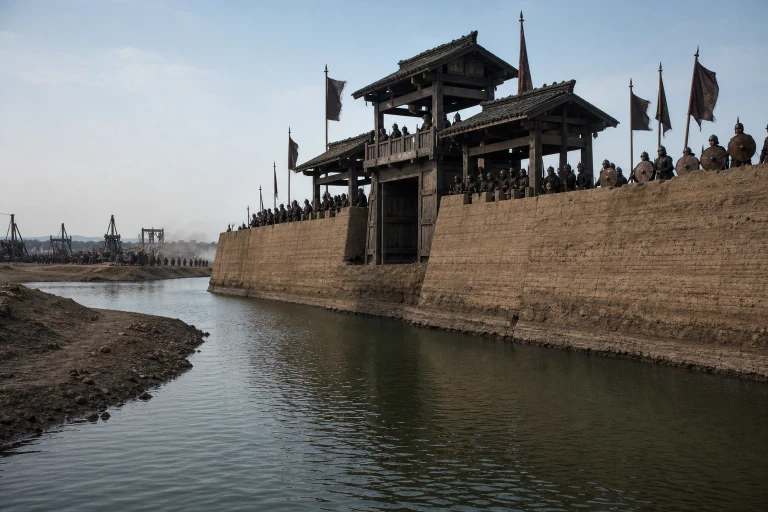
Steadied by his decisive leadership, the garrison resolved to defend the small county outpost (Xiancheng). Though compact, Kunyang was strategically built: its thick, compressed rammed-earth (Hangtu) walls absorbed shock from siege engines, and its outer defenses used a deep perimeter moat fed by a diverted channel of the neighboring Ying River. This engineering prevented the imperial troops from easily undermining the perimeter or rushing the heavy wooden gatehouse towers.
A daring breakout let the rebels launch a surprise counterattack
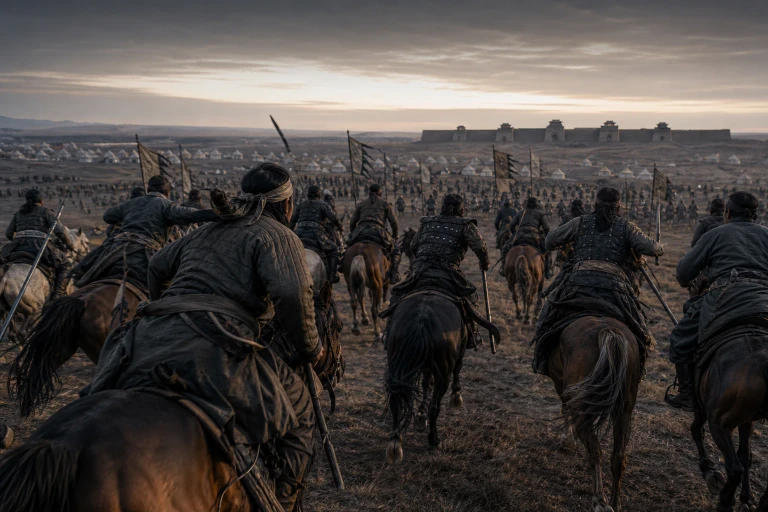
Recognizing that Kunyang could not endure a prolonged siege against such overwhelming numbers, Liu Xiu slipped out under cover of night with thirteen brave riders to gather external relief forces. Returning several days later with a vanguard of only a few thousand warriors, Liu Xiu personally spearheaded a fearless assault against the main Xin encampment.
Imperial General Wang Xun, underestimating the small force, led only a fraction of his troops out to engage them, strictly ordering the rest of his army to remain in formation. Taking advantage of this fatal miscalculation, Liu Xiu and his shock cavalry fought with desperate courage, charging directly into the command detachment and slaying Wang Xun on the field. The sudden death of their top commander sent immediate shockwaves of panic through the imperial ranks, prompting the besieged garrison inside Kunyang to throw open the gates and sally forth, striking the enemy simultaneously from front and rear.
“If we unite and fight the enemy together, we still have a chance of victory. But if we scatter and retreat, the enemy will pursue us, and none of us will survive.”
Liu Xiu, Book of the Later Han
A sudden storm threw the imperial army into chaos
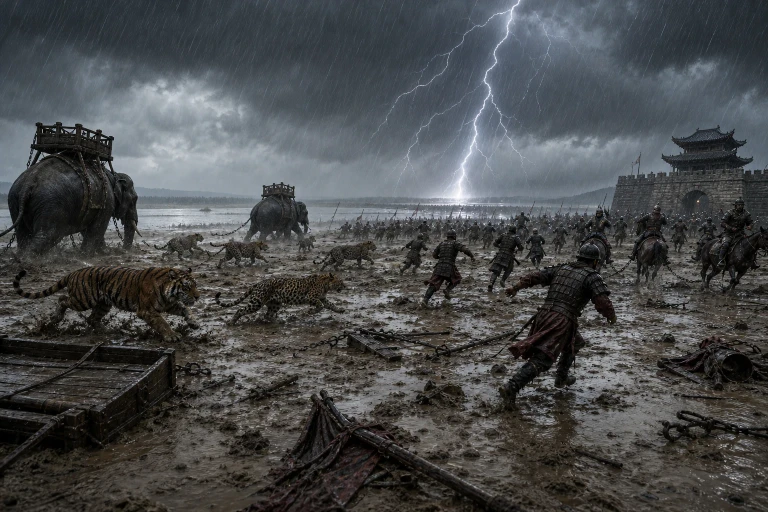
Just as the two armies collided in furious battle, a sudden, violent tempest swept across the plains. Deafening thunder shook the earth, blinding flashes of lightning filled the skies, and torrential rain turned the battlefield into a sea of mud. The exotic war beasts under Ju Mu Ba’s command — terrified by the storm and unable to hear verbal commands over the howling wind — broke their restraints and panicked in total frenzy.
Tigers snapped their chains and mauled their handlers, leopards darted wild through dense infantry ranks, and armored elephants turned violently upon their own troops, crushing command platforms and trampling thousands of fleeing soldiers. Thousands more drowned in the swollen waters of the nearby river while attempting to escape. The massive imperial army completely collapsed into disorganized flight, leaving Commander Wang Yi to flee back to Luoyang with only a handful of surviving guards.
The unexpected victory reshaped the history of China
The incredible victory at Kunyang utterly broke the power of Wang Mang’s Xin Dynasty and altered the course of Chinese history. Before the battle, Liu Xiu was merely a minor rebel figure; after Kunyang, his name resonated across the provinces as a military genius destined for greatness. Regional lords hastily pledged their allegiance to his cause, imperial garrisons surrendered without a fight, and within months, the short-lived Xin regime collapsed entirely.
Liu Xiu ultimately emerged victorious from the civil wars that followed, ascending the throne as Emperor Guangwu and restoring the Han lineage — initiating the prosperous Eastern Han Dynasty. As ancient chroniclers recorded, the Battle of Kunyang showed how tactical brilliance, unwavering resolve, and a timely turn of nature could let a minuscule force dismantle one of the largest armies ever assembled.
Translated by Eva and reviewed by Helen London
Follow us on X, Facebook, or Pinterest
