

In early November 2026, dozens of Chinese protesters gathered outside the Chinese Consulate in Toronto, holding banners and chanting slogans during a “Jasmine Action” demonstration. Among them was Xiao Jie, a woman originally from Sichuan Province, who joined the crowd in calling out: “China needs freedom.”
Today, Xiao Jie is an active participant in Canada’s Chinese democracy movement. But her journey into political activism began with concerns far removed from politics. After spending a decade as the director of a private preschool in Qingdao, she became increasingly troubled by what she witnessed in China’s education system. Her daughter’s experience with school bullying, lingering questions about the 2008 Wenchuan earthquake, and the oppressive restrictions of the COVID-19 pandemic eventually convinced her that she needed to seek a different future for her family.
A kindergarten built around love
After graduating from a university in Sichuan, Xiao Jie met her future husband, a native of Qingdao, and settled in the coastal city. Together with several friends, she established Qingqing Baby Kindergarten, a private preschool inspired by Waldorf educational principles. Their guiding philosophy was to bring love back into education and allow children to develop naturally.
“We didn’t want children to become robots who only sit when told to sit and stand when told to stand,” she explained.

The kindergarten operated five or six classes, each with approximately 15 students. It also welcomed seven or eight children who had been turned away by other institutions, including those with ADHD or intellectual developmental delays. These children paid the same tuition as everyone else.
For Xiao Jie, education was about nurturing each child’s individuality rather than demanding unquestioning obedience. But her visits to public kindergartens revealed practices that deeply disturbed her.
She recalled seeing children who were mischievous or frequently clashed with classmates left alone in corners for entire days, with teachers paying little attention to them. During free-play periods, some teachers designated large areas as off-limits to avoid responsibility for potential injuries. At mealtimes, uneaten food was discarded as soon as the allotted time ended, leaving slower eaters hungry.
She was equally troubled by the emphasis on appearances. Before scheduled visits, teachers would spend a week rehearsing presentations and memorizing talking points to create a favorable impression.
“It was all very fake. That wasn’t how things normally were,” she recalled.
As government policies increasingly brought private kindergartens under standardized public oversight, Xiao Jie and her partners faced pressure to follow prescribed educational programs. Unwilling to abandon their educational philosophy, they eventually closed the kindergarten.
Xiao Jie subsequently began teaching vocal music at a private arts training school. Yet the experiences that would ultimately change her life were only beginning.
When her daughter became a target
Although Xiao Jie had grown disillusioned with China’s education system, the experience that finally pushed her toward leaving the country involved her own daughter.
At the time, the family was living in Qingdao, and her daughter was in the second or third grade of elementary school.
Naturally introverted, the girl nevertheless possessed a strong sense of fairness. When she witnessed classmates being bullied, she would speak up, sometimes challenging children whose families had connections to government officials.
According to Xiao Jie, her daughter eventually became a target herself. Other students repeatedly pushed and shoved her, knocking her to the ground several times. Fortunately, she did not suffer serious physical injuries.
From an early age, Xiao Jie had encouraged her daughter to speak openly about anything that troubled her, promising that she would never blame her for sharing her difficulties. As a result, the child felt comfortable telling her mother what was happening at school.
One day, her daughter asked whether she could stay home. Sensing how distressed the girl had become, Xiao Jie allowed her to take a day off to recover emotionally. The following day, her daughter returned to class.

Hoping to resolve the problem, Xiao Jie approached the homeroom teacher. But the response left her disheartened.
“We’re just ordinary teachers. We don’t have that much power,” the teacher told her, according to Xiao Jie.
The teacher advised her to turn a blind eye to the bullying rather than make the situation into a larger dispute. Xiao Jie subsequently wrote to the local Education Bureau through its public email address but received no reply.
She also noticed that other parents routinely gave teachers gifts during holidays and festivals. Xiao Jie refused to participate, believing that such practices encouraged an unhealthy culture of favoritism.
Despite her daughter’s difficulties, she hesitated to transfer her to another school. She feared that a change of environment might make matters even worse.
Instead, she increasingly set her sights on giving her daughter an opportunity to study abroad.
The pressures facing Chinese students
While teaching at the arts training school, Xiao Jie encountered other troubling examples of the pressures facing young people.
One high school student developed a fever of nearly 104°F (40°C) but returned to class immediately after receiving an intravenous drip, afraid that missing lessons would leave him behind academically.
Another student had been bullied at school. When the child’s parents complained, school administrators reportedly suggested that they should transfer their child elsewhere if they intended to continue making trouble.
On one public holiday, a teenager arrived for a vocal music lesson carrying 20 to 30 examination practice papers.
“Everyone else is doing practice papers. If I don’t, I’ll fall behind,” the student explained.
To Xiao Jie, these experiences revealed an education system in which academic competition, conformity, and institutional authority often took precedence over children’s emotional well-being.
Her years as an educator had convinced her that children needed understanding, encouragement, and room to develop their own personalities. Yet the experiences of her daughter and students repeatedly suggested that these qualities were being neglected.
The earthquake that raised lasting questions
Xiao Jie’s doubts about official institutions extended beyond education.
When the devastating Wenchuan earthquake struck Sichuan in May 2008, she was visiting her hometown. Communications were disrupted, and information about the disaster was difficult to obtain.
She recalled official messages initially suggesting that the situation was not especially serious and urging people not to panic. Yet she soon learned that relatives of former classmates had suffered devastating losses.
When she later visited the earthquake ruins, the destruction was almost unbearable to witness.

The discrepancy between what she had initially heard and the suffering she subsequently encountered left a lasting impression. Xiao Jie came to believe that official reporting had concealed the disaster’s severity and that the public had been denied transparent information.
The experience planted doubts about the reliability of state-controlled media that remained with her for years.
Three years of pandemic restrictions
Those doubts deepened during China’s three years of COVID-19 restrictions.
Xiao Jie recalled the daily lines for COVID-19 testing, mandatory health-code checks, and restrictions on entering public places. Ordinary activities became dependent on meeting government requirements.
She was especially troubled by the vaccination policies affecting children. Concerned about possible long-term side effects, she initially resisted having her daughter vaccinated. But when it became clear that her daughter would be unable to attend school without vaccination, she reluctantly agreed.
For Xiao Jie, the situation underscored how little freedom families had to make their own decisions.
She also recalled that a relative working in health care had been dispatched to Wuhan during the outbreak response. According to Xiao Jie, the medical workers’ phones were collected when they arrived and were not returned until their assignment ended.
Meanwhile, one of her close friends became depressed during the prolonged lockdowns. With few opportunities to meet in person, the two women relied on telephone conversations to comfort and encourage each other.
During those difficult years, Xiao Jie found herself repeatedly wondering when she would finally be able to leave China.
The pandemic reinforced her growing conviction that the Chinese Communist Party’s (CCP) control extended into nearly every aspect of ordinary life.

When the restrictions were finally lifted, she immediately began preparing arrangements for her daughter to study overseas. A little more than a year later, those plans became a reality.
A new beginning in Canada
In choosing a destination, Xiao Jie sought advice from several parents involved in international trade who had traveled to Australia, Europe, and other parts of the world.
They consistently recommended Canada, describing it as a welcoming, inclusive country where Chinese people could live without the discrimination she had feared.
After arriving, Xiao Jie found that her own experiences largely confirmed their descriptions. She was especially touched by the kindness and acceptance she encountered.
Her daughter initially enrolled in a private school operated by members of Toronto’s Hong Kong community, where she could adjust to the language and new environment. She later transferred to a public school.
The transformation was remarkable.
The girl who had once dreaded attending school in China began returning home with enthusiasm.
“I really like going to school now,” she would tell her mother.
Her daughter became more outgoing and independent, learned to manage everyday responsibilities, and performed well academically. Xiao Jie no longer felt the same constant anxiety about her education.
Just as striking was the relationship between teachers and students.
Her daughter described classrooms with slightly more than 20 students, where teachers joined children in activities and encouraged them to ask questions. Teachers’ office doors remained open, and students could seek help whenever they encountered difficulties.
For Xiao Jie, this atmosphere was a dramatic contrast to the experiences her family had endured in China.
The change also brought mother and daughter closer.
“My daughter and I are like friends now,” she said.
As she spoke about her daughter’s happiness and growing confidence, Xiao Jie’s eyes filled with tears.
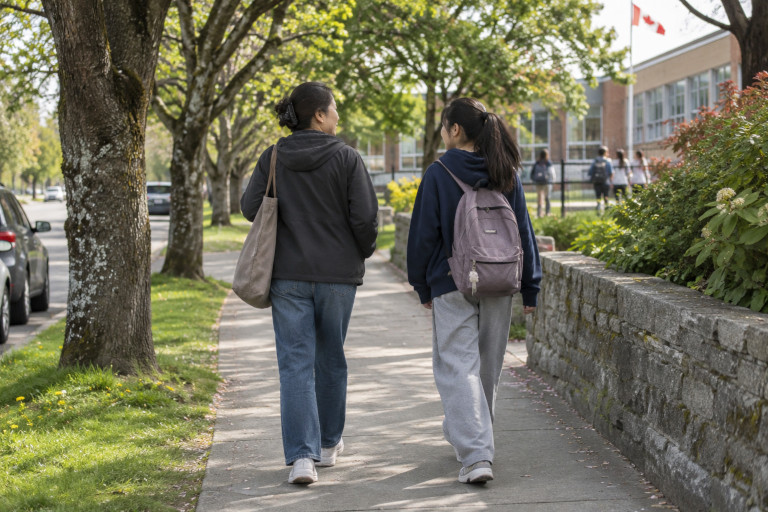
“I’m truly grateful that Canada has provided my daughter with a healthy environment in which to grow up,” she said.
Finding freedom and finding her voice
Not long after arriving in Canada, Xiao Jie began attending community gatherings through friends.
At these events, she encountered people who freely shared their opinions, discussed public affairs, and spoke openly about political issues. The atmosphere of mutual support and unrestricted expression was unlike anything she had previously experienced.
She later noticed members of the Democratic Party of China holding demonstrations near Toronto’s Chinese Consulate, where participants delivered speeches and shouted slogans calling for political change.
Many of the sentiments expressed at these rallies were things Xiao Jie had long believed but had never dared to say publicly while living in China.
Her political awareness had been developing for years. Even before leaving China, she had used internet circumvention tools to access YouTube and independent overseas media outlets blocked by the country’s internet firewall. She had also stopped watching CCTV’s Xinwen Lianbo news program, which she regarded as filled with propaganda and misleading information.
In Canada, however, she found something she had previously lacked: the freedom to express those views openly and a community of people who shared her concerns.
After joining online discussion groups and attending pro-democracy gatherings, Xiao Jie formally became a member of the Canada Committee of the Democratic Party of China in September 2026.
Since then, she says she has rarely missed a Jasmine Action demonstration. She has also attended the party’s educational meetings, where discussions about China’s political future have resonated deeply with her.
Some of the things she heard, she said, spoke directly to her heart.
Looking back, Xiao Jie’s journey from kindergarten founder to democracy activist was shaped by years of personal experience.
The mistreatment of children, her daughter’s suffering at school, the unanswered questions surrounding the Wenchuan earthquake, and the restrictions imposed during the pandemic gradually convinced her that the problems she had witnessed were not isolated incidents.
She came to see them as consequences of a political system that placed control and obedience above individual rights and freedoms.
Now living in Canada, Xiao Jie hopes that people in China will one day enjoy the same freedom of expression she has discovered abroad.
She says she intends to do everything she can to support the democracy movement and hopes to work with the Democratic Party of China to overthrow the CCP’s dictatorial rule.
She also dreams of a day when her relatives and friends still living in China can visit Canada and, in her words, “breathe the air of freedom.”
For Xiao Jie, the hope behind that dream is captured in the slogan she now joins other demonstrators in proclaiming outside the Chinese Consulate in Toronto:
“China needs freedom.”
Translated by Chua BC
Follow us on X, Facebook, or Pinterest
