

In 1506, during the reign of the Ming Dynasty’s Zhengde Emperor, Wang Yangming appeared to have everything a scholar-official could hope for. Born into a distinguished family in Yuyao, Zhejiang Province, he had earned the prestigious jinshi degree in the imperial civil service examinations and held positions in both the Ministry of Justice and the Ministry of War.
His father, Wang Hua, had placed first in the highest-level imperial examination and later risen to become Vice Minister of Rites. With his family’s reputation, his own academic achievements, and a promising career, Wang Yangming seemed destined for continued success.
But his fortunes changed dramatically that year.
The powerful eunuch Liu Jin was consolidating his control over the imperial court. When several officials in Nanjing were arrested, Wang Yangming submitted a memorial to the emperor pleading on their behalf. His intervention angered Liu Jin, and Wang Yangming was punished with 40 strokes of the imperial court cane before being demoted to superintendent of a remote government relay station in Longchang, Guizhou Province.
The journey into exile was dangerous. According to historical accounts, Liu Jin continued to pursue him, forcing Wang Yangming to flee for his life. At one point, he left his clothing and belongings beside the Qiantang River to create the impression that he had drowned.
After a long and difficult journey, he finally arrived in Longchang in the spring of 1508.
Finding a home in the wilderness
Longchang lay deep among the mountains of Guizhou, where steep paths wound through dense vegetation. When Wang Yangming arrived, he had no proper shelter. He initially lived among the thickets before moving to a rocky cave on an eastern hillside.
The companions who had accompanied him began falling ill, and Wang Yangming found himself responsible for their care. He fetched water, gathered firewood, prepared meals, and tended to them as best he could. To ease their suffering and lift their spirits, he composed songs, sang melodies from his native Yue region, and shared conversation and laughter with them.

The life he had known in the imperial capital seemed impossibly distant. His official rank and scholarly honors offered little protection against illness, isolation, or the threat of death.
Yet the people of Longchang eventually showed him kindness. Seeing that he had no suitable place to live, local residents helped build him a modest wooden house. He named the dwelling He Lou Xuan, roughly meaning “How Could It Be Humble?” The name came from a passage in the Analects of Confucius: “Where a gentleman dwells, how could it be considered humble?”
Wang Yangming planted cypress trees, bamboo, flowers, and medicinal plants around his new dwelling. Inside, he arranged his books, musical instruments, maps, and historical records. Students gradually began visiting him, bringing the sounds of reading and scholarly discussion into the secluded mountain settlement.
In his essay He Lou Xuan Ji, Wang Yangming reflected that he had grown so accustomed to his surroundings that he had almost forgotten he was living among the peoples of the frontier. He also expressed appreciation for the sincerity and simplicity of the local people, questioning whether those regarded as culturally sophisticated were necessarily more virtuous.
Although his circumstances remained difficult, Wang Yangming was discovering that a meaningful life did not depend entirely on material comfort or social standing.
Confronting life and death
Despite these moments of peace, the dangers surrounding Wang Yangming had not disappeared. Disease remained a constant threat, and Liu Jin’s hostility toward him continued.
According to the Chronicle of Wang Yangming’s Life, Wang Yangming gradually let go of his concerns about worldly success, failure, honor, and disgrace. Yet one fear remained: death itself.
The chronicle describes him preparing a stone burial enclosure, as though making arrangements for his own passing. He declared: “All I can do now is entrust myself to Heaven’s will.”
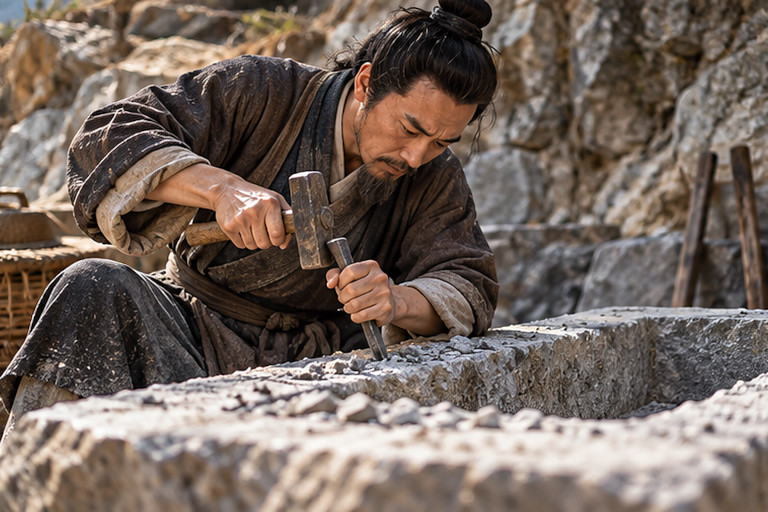
Having reached the limits of what he could control, Wang Yangming devoted himself to quiet reflection. During this period, an important question arose in his mind: If a sage were placed in such circumstances, what would he do?
In the imperial capital, he had pursued wisdom through study, scholarship, and public service. Now, far from the centers of learning and power, he possessed almost none of the things that had once defined his life.
Where, then, could he find the Way of the sages?
The Way of the sages lies within
One night in 1508, Wang Yangming experienced the profound realization that would later become known as the Longchang Enlightenment.
The Chronicle of Wang Yangming’s Life records that he suddenly understood the true meaning of “investigating things and extending knowledge,” a central concept in Confucian philosophy. The revelation was so vivid that it seemed as though someone were speaking directly to him. He leaped up in excitement, startling his sleeping companions.
Wang Yangming expressed his realization in words that would become central to his philosophy: “Only now do I understand that the Way of the sages is already complete within my own nature. My earlier attempts to seek principle in external things were mistaken.”
For years, Wang Yangming had followed the prevailing Neo-Confucian approach of seeking moral principles through the investigation of things in the external world. But his experiences in Longchang led him toward a different understanding.
He came to believe that the foundation of moral wisdom was already present within human nature. The principles needed to distinguish right from wrong and guide one’s conduct were not dependent upon official position, scholarly recognition, or favorable circumstances.
This did not mean that learning or action in the world was unimportant. Rather, genuine moral understanding had to begin within one’s own mind and be expressed through one’s conduct.
The realization became a foundation of Wang Yangming’s philosophy, later associated with the School of Mind, and helped shape his teaching on the unity of knowledge and action.
What he had spent years seeking through external study, he now understood to have its foundation within himself.
Compassion in the face of death
An incident the following year illustrated another aspect of Wang Yangming’s character.
In 1509, a minor official traveling from the capital passed through Longchang with his son and a servant. Near Wugong Slope, the three died one after another, leaving their bodies exposed in the mountains.
When Wang Yangming learned what had happened, he took two young attendants and set out to bury them. The boys were frightened at the prospect of approaching the bodies and hesitated to continue.
Wang Yangming told them: “We are no different from them.”
His words moved the attendants, who agreed to help. Together, they buried the three strangers and offered chicken and rice beside their graves as a memorial tribute.
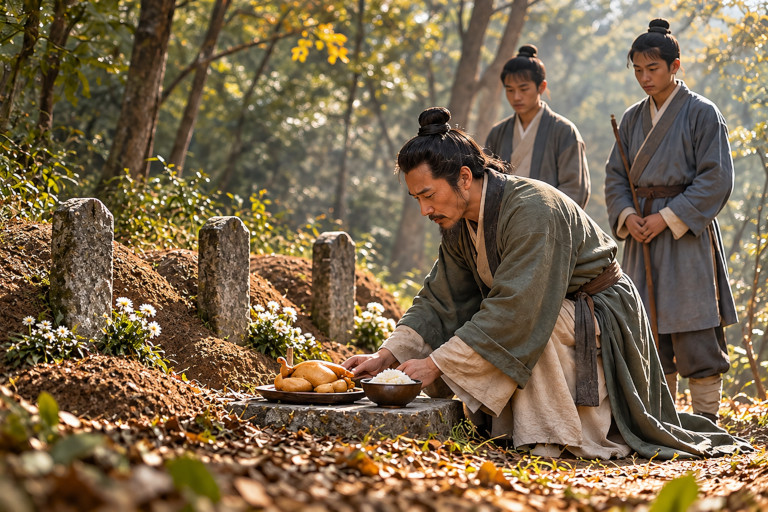
Wang Yangming later described the incident in Yilü Wen (“An Essay on Burying Travelers”), expressing deep sorrow for people who had died so far from their homes.
His compassion was informed by an awareness of their shared humanity. Like the travelers, Wang Yangming was far from his native land, vulnerable to illness and death. Whatever distinctions society placed between officials, servants, scholars, and ordinary people, none could escape the uncertainty of human existence.
The burial reflected a recognition that dignity and compassion should not depend on a person’s rank or circumstances.
A transformation that endured
In 1510, Wang Yangming left Longchang and returned to government service. He became magistrate of Luling and subsequently held other official positions, including a post in the Nanjing Ministry of Justice. In later years, he was entrusted with military campaigns against rebellions in several regions of China.
His life remained filled with public responsibilities and difficult decisions. Yet the insight he had gained during his exile continued to guide his understanding of the world.
Before Longchang, Wang Yangming had sought advancement through scholarship and official service. In exile, he had been deprived of nearly everything that once gave him security and standing. But the experience had led him to discover a foundation for moral understanding that did not depend on external circumstances.
Longchang offered him neither comfort nor worldly success. Instead, through hardship, reflection, and his encounters with others, Wang Yangming found a deeper understanding of the Way he had sought for so long.
The mountains had not changed, nor had the difficulties of human existence. What had changed was the foundation from which he faced them.
Translated by Katy Liu
Follow us on X, Facebook, or Pinterest
