

Before dawn, the Tuojiang River carries a thin skin of mist, and the wooden houses along its banks seem to stand on the water rather than beside it. A woman crouches at the stone steps and beats her laundry against them, the sound carrying flatly across the current, as her grandmother’s did. Somewhere upriver, a boatman’s pole knocks against a hull. For one hour, before the buses arrive from Zhangjiajie, Fenghuang Ancient Town belongs to the people who live in it. Photographers have made this place famous. Search for it, and you will find the same image a thousand times over: stilt houses, red lanterns, mist on water. What you will rarely find is an answer to the simplest question the town raises.
Everyone calls Fenghuang the most beautiful town in China. Almost nobody can tell you what its name means. That answer turns out to be the key to everything else here. It leads to a wall built to divide a people, to a history recorded in silver rather than writing, and to a novelist who saw much of the world and asked to be buried above this one small river. Let us begin with the bird.
The name represents a mythical bird of virtue rather than ashes
Fenghuang (凤凰, fènghuáng) is a mythical bird in Chinese tradition, usually translated as “phoenix.” Its name joins feng (凤), the male bird, with huang (凰), the female. Unlike the Western phoenix, the fenghuang does not burn itself and rise from ashes. It is a creature of virtue and harmony, appearing when the world is at peace. This distinction matters more than it might seem, because the two birds have been quietly confused for centuries.
The story of a bird that burns itself at the end of a long life and is reborn from the embers belongs to the Greek phoenix, which in turn descends from the Egyptian bennu. It is a myth about death and resurrection. When European translators met the fenghuang, they reached for the nearest word they had, and the fire came with it. Travel guides still repeat the ashes today. The Chinese bird was never about burning. It was about balance.
In the ancient Shanhaijing (山海经), the Classic of Mountains and Seas, the fenghuang is described as bearing the characters for virtue, duty, ritual, compassion, and trust upon its body. Its tail carries the five sacred colors, and those colors correspond to the five Confucian virtues: benevolence, righteousness, propriety, wisdom, and fidelity. A single creature holds male and female together, yin and yang in one plumage.
Seeing a fenghuang was not witnessing a resurrection. It was receiving an omen that the world had come into order, and that those who governed it were worthy. Paired with the dragon, whose imperial symbolism runs through Chinese art from palace walls to porcelain, the fenghuang came to represent the empress beside the emperor. The dragon rules. The phoenix blesses.
As for how the town took the name, legend has it that two of these birds once passed overhead, found the place so lovely that they hovered rather than flew on, and were reluctant to leave at all. Whether or not you believe in phoenixes, it is a fine thing to be a town that a bird of virtue could not bear to leave. If you would like the fuller story, we have written elsewhere about what the Chinese phoenix actually symbolizes and how it acquired its feathers.

The ancient town began its history as a remote frontier garrison
Fenghuang, Hunan, sits in the far western reaches of the province, in the Xiangxi Tujia and Miao Autonomous Prefecture, where the hills fold steeply, and the Tuojiang River (沱江) runs green through the middle of everything. Guizhou lies to the west. The nearest city of any size, Jishou, is some 37 kilometers away.
This was frontier country, and the town was born as a garrison. The oldest stonework nearby, the castle at Huangsiqiao, was raised in 687 CE during the Tang Dynasty and remains the best-preserved stone fortress in the region. The walled town that visitors walk through today took its present shape much later, in 1704, during the long reign of the Kangxi Emperor of the Qing Dynasty, a period now remembered as one of the high points of traditional Chinese culture.
The town did not always bear that name. For most of Fenghuang Ancient Town’s history, the settlement was known as Zhen’gan, a soldier’s name for a soldier’s place. Only in 1913, as the Qing gave way to the Republic, did it take the name of the phoenix. English-language guides often render this as Phoenix Ancient Town, which is simply the same name in translation.
What remains is remarkably intact. The ancient town covers roughly 1.8 square kilometers and holds some 20 ancient streets and more than 200 historic residences in Ming and Qing styles, threaded with lanes barely wide enough for two people to pass. In recognition of this, UNESCO added Fenghuang Ancient Town to its World Heritage Tentative List in 2008, in the cultural category. One more fact shapes everything you will see. More than half the people here are not Han Chinese. They are Miao and Tujia, and this has always been their country.
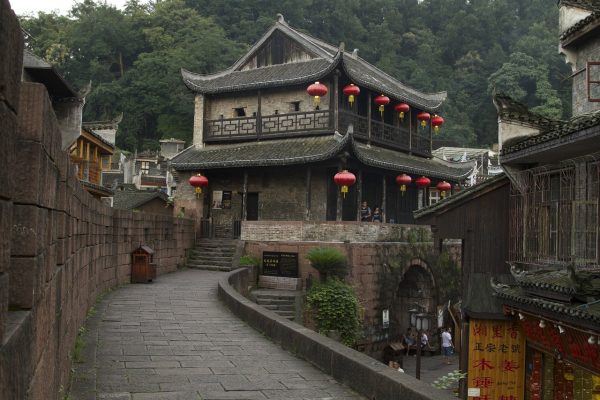
Traditional stilt houses are built over the river without a single nail
The houses that lean over the river are called diaojiaolou (吊脚楼), which roughly means “hanging-leg buildings.” The name is exact. The front of each house rests on slender timber stilts planted in the riverbank, while the back is anchored into the hillside behind. The building appears to be wading. They were not built this way for the view.
In a valley where flat ground is precious, a house on legs consumes almost no soil that might otherwise grow food. Lifted above the bank, its living quarters stay clear of the river when it rises and dry when the damp comes up in summer. The lower level traditionally held livestock and farm tools. The family lived above, closer to the light.
The most remarkable thing about them is what they lack. The entire wooden frame is joined by mortise and tenon, timber slotted into timber, with no nails and no bolts anywhere in the structure. The joints alone provide stability. Carpenters shaped these houses so that the wood could breathe, swell, and settle with the seasons, which is precisely why so many have stood for two and three centuries in river air that would have rusted iron away long ago. The same patience shows across the rest of the old town.
Key architectural sights define the cultural landscape of the town
- Hongqiao, the Rainbow Bridge: A covered Ming-era span whose lower level has been trading goods for centuries.
- The East Gate Tower and city wall: The best-preserved stretch of rampart, walkable above the rooftops.
- The North Gate Tower: The Ming gate at the far end of the old town.
- The Stepping Stones (跳岩, tiaoyan): A line of stone piers set into the Tuojiang, crossed one hop at a time.
- Wanming Pagoda: Seven hexagonal stories rising about 21 meters, first built in 1776 and rebuilt under its present name in 1985.
- Chaoyang Palace: Once used for official ceremonies. The top floor now serves tea at sunset.
- Shen Congwen’s former residence: The late-Qing courtyard house his grandfather built in 1866, where the writer spent his childhood.
- Xiong Xiling’s former residence: The birthplace of a man who would briefly govern a republic.
The Southern Great Wall was raised to divide local ethnic populations
An hour from town, a line of grey stone runs over the ridges. Guidebooks call it the Southern Great Wall. Its older name is the Miaojiang Great Wall, and its purpose was not what most visitors assume. The wall was begun in 1554, during the Ming Dynasty, and extended over the next century. It runs roughly 190 kilometers, standing about three meters high and two meters wide, and is studded with more than 1,300 blockhouses, watchtowers, and gates. Over 800 of them lie within Fenghuang County alone.
The Great Wall in the north was built to keep out invaders from beyond the empire. This wall was built to divide people who already lived inside it. On one side, the Ming court placed the Miao who had submitted to imperial authority. On the other, it placed the Miao who had not. Stone, garrisons, and taxes were arranged along the line between them, and the line was maintained by force for generations. There is no gentle way to say this, and it would be a disservice to the Miao to pretend otherwise. A wall raised against a people is a monument to the failure to live with them.
And yet stand on it now, in the wind, and look at what the wall did not accomplish. The Miao are still here. So are the Tujia. So are the Han. They share the same streets, the same river, the same market, and the same town, and the barrier meant to hold them apart is a ruin their grandchildren climb for the view. Compared with the far more famous wall to the north, it is a modest thing of stone. As a lesson, it may be the more valuable of the two.

Local history is vividly recorded in silver and intricate threads
Walk through the market in Fenghuang Ancient Town, and you will hear the Miao before you see them. Silver announces itself. The Miao have worn silver for more than 400 years. A full ceremonial headdress may weigh several kilograms, built from horns, fans, combs, hairpins, flowers, and fine chains, worked in filigree so delicate it resembles lace. It is not only meant to catch the light. It is meant to sound, ringing softly with every step, so that a woman is heard approaching before she arrives.
The silver carries meaning at every level. It speaks of a family’s prosperity, whether a woman is married, protection from harm, and belonging to a particular place and lineage. Hunan’s provincial authorities recognize Miao silver jewelry as intangible cultural heritage, and the craft passes from one generation of smiths to the next. Now consider why this matters so much more than ornament.
For most of their history, the Miao had no written script of their own. Their migrations, cosmology, genealogies, and griefs could not be set down in books. So they set them down in silver, embroidery, and batik. The patterns are not decoration applied to a culture. They are the culture’s archive. Xiangxi embroidery, worked in bold animal and plant motifs and bright contrasting colors, is taught by mothers to daughters in a chain of instruction that has never once been broken by a library fire or a burned manuscript, because it was never entrusted to paper. A people wrote their history where it could not be taken from them. They wrote it on their bodies.
Shen Congwen was a celebrated lyric writer who came home to rest
On December 28, 1902, in the town then still called Zhen’gan, a boy was born who would become, in Britannica’s phrase, the greatest lyric novelist in modern China. Shen Congwen left school early. He served as a soldier and a tax collector along these frontier rivers, watching the boatmen and the ferry girls and the small cruelties and kindnesses of a place the rest of China barely thought about. He carried it all to Beijing, and there he turned it into prose so tender and so unhurried that it seems to move at the speed of the current itself.
His masterwork, Biancheng (边城), published in 1934 and known in English as Border Town, tells of a ferryman’s granddaughter and the two brothers who love her. One point deserves care, because many travel guides get it wrong: Border Town is not set in Fenghuang. It is set in Chadong, in Huayuan County, further along the border. Fenghuang is not the stage. It is the soil the whole sensibility grew from. Shen was reportedly under serious consideration for the Nobel Prize in Literature in 1988. He died in May of that year, before any announcement could be made.
They brought him home. Shen Congwen’s grave lies on Tingtao Mountain (听涛山), whose name means “Listening to the Waves,” on a slope above the Tuojiang. There is no carved monument, only an unshaped natural stone weighing more than six tons, chosen because it had not been improved by anyone. The river he wrote about all his life goes on making its noise below.
He is not the only remarkable son of this town. Xiong Xiling was born here in 1870 and rose to become Premier and Finance Minister of the young Republic of China in July 1913. Within seven months he had resigned, unwilling to lend himself to Yuan Shikai’s designs on power. He spent the rest of his life on orphanages, schools, and famine relief, and he died in Hong Kong on December 25, 1937, having gone there after working to aid refugees from the fighting in Shanghai. Two men, one small town. One chose the sentence. One chose the orphanage. Both turned away from power, and in Chinese storytelling that turning away has always been the surest mark of virtue.
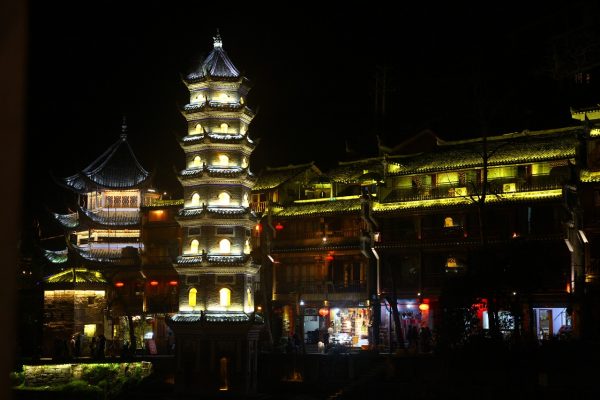
Visiting Fenghuang Ancient Town requires planning to navigate the commercial crowds
Yes, but honestly, and with your eyes open. Fenghuang Ancient Town receives millions of visitors a year, and at peak times the lanes move at a shuffle. Come outside the Chinese holidays, stay overnight rather than passing through, and walk the riverbank at dawn. The town that made its reputation is still there. It is simply not there at two in the afternoon.
Then there is the other Fenghuang. After dark, red lanterns come on beneath the eaves, the stilt houses throw their light down onto the water, and the Tuojiang carries a second town on its surface. Hongqiao burns brightest of all. This is the image that made Fenghuang Ancient Town famous, and it is the reason to stay a night rather than pass through. The strain is not new, and the town has been unusually candid about it.
In 2013, the county introduced an entry fee to thin the crowds and slow the commercial churn. The effect was immediate and severe. According to reporting in the Global Times, daily visitor numbers fell from around 20,000 to roughly 6,000. One bar owner watched his custom drop by 70%. After sustained protest from local business owners, the policy was abandoned. Today the lanes are free to walk once more, and only the historic houses and museums sit behind a combined ticket.
What lingers is not the policy but the reason given for it. Officials described a waterway filling with kitchen waste and flagstone streets that, in their words, “smack of beer and popcorn.” That is a town saying aloud that it can feel itself becoming a product. Fenghuang has since been rated a national 5A scenic area, China’s highest tourism classification, and its international visitor numbers are climbing again. Prosperity has come. Whether the town’s soul travels with it is a question the residents are still answering, and it is worth arriving as someone who has thought about it.
Practical travel tips ensure a better experience for visitors
- Best time to visit: April to late October. November through March is genuinely cold.
- When to stay away: Golden Week in early October and the Lunar New Year, unless crowds are what you came for.
- Getting there: Most visitors arrive via Zhangjiajie or Jishou, or fly into Tongren Fenghuang Airport.
- Tickets: Walking the old town costs nothing. A combined ticket covers the historic houses and museums.
- Cash: Small vendors here still prefer notes to coins.
- Be gently skeptical: Watch out for anyone offering free gifts, discounted tickets, or a better itinerary. Our guide to the scams that follow crowds in China applies well beyond this valley.
Above all, remember that you are walking through someone’s home. The etiquette that matters here is not a list of exotic rules. It is the ordinary courtesy of a guest: ask before photographing a face, step around a doorway rather than on its sill, and lower your voice in the lanes at night.

The ancient settlement remains a bird worth appearing for
Fenghuang Ancient Town rewards the traveler who looks past the photograph. Beneath the mist and the lanterns lies a garrison that became a sanctuary, a wall that failed at the one thing it was built to do, a people who kept their history in silver when the world denied them paper, and a writer who could have been buried anywhere and chose a stone above this river. And beneath all of it lies the bird.
The fenghuang never burned. It never rose from ashes, whatever the guidebooks say. It came when a place was in harmony, when those who held power held it justly, and when virtue was something you could recognize on sight. It was not a promise of rebirth after ruin. It was a sign that ruin had been avoided. That is a harder standard, and a better one. A town named for such a bird cannot simply be beautiful. It has to be worth appearing over. Fenghuang has been many things across 1,300 years: a fortress, a border, a hometown, and now one of the most photographed places in the country, and in each of those lives it has had to earn the name again.
Go early. Go quietly. Go in the season when the mist still belongs to the river. And when you stand on the bank at first light, and the town wakes around you without an audience, you may understand why two phoenixes are said to have circled once and found they could not leave.
Follow us on X, Facebook, or Pinterest
