

At dusk on a Ming watchtower in 1500, a soldier lit a small fire of dry grass. Down the ridge, two miles away, another soldier saw the smoke rise and answered with a fire of his own. Within an hour, the warning had crossed 500 miles of mountain spine, racing faster than any horse could ride. This was how the Great Wall of China spoke. And 2,000 years after the first stones were laid, the wall is still speaking, to every traveler who climbs its steps, every reader who hears the legends woven through it, and every culture that asks what it means to build something that outlasts an empire.
Most people know the Great Wall by a single fact: it is long. But its real story is older, stranger, and far more human than the postcard view suggests. It is a story of 1 million workers, seven dynasties, a grieving widow whose tears reshaped a mountain, and a bowl of glutinous rice that helped ancient bricks survive the centuries. Below, we’ll trace that story from its earliest earthen ridges to the moonlit ramparts of Mutianyu, and along the way, we’ll discover what the chángchéng (长城) still has to teach a world that builds quickly and remembers slowly.
How long is the Great Wall of China?
The Great Wall of China measures approximately 21,196 km (13,170 miles) when all wall sections ever built across more than 2,000 years are counted. The best-preserved Ming Dynasty section runs roughly 8,850 km (5,500 miles) on its own. The wall stretches across 15 northern Chinese provinces, from Mount Hu near Dandong in Liaoning to Jiayu Pass in Gansu, climbing mountains, fording rivers, and crossing deserts along the way.
That total, confirmed by a 2012 mapping survey from China’s National Cultural Heritage Administration, is more than half the circumference of the Earth at the equator. It is also a humbling number, because roughly 30% of those Ming-era sections have eroded, collapsed, or vanished entirely. What remains is a magnificent ruin, lovingly tended in places, weathered in others, and slowly returning to the land it once defended.
A 2,000-Year Story: Who built the Great Wall and when?
The Great Wall of China was built over more than 2,000 years by successive dynasties. It was not the work of one ruler, one century, or one design. It is a palimpsest in stone, each generation writing over the last.
The first walls (7th-3rd century BCE)
The earliest sections trace back to the Spring and Autumn period (770-476 BCE) and the Warring States period (475-221 BCE), when seven rival kingdoms fortified their borders against one another. These were rammed-earth ramparts, layered between wooden frames and pounded into shape by the bare feet of conscripts. Some stood barely the height of a man. Others ran for hundreds of miles. They were, in the language of the time, simply cheng: walls.
Qin Shi Huang and the connecting of the walls (221-206 BCE)
In 221 BCE, the king of Qin defeated his last rival and crowned himself Qin Shi Huang, the First Emperor of a unified China. Among his many sweeping projects, standardizing writing, currency, and the axle-width of carts, he gave one order that would echo through history: connect the northern walls into a single defense against the Xiongnu, the nomadic horsemen of the steppe.
Qin Shi Huang’s vision was guided by Legalist philosophy, which valued strict order and sweeping authority over individual welfare. The wall’s construction, conducted under that ideology, was harsh beyond measure. Soldiers, peasants, and prisoners labored together in conditions that buried thousands. By the time the Qin Dynasty fell in 206 BCE, less than two decades after the project began, an estimated rampart of more than 5,000 km had been built, and the bones of countless workers lay within and beneath it. The grim folk name “the longest cemetery on earth” would attach itself to the wall for centuries to come.
The Han, Sui, and the long middle centuries
The Han Dynasty (202 BCE-220 CE) extended the wall westward, pushing it deep into the Hexi Corridor to protect the trade caravans that would soon weave together the legendary Silk Road. The Han wall reached almost to the edge of the Taklamakan Desert, marking the longest ramparts in Chinese history at the time.
Over the next thousand years, the wall waxed and waned with the strength of its dynasties. The Northern Wei, Northern Qi, and Sui repaired and extended sections; the Tang, confident in their cavalry and diplomacy, neglected them. By the time the Mongol Yuan Dynasty took power in 1271, the wall was largely abandoned. After all, the new emperors had come from the very steppes the wall was built to keep out.

The Ming Renaissance (1368-1644)
When the native Han Chinese reclaimed the throne under the Ming Dynasty, the wall returned to the heart of imperial strategy. Ming engineers rebuilt it in brick and dressed stone, raising parapets to nearly 8 meters (26 feet) in places, doubling watchtowers, and weaving in beacon stations every few hundred paces. The wall most travelers see today, at Badaling, Mutianyu, Jinshanling, and Simatai, is overwhelmingly Ming. It is the version of the wall that captured the world’s imagination and is the one most worth saving.
How the Great Wall was built: Stone, earth, and sticky rice
The Great Wall is often described as a feat of engineering. It is more accurate to call it a feat of patience. There was no master design. Builders adapted to the land, the era, and the materials they could carry. The result is a wall that changes character every few miles.
Local materials, local wisdom
In the plains of the central provinces, builders pounded earth between wooden frames, layer by layer, until the walls reached their full height. In the mountains, they quarried stone from the slopes themselves. In the deserts of the west, they sometimes mixed reeds and sand, creating ramparts that still stand after 16 centuries of dry wind. Wherever possible, the wall used what the land gave: a quiet act of trust in local resources that modern engineers are now rediscovering.
After the Tang Dynasty, fired bricks became increasingly common. By the Ming era, kilns operated alongside many sections of the wall, baking the bricks that would form the famous battlements at Badaling. Each brick carried the seal of its kiln, a quality-control measure remarkable for the 16th century, and a reminder that someone, somewhere, had to answer for every stone.
The glutinous rice mortar secret
For centuries, scholars wondered why Ming sections of the Great Wall survived storms, earthquakes, and weeds when older sections had crumbled. In 2010, researchers at Zhejiang University announced an answer: glutinous rice. Ming workers had mixed sticky rice paste with slaked lime to create one of the strongest mortars in pre-modern history. The amylopectin starch in the rice formed a chemical bond with the lime, producing a binder so durable that grass could not push through it and rain could not dissolve it.
It is a small detail with a large meaning. The very ingredient that fed Chinese families had also held their wall together for half a millennium, ancient wisdom and modern science meeting in a single bowl of porridge.
The workforce: Soldiers, peasants, and prisoners
We will never know exactly how many people built the Great Wall, or how many died in the building. Soldiers led the work. Peasants were conscripted by the millions across two millennia. Prisoners were sent in chains. The traditional figure of one million deaths is impossible to verify, and serious historians caution against treating it as precise. What is certain is that whole villages were emptied of men, that families waited for letters that never came, and that the cost of every mile of stone was measured in lives. The wall protected an empire. It also broke an enormous number of human hearts.
Architecture of the wall: Walls, frontier passes, and beacon towers
To call the Great Wall a “wall” is almost a misnomer. It is a system. Three components work together: the wall itself, the fortified passes that pierce it, and the network of beacon towers that runs its length.
The three components
The walls form the spine of the system. In the Ming era, they typically stood 5 to 8 meters tall (16 to 26 feet) and were wide enough on top, about 5 meters, for soldiers to march five abreast or for horses to gallop in formation. Crenelated parapets protected defenders on the steppe-facing side; lower walls on the inner side allowed quick movement of supplies.
The frontier passes were the wall’s gates and arteries. Built where rivers, valleys, and ancient roads cut through the mountains, they doubled as customs posts, military bases, and trading hubs. Each pass had iron-studded wooden doors, brick arches, and inner courtyards designed to trap any enemy who breached the outer gate.
The beacon towers stood like sentinels at intervals along the wall, each within sight of the next. They were the eyes of the system, and the wall depended on them as much as on its stone.

Famous passes
Three passes deserve special note. Shanhai Pass, in Hebei, is where the wall meets the sea, the easternmost terminus of the Ming wall, guarded by the great Old Dragon’s Head fortress that juts into the Bohai Gulf. Juyongguan, just north of Beijing, was the gateway to the imperial capital, and its inner-arch carvings of bodhisattvas in seven languages remain a marvel of Yuan-era artistry. Jiayu Pass, in the western Gansu corridor, was the last gate before the Silk Road plunged into the desert. Travelers leaving China through Jiayu were said to feel the imperial world end behind them.
The beacon tower network: China’s first information highway
Long before semaphore lines or telegraph wires, the Great Wall served as a remarkable information network. Each beacon tower was within sight of two others. Soldiers used standardized signals: one fire and one cannon meant about 100 enemies were approaching; two fires and two cannons meant 500; five fires and five cannons meant 10,000 or more. Smoke carried messages by day, fire by night, and burning grass or lanterns by storm. A warning could cross the entire Ming wall, from Liaoning to Gansu, in less than a single day. It was, in every meaningful sense, the world’s first wireless network, and its towers are still there.
The legend of Meng Jiangnu: Tears that brought down a wall
Of all the stories that have grown around the Great Wall of China, none is more beloved or more sorrowful than the legend of Meng Jiangnu (孟姜女).
In the time of Qin Shi Huang, the story goes, a young woman named Meng Jiangnu married a kind scholar named Fan Qiliang. They had only days together before imperial soldiers arrived to conscript Fan to the wall. Months passed. Winter came. Meng Jiangnu sewed a coat for her husband and set out alone, walking hundreds of miles north to bring it to him.
When she finally reached the construction camp, the foreman lowered his eyes. Fan was dead, he said, and his body, like so many others, had been buried inside the wall to save the trouble of carrying it home. Meng Jiangnu sank to her knees at the base of the rampart and wept for three days and three nights. Her grief was so great, the legend says, that the wall itself could not bear it. A section collapsed before her, exposing the bones of her husband and the bones of countless others who had died beside him.
The story is one of China’s Four Great Folktales, told in ballads, operas, and chantefables for over two thousand years. The Temple of Lady Meng Jiang, near Shanhai Pass, was rebuilt in 1594 and still draws pilgrims today. The legend has carried many meanings over the centuries; some readings see it as a quiet protest against imperial cruelty, while others see it as an emblem of marital love stronger than empire. What endures is the image of a small woman, alone at the base of an enormous wall, weeping a hole through stone. It is a reminder that every brick of the Great Wall was set by a hand that someone, somewhere, was waiting to hold again.
Symbolism and spirit: The dragon’s path
For most of its history, the Great Wall has not just been an object in China. It has been a being.
The dragon legend
Folk belief in northern China holds that the wall’s serpentine path was guided by a celestial dragon, that the engineers were merely tracing the body of a creature already laid across the mountains. This is not as fanciful as it sounds. Chinese cosmology, drawing on the eight trigrams of the Bagua, reads landscape as living force, with mountain spines (dragon veins, lóngmài) acting as channels for the energy that animates a region. Building along the dragon’s back was not just strategic. It was an act of cosmic alignment.
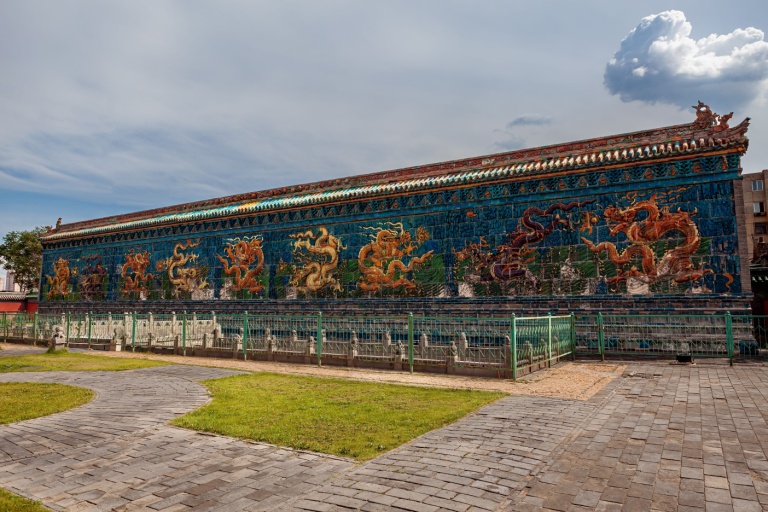
You can see the same impulse in the symbolism of the Nine-Dragon Wall at the imperial palaces, where dragons are not decoration but presence. The Great Wall, by this reading, is the longest dragon ever drawn, a creature of stone whose head dips into the eastern sea at Shanhai Pass and whose tail trails into the western sands at Jiayu.
A living symbol of Chinese civilization
Even setting legend aside, the Great Wall is a symbol unlike any other. Every dynasty that built it eventually fell. Every emperor who ordered new stones laid is now dust. The wall, somehow, remains. It has come to represent qualities the Chinese have prized for millennia: endurance, unity, sacrifice, and the willingness to undertake what cannot be finished in a single lifetime.
It also stands for something more bittersweet. A wall, by its nature, divides. It says this much and no further. Yet over the centuries, the Great Wall has become a meeting place rather than a barrier, a destination for travelers, scholars, lovers of Chinese culture and traditions, and pilgrims of meaning. The thing built to keep people out has become one of the world’s greatest invitations to come in.
Myths and realities: Setting the record straight
A monument this old gathers myths the way a beach gathers shells. Here are three worth examining honestly.
Can the Great Wall of China be seen from space?
No, the Great Wall of China cannot be seen from space with the naked eye. Chinese astronaut Yang Liwei, the first of his nation in orbit, confirmed in 2003 that he could not see it from his Shenzhou capsule. NASA has since echoed the finding. The wall is long, but it is only 5 to 8 meters wide, far too narrow to resolve from low Earth orbit, let alone from the moon. The myth seems to have begun in a 1932 Ripley’s Believe It or Not! cartoon and then run away from the truth.
Is the Great Wall one continuous wall?
No. The “wall” is many walls, parallel walls, branching walls, and natural barriers; about 25 percent of the total length is rivers, ridges, and cliffs that the builders simply incorporated. The popular image of one unbroken line on the map has always been a simplification.
Did one million people really die building the wall?
The figure is traditional and probably approximate. Spread across more than 2,000 years and many dynasties, the human cost was undoubtedly enormous, and the suffering is documented in poetry, official records, and the endurance of legends like Meng Jiangnu’s. But historians caution that exact numbers are unknowable. What is certain is that the cost was measured not in stone but in lives.
What the wall still teaches us
The Great Wall of China is, in the end, two things at once. It is the largest defensive structure ever built, and it failed, in every century, to keep determined invaders out. The Mongols climbed it. The Manchus negotiated their way past it. Genghis Khan is said to have remarked that the strength of a wall lies in the courage of those who defend it. The lesson the wall offers is not the lesson its builders intended.
What endures, instead, is something gentler. The wall outlasted every dynasty that raised it. The legend of Meng Jiangnu outlasted the empire that grieved her. The recipe for sticky-rice mortar outlasted the kiln masters who mixed it. What we build with patience and love tends to last longer than what we build with fear.
That is the real wisdom of the Great Wall, and the reason travelers still climb its steps in the cold morning light. Stand on a Ming parapet at dawn, watch the mountains roll away in every direction, and you’ll feel it: the weight of two thousand years of human work, the weight of a million unnamed lives, and underneath both, the quiet, persistent fact of beauty. The wall is still here. So are we. So is the chance, every morning, to build something worth keeping.
May every traveler who walks the Great Wall carry away not just a photograph but a deeper sense of what time and patience can shape, and may our own walls, whatever we build, be the kind that invite the world in.
Follow us on X, Facebook, or Pinterest
