
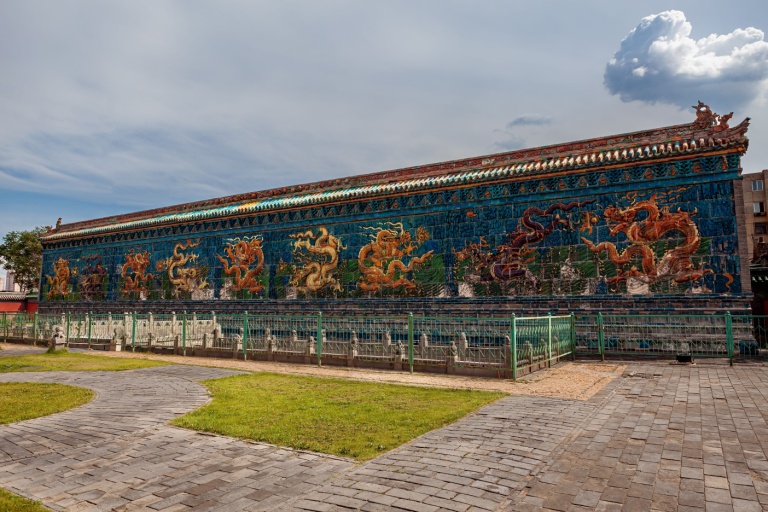
Standing before the shimmering Nine-Dragon Wall in Beijing’s Forbidden City, most visitors pause to admire the nine brilliantly colored dragons writhing across its glazed surface. They snap photos, marvel at the craftsmanship, and move on. But few realize how many layers of meaning are woven into every tile, every color, and every curve of this imperial masterpiece.
The Forbidden City remains one of Beijing’s most breathtaking attractions, a vast palace complex that served as the home of Chinese emperors for nearly 500 years. Among its countless marvels, the Nine-Dragon Wall stands out as one of the most symbolically rich. Behind its dazzling exterior lies a story of ancient cosmology, imperial authority, and one carpenter’s desperate act of ingenuity that saved lives. Here is what most visitors never learn about this extraordinary wall.
What is the Nine-Dragon Wall?
The Nine-Dragon Wall (Jiulongbi) is a large glazed-tile screen wall located south of the Gate of Imperial Supremacy within the Forbidden City. It stretches 29.4 meters (96.5 feet) long and stands 3.5 meters (11.5 feet) tall, its surface alive with nine writhing dragons playing with flaming pearls against a backdrop of sea waves and swirling clouds.
Emperor Qianlong commissioned the wall between 1771 and 1773 during the Qing Dynasty as part of a renovation of the palace’s northeastern section. This area was being transformed into a retirement complex where the emperor planned to spend his later years in contemplation and leisure. The wall was designed to mark the entrance to this private imperial sanctuary.
Composed of 270 individual pieces of colored glaze in yellow, blue, white, and purple, the wall sits on a white marble Sumeru base and features a double roof in the classical wudian (thatched hall) style, covered with yellow-glazed tiles. An additional 45 dragon-patterned arch bricks line the top. It is considered the best-preserved nine-dragon wall in all of China, and its craftsmanship represents the pinnacle of Qing Dynasty decorative arts.

The ancient tradition of spirit screen walls
To understand the Nine-Dragon Wall, you first need to understand an architectural tradition that stretches back over 3,000 years. In traditional Chinese architecture, homes and courtyards were not simply open beyond the front gate. Instead, a screen wall, known as a yingbi or zhaobi, stood just inside or outside the entrance. These spirit screen walls date back to the Western Zhou Dynasty (11th century B.C.), making them one of the oldest continuous architectural traditions in China.
The spiritual purpose was straightforward: the Chinese believed that wandering ghosts and malevolent spirits could only travel in straight lines. A screen wall placed directly in front of an entrance would force these spirits to encounter an obstacle they could not navigate around. Some traditions held that spirits would see their own reflection in the wall’s surface and frighten themselves away.
Beyond the supernatural, screen walls served a practical purpose. They shielded the interior courtyard from the gaze of passersby, providing privacy and dignity. Over time, the walls also became powerful status symbols. Ordinary homes used simple brick walls. Wealthy families added carved stone. And the imperial family? They used walls of brilliant glazed tile, decorated with the most powerful symbol in all of China: the dragon.
Why nine dragons? The power of the number nine
A common question visitors ask is simple: why specifically nine dragons? Why not 8, or 10, or 12? The answer lies in one of the oldest Chinese classic texts, the Zhou Yi (also known as the I Ching, or Book of Changes). According to this ancient wisdom, all numbers fall into two categories. Odd numbers (1, 3, 5, 7, 9) represent yang, the active, masculine, celestial principle. Even numbers (2, 4, 6, 8) represent yin, the passive, receptive, earthly principle.
Among all yang numbers, nine holds the highest position. It is the largest single-digit odd number, representing the ultimate expression of yang energy and the peak of celestial power. The Chinese word for nine, jiu (九), is also a near-perfect homophone of jiu (久), meaning “long-lasting” or “eternal,” reinforcing the number’s deep association with permanence, longevity, and enduring authority.
The ancient Chinese also believed in “nine heavens,” a layered cosmological structure that linked the emperor’s authority directly to the divine order. The emperor was known as the “Son of Heaven,” and the number nine reinforced his supreme status as the bridge between the mortal world and the celestial realm.
This reverence for nine permeated the entire Forbidden City. Imperial gates were studded with 81 brass nails, arranged in nine rows of nine. Legend holds that the palace complex was designed to contain 9,999 and a half rooms, precisely one half-room fewer than the 10,000 rooms believed to exist in the heavenly palace, so as not to show disrespect to the gods.
Even the wall itself encodes this numerology. It’s 270 glazed tiles and 45 dragon-patterned arch bricks, both of which are evenly divisible by 9 and 5. In Chinese cosmology, nine represents the supreme yang, while five, the middle number, represents the emperor’s pivotal position at the center of the universe. Together, nine and five formed the ultimate expression of imperial supremacy, known as jiuwu zhizun (the nine-five supreme). Nine was not merely a number in imperial China. It was a declaration of divine authority.
Dragon symbolism in imperial China
If the number nine represented celestial perfection, the dragon represented the emperor himself. In Chinese culture, dragons are not the fearsome, fire-breathing monsters of Western mythology. They are benevolent, powerful creatures that symbolize strength, wisdom, good fortune, and the power to command the forces of nature, particularly water and weather. The dragon represented the connection between heaven, earth, and the ruler.
The five-clawed dragon was reserved exclusively for the emperor. No one else in the empire was permitted to wear dragon-embroidered robes, sit on a dragon-carved throne, or display dragon imagery of any kind. To do so was an act of treason.
Chinese tradition describes the dragon through nine distinct attributes and holds that there are nine forms of the dragon and nine sons of the dragon. A Chinese dragon is traditionally said to have 117 scales: 81 yang scales (nine times nine) and 36 yin scales (nine times four). This numerical structure mirrors the cosmic balance of yin and yang that governed all of imperial life.
The central dragon on the Nine-Dragon Wall appears in brilliant yellow, which the Chinese considered “the noblest color.” Yellow was the color of the earth element in Chinese cosmology and was exclusively reserved for the emperor. This is why imperial robes, palace roof tiles, and the central dragon on the wall all glow with the same golden hue. Together, the dragon and the color yellow formed an unmistakable message: this place belongs to the Son of Heaven, and no one else.

The nine dragons: colors, positions, and meanings
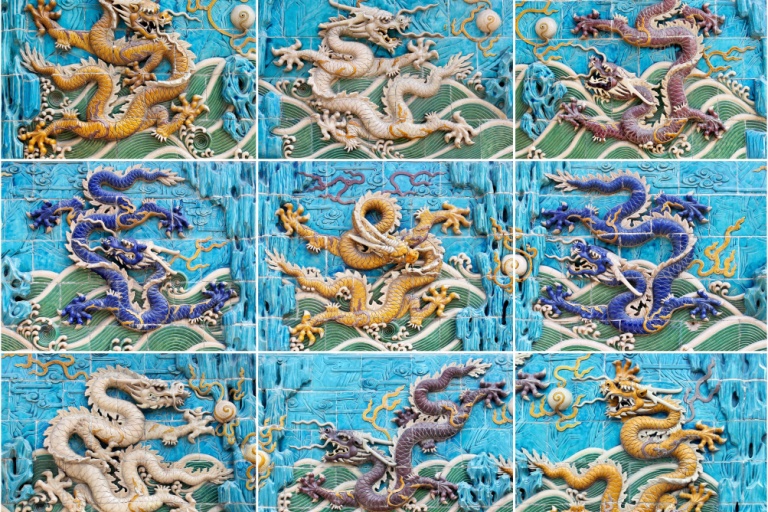
The nine dragons on the wall are not simply decorative repetitions. Each occupies a specific position and displays distinct colors that carry symbolic meaning. The central dragon, the principal figure, coils in imperial yellow. It clutches a flaming pearl in its front claws, a symbol of wisdom, spiritual energy, and the pursuit of perfection. The pearl is also considered a representation of the beginning of life, the egg of a creature, and the dragon protecting it reflects a reverence for life itself. Its tail churns the waters below, representing the emperor’s command over the natural world.
Flanking the central dragon are ascending dragons and descending dragons, arranged symmetrically. The ascending dragons rise toward Heaven, symbolizing ambition, growth, and the pursuit of enlightenment. The descending dragons reach toward earth, representing the emperor’s responsibility to govern and protect his people. The colors used across the wall, including yellow, blue, white, and purple, each carry their own significance. Blue represents the sky and immortality. White symbolizes purity. Purple signifies nobility and spiritual awareness.
Behind all nine dragons, the backdrop of rolling sea waves and billowing clouds represents the vastness of the emperor’s domain. The sea symbolizes the breadth of the empire. The clouds symbolize the heavenly mandate that conferred the emperor’s authority.
A carpenter’s secret that saved lives
Of all the stories surrounding the Nine-Dragon Wall, perhaps the most human is one that has been passed down for generations. When the 270 glazed tiles were being fired in the imperial kilns, a tile at the center of the third dragon, a white dragon, cracked during the firing process. Specifically, the damage was to a piece forming part of the dragon’s belly. In imperial China, such a failure of an emperor-commissioned project could result in the death penalty for everyone involved in its production.
With the deadline looming and no time to fire a replacement, one resourceful carpenter volunteered to attempt a solution. Working through the night, he carved a replacement piece from wood, shaping and painting it to match the surrounding glazed tiles so precisely that no one could tell the difference. The wall was installed on schedule, and the deception held.
It was not until the early years of the Republic of China, sometime between 1912 and 1926, that the secret was finally uncovered. Decades of sun, rain, snow, and temperature changes had caused the paint on the wooden piece to peel differently from the surrounding glaze. What centuries of imperial inspections had failed to detect, the slow, patient work of weather eventually revealed. Rather than diminishing the wall’s legacy, the story adds a deeply human dimension to this imperial monument: a reminder that behind every grand achievement are ordinary people whose courage and skill made it possible.
China’s three famous nine-dragon walls
The Forbidden City’s Nine-Dragon Wall is the most famous, but it is actually one of three celebrated nine-dragon walls in China. The Datong Nine-Dragon Wall is the oldest, built in 1392 during the Ming Dynasty in Shanxi Province. At 45.5 meters long and 8 meters tall, it is also the largest of the three. It originally stood before the palace of the 13th son of the founder of the Ming Dynasty, Emperor Zhu Yuanzhang.
The Beihai Park Nine-Dragon Wall, built in 1756, also during the Qing Dynasty, stands in Beijing’s Beihai Park. It is unique among the three because it features dragons on both sides of the wall, for a total of 18 dragons, while the other two walls display dragons on only one face. The Forbidden City Nine-Dragon Wall, the youngest of the three, is widely considered the most artistically refined. Its compact size and brilliant glazework represent the height of Qing Dynasty ceramic artistry. Together, these three walls form a living record of how Chinese imperial art evolved across nearly 400 years.
Ancient wisdom in every tile
The Nine-Dragon Wall is more than a decorative screen. It is a physical expression of how ancient Chinese civilization understood the relationship between the human world and the cosmos. The tradition of spirit screen walls reflects a worldview where architecture was not merely functional but deeply intentional. Every material, every color, every number was chosen to harmonize with the natural and spiritual order. The design principles visible throughout the Forbidden City, including proportion, symmetry, and symbolic alignment, grew from a common root: the belief that the spaces we inhabit shape our relationship with the world around us.
In this sense, the Nine-Dragon Wall is not a relic of a vanished era. It is a window into a way of thinking about design, meaning, and human connection that still resonates today. The next time you stand before the Nine-Dragon Wall, or see a photograph of its nine shimmering dragons, look beyond the surface. Count the dragons. Notice the colors. Consider the number nine and its promise of eternity. And remember the carpenter who worked through the night, carving wood into something indistinguishable from imperial porcelain, to save the lives of his fellow craftsmen.
Every tile tells a story. And stories like these are what make the Forbidden City and Chinese culture endlessly fascinating to explore, from dragons to qilins to guardian lions.
Follow us on X, Facebook, or Pinterest
