
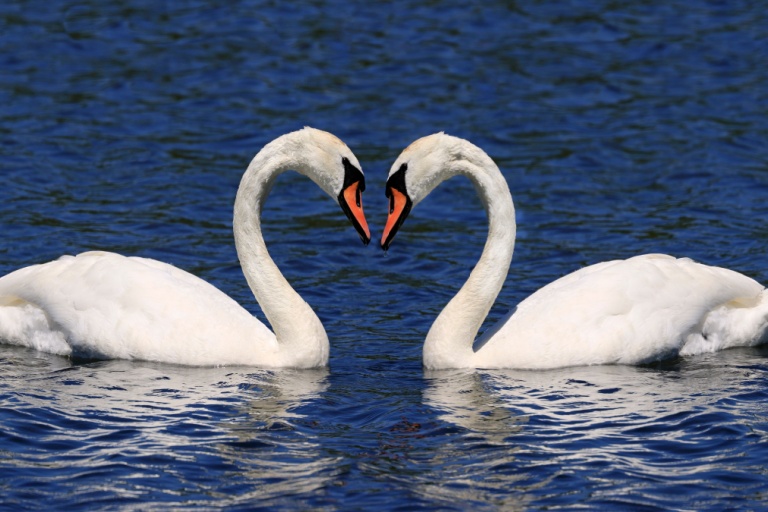
Swans are a type of waterfowl. They resemble geese in appearance, have loud calls, and feed on plants and insects. Although they are water birds, they are skilled at flying.
In Zhuangzi’s Heavenly Motion, it is said: “The swan does not bathe daily yet remains white; the crow does not sun itself daily yet remains black.” Swans are naturally white without bathing, while crows are naturally black without sunning. In Shuowen Jiezi, the swan is described as a bird that flies high, often mentioned alongside the wild goose, symbolizing lofty aspirations and ideals. In ancient Chinese literature, the swan often symbolized noble ambition, as in the phrase “the aspirations of swans and geese.”
Though swans may be separated during migration, their loyalty remains strong. They are considered lifelong partners — once they choose a mate, they usually stay together until death.
My ancestral home is Shanxi. When I was about ten, my parents and I returned from the northeast to Yuanping for the New Year to visit my grandparents. We lived on a farm, where I had never seen mountains, let alone rolling rocky ranges. Seeing Yuanping’s mountains filled me with excitement. My father took me to sit by a spring. The afternoon sun bathed the land, and shepherds whistled as they watched over their flocks. When a mischievous sheep strayed, the shepherd picked up a stone and threw it, striking the animal’s horn with precision. I was amazed. My father then began to tell a story.
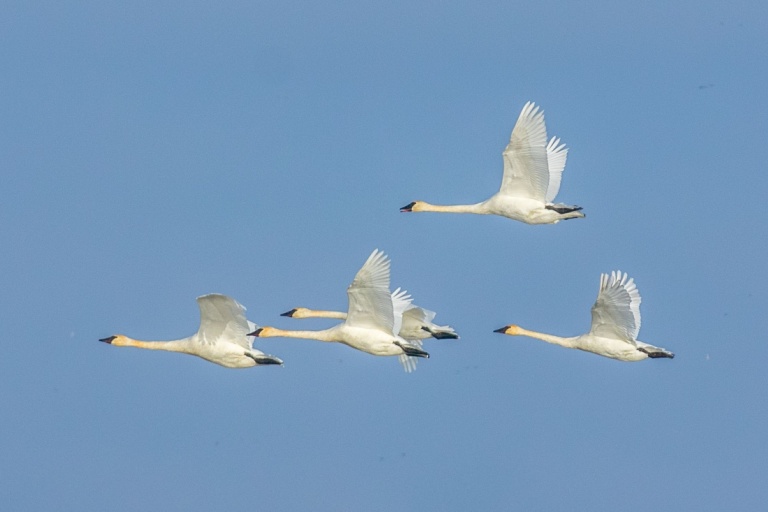
When he was young, a cousin herded sheep, too. Because wolves and leopards would sometimes prey on the flock, shepherds carried rifles. As winter turned to spring, flocks of migratory birds often returned north. One day, while tending sheep on a mountain top, his cousin saw a group of swans flying overhead. On impulse, he raised his gun and shot one down. Its wing was broken, so he bandaged it and brought it home. The elders scolded him, saying: “A hunter does not shoot coupling birds — it is a sin!” Feeling guilty, he kept the swan in the courtyard.
As the leaves turned yellow and the birds migrated south, a lone large swan, probably male, flew overhead, crying mournfully. The swan in the courtyard heard and called back loudly. Recognizing its mate’s voice, the lone swan reached the other bird, despite the danger. Reunited after a long separation, the two swans poured out their emotions. The bigger bird, discovering that his mate’s wing was broken and could no longer fly, spread his wings and cried in grief. They then entwined their necks tightly and died together. Time flows like water, washing away many memories, yet this story has remained vivid in my mind.
In the bird world, other species also show loyalty to their mates. The great hornbill, now endangered due to habitat destruction and illegal hunting, displays deep devotion — once bonded, it stays with its partner for life. During the breeding season, the female incubates eggs, while the male provides food.

The bald eagle, a raptor about 80-100 cm long with a wingspan of up to 2.3 meters, also practices lifelong monogamy. If one partner dies, the other often follows. They appear in groups during breeding season, building nests on cliffs or treetops. Yet, due to habitat loss and illegal hunting, the bald eagle is now considered vulnerable.
The albatross, a large seabird with a wingspan of 2.5-3.5 meters, is among the most devoted creatures to its mate. Spending over 90 percent of its life at sea, it still remembers its home and partner. Once bonded, it remains faithful for life. Even after years apart, it can recognize its mate’s voice and appearance. Single albatrosses seek partners during the breeding season, while paired ones patiently await their mate’s return. Albatross is also a near‑threatened species.
Traditional views of marriage in human society emphasize sharing hardship together and never abandoning a spouse in poverty. In the West, people make vows in church to care for one another and remain faithful, no matter the circumstances. Nonetheless, humanity today has been heavily indoctrinated by evolutionism and atheism; morality and faith have disappeared, boundaries are gone, infidelity and incest abound, divorce rates are high, and people behave poorly. Layer upon layer of cognitive traps are laid, leading humanity toward corruption and destruction.
When those whom God approves as good become an endangered group in society, this is a sign that this generation of humanity will be destroyed by the divine.
Translated by Cecilia and edited by Laura Cozzolino
Follow us on X, Facebook, or Pinterest
