

You will spend approximately 26 years of your life in bed. That is one-third of your existence devoted to sleep, rest, and restoration. Given how much time you spend there, the position of your bed matters far more than most people realize.
For over 3,000 years, the Chinese art of feng shui has provided guidance on arranging living spaces to promote well-being. And of all the rooms in a home, feng shui practitioners consider the bedroom the most important. This is where you restore your energy, heal your body, and prepare for each new day.
Feng shui bed placement is not about superstition or arbitrary rules. It is about creating a sanctuary where your body can truly rest and your mind can find peace. Many of the principles align closely with what modern sleep science indicates about optimal bedroom environments.
This guide explores the essential feng shui bed placement rules, explains the cultural wisdom behind each guideline, and provides practical solutions for real-world bedrooms. Whether your room is spacious or cramped, whether you sleep alone or with a partner, you will find actionable guidance to transform your bedroom into a haven for restful sleep.
Understanding feng shui: Energy in your bedroom
Before diving into specific feng shui bed position rules, it helps to understand the underlying philosophy. Feng shui, which literally translates to “wind-water,” is the ancient Chinese practice of harmonizing people with their surroundings.
Chi: The life force in your space
At the heart of feng shui is the concept of chi (also spelled qi). Chi is the vital life force energy that flows through all living things and spaces. In a well-designed room, chi moves smoothly and gently, nourishing everyone within it. In a poorly arranged room, chi can become stagnant, blocked, or rush through too quickly, creating imbalance and discomfort.
Think of chi like water flowing through your home. You want it to meander gently, reaching every corner without pooling or rushing. A bedroom with good chi flow feels calm, welcoming, and restful. A bedroom with poor chi flow might feel uncomfortable, unsettling, or difficult to relax in, even if you cannot identify why.
The bedroom requires a particular kind of chi. Unlike living spaces where active, vibrant energy supports socializing and productivity, the bedroom needs yin energy: soft, quiet, and restorative. Every feng shui bed placement decision aims to create this peaceful atmosphere. Your bed sits at the center of this energy equation. Its position determines how chi flows around you while you sleep, affecting everything from the quality of your rest to your sense of security upon waking.

The commanding position: feng shui’s golden rule
If you learn only one feng shui bed placement principle, let it be this: place your bed in the commanding position. This single guideline most strongly influences sleep quality, sense of security, and overall bedroom harmony.
Where power and peace intersect
The commanding position means placing your bed where you can see the door without being directly in line with it. Ideally, your bed sits diagonally across from the main entrance, with your headboard against a solid wall. From this position, you can see anyone entering while lying in bed, but you are not directly in the path of incoming energy.
Why does this matter so much? The commanding position satisfies a deep human need for safety. Even while sleeping, part of your brain remains alert to potential threats. When you cannot see the door, your subconscious stays on guard, preventing truly deep rest. When the door is visible, your nervous system relaxes, allowing more restorative sleep.
Traditional feng shui explains this through energy flow: the commanding position allows you to receive opportunities (represented by the door) while remaining protected (by the solid wall behind you). Modern psychology offers a parallel explanation through evolutionary biology. Our ancestors who slept where they could see approaching threats survived longer. That instinct remains encoded in our nervous systems today.
Finding the commanding position in your room
Stand at your bedroom door and look inside. The commanding position is typically in one of the far corners, diagonally across from where you are standing. If your door is on the left wall, the commanding position is usually the far-right corner; otherwise, it is usually the far-left corner. Your headboard should rest against the wall furthest from the door. You should be able to see the door clearly from where your head rests on the pillow. If your bedroom has multiple doors, prioritize visibility of the main entrance.
When perfect placement is not possible
Real bedrooms do not always accommodate ideal feng shui bed placement. Windows, closets, built-in furniture, or room dimensions may limit your options. If you cannot achieve the perfect commanding position, use these remedies:
- If you cannot see the door: Place a mirror that reflects it from your bed. Position it so you can glance at it without the mirror directly facing your bed while you sleep.
- If you must place your bed against the door: Add a footboard or place a piece of furniture between the bed and the door to create a buffer. A bench, a low bookshelf, or even a folded blanket at the foot of the bed helps break up the direct energy flow.
- If your headboard cannot be against a solid wall: Use a substantial, solid headboard to create the sense of support that a wall would provide. The headboard becomes your symbolic wall.
The death position: Why feet poiting to a door is forbidden
One feng shui bed placement rule stands above all others as an absolute prohibition: Never position your bed with your feet pointing directly at the door. This arrangement, known as the coffin position or death position, is considered deeply inauspicious in Chinese tradition.
The coffin position explained
The name reveals its origin. In Chinese culture, the deceased are carried out of rooms feet-first. Sleeping with your feet toward the door mimics this position, symbolically placing you in the position of death each night.
Beyond symbolism, feng shui practitioners believe this position allows vital chi to drain from your body while you sleep. The direct path from your feet to the door creates an energy highway that drains your energy throughout the night. People who sleep in this position often report feeling tired upon waking, even after adequate hours of sleep. The death position also violates the commanding position principle. When your feet point at the door, you typically cannot see the entrance, leaving your subconscious on alert all night.
Solutions for challenging layouts
Some bedrooms seem to demand the coffin position. Perhaps the only wall long enough for your bed faces the door directly. If you find yourself in this situation, do not despair. Feng shui offers several remedies:
- Create a visual barrier: Place a footboard, bench, or trunk at the end of your bed. This breaks the direct line between your feet and the door, slowing the energy flow.
- Use a screen or a curtain: A folding screen positioned between your bed and the door serves the same purpose. Even a tall plant can help redirect chi.
- Close the bedroom door while sleeping: If nothing else is possible, keeping it closed at night reduces the effect of the death position.
- Hang a crystal: Some feng shui practitioners recommend hanging a faceted crystal between the bed and door to disperse rushing chi.
The goal is to create some interruption in the direct path. Even a small barrier helps protect your energy while you sleep.
Essential feng shui bed placement rules
Beyond commanding and avoiding the death position, several additional feng shui bedroom rules support optimal sleep and well-being.
Headboard against a solid wall
Your headboard should rest firmly against a solid wall. This provides energetic support and grounding while you sleep. A floating bed, or one placed in the center of the room, lacks the stability that promotes deep rest.
Avoid placing your headboard against:
- A window: Chi leaks out through windows, draining your energy. You may also experience sleep disturbances due to drafts, light, or noise.
- A bathroom wall: Plumbing carries water (and chi) away, creating draining energy on the other side of your headboard.
- A shared wall with a kitchen: The active energy of cooking and appliances is too stimulating for restful sleep.
If your only option is a window wall, use heavy curtains and position your headboard to cover as much of the window as possible. The curtains act as an energy barrier when closed at night.
Equal space on both sides
For couples, feng shui bed placement requires equal space on both sides of the bed. This represents equality in the relationship and ensures both partners have their own access and energy flow. A bed pushed against a wall forces one partner to climb over the other, creating an energetic imbalance. It can manifest as one partner feeling trapped or less important in the relationship. Single people should also maintain space on both sides if they wish to attract a partner.
Avoid beams and sloped ceilings
Never place your bed directly under an exposed beam. Beams can exert downward pressure, which may manifest as headaches, pressure, or a sense of burden. If beams are unavoidable, position your bed so the beam does not cross directly over your body, especially your head or chest. Sloped ceilings present similar challenges. Sleep with your head at the highest point of the slope rather than where the ceiling descends toward the floor.
Distance from doors
Beyond seeing the door, maintain some distance from it. A bed too close to the entrance receives too much active chi, making rest difficult. The area near a door is the most yang (active) part of any room, while the area furthest from the door is the most yin (restful). For en-suite bathrooms and closets, the same principles apply. Keep your bed away from bathroom doors, especially as bathrooms drain chi. Close bathroom doors at night when possible.

Mirrors, windows, and doors: Managing energy flow
Three elements require special attention in feng shui bed placement: mirrors, windows, and doors. Each affects chi flow and sleep quality in specific ways.
The mirror warning
Perhaps no feng shui bedroom rule is more widely known than this: Never place a mirror facing your bed. This guideline exists for several reasons. Mirrors are considered energy activators. They bounce chi around a room, creating movement and stimulation. While useful in living spaces, this activation works against the calm energy a bedroom needs.
Traditional belief holds that mirrors facing the bed can invite third parties into a relationship, either by reflecting the couple or by creating an energetic opening. Whether or not you share this belief, the practical effects of a bed-facing mirror are worth considering.
Even sleep scientists note that mirrors can disturb rest. Movement in your peripheral vision, even your own reflection shifting as you turn over, can trigger your brain’s alertness response. You may not consciously notice it, but your sleep architecture is affected. If you have a mirror in your bedroom, position it so it does not reflect the bed. Cover it with a cloth at night if repositioning is not possible.
Window placement
Windows let chi flow in and out of your room. While you need windows for fresh air and light, too much exposure at night can disrupt sleep. Avoid placing your bed directly under a window. The chi exchange at the window creates an unsettled feeling, and practical concerns such as drafts and early-morning light can wake you prematurely. If your bed must be near windows, use substantial curtains or blinds. Close them at night to contain the room’s chi and create a protective boundary.
Multiple doors
Many bedrooms have multiple doors: the main entrance, a closet, an en suite bathroom, and perhaps a balcony. Each door represents a potential chi pathway. Too many open doors create scattered energy, making it difficult to settle into deep sleep. Position your bed so you can see the main entrance while minimizing exposure to other doors. Keep closet and bathroom doors closed at night. If your bedroom has many doors, this becomes even more important.
Kua numbers: Your personal sleeping direction
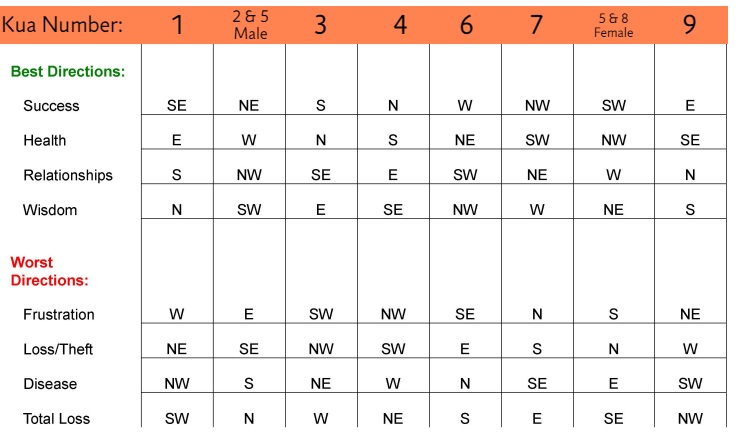
Feng shui bed placement can be personalized further through Kua numbers, a system that identifies your most auspicious directions based on your birth year and gender.
Finding your Kua number
Your Kua number determines whether you belong to the East Group or the West Group, each with four favorable and four unfavorable directions. Calculating it involves your birth year and a simple formula:
- For males born before 2000: Add the last two digits of your birth year together. If the result is double-digit, add again until it is single-digit. Subtract that number from 10.
- For females born before 2000: Add the last two digits of your birth year together until you get a single digit. Add 5 to that number. If the result is a double-digit number, add again.
For those born in 2000 or later, the formulas adjust slightly. Many online calculators can determine your Kua number instantly if you prefer.
Your four auspicious directions
Each Kua number has four favorable directions:
- Sheng Chi (Success): Best direction for attracting prosperity and vitality
- Tien Yi (Health): Best direction for physical wellbeing and recovery
- Nien Yen (Relationships): Best direction for love and family harmony
- Fu Wei (Wisdom): Best direction for wisdom and peace
For sleep, most practitioners recommend orienting your head toward your Tien Yi (health) or Nien Yen (relationships) direction, depending on your relationship status.
Kua numbers quick reference
- East Group (Kua 1, 3, 4, 9): Favorable directions are East, Southeast, North, South
- West Group (Kua 2, 5, 6, 7, 8): Favorable directions are West, Northwest, Southwest, Northeast
When couples have different Kua groups, compromise becomes necessary. Generally, orient the bed toward the partner who most needs support, whether for health, relationship harmony, or career success.
Feng shui bedroom colors for sleep
Color affects energy and mood profoundly. Feng shui offers guidance on which colors support restful sleep and which to avoid.
Colors that promote rest
- Earth tones (beige, tan, terracotta, soft browns): These grounding colors create stability and warmth. They connect to the earth element, promoting security and solid sleep.
- Soft blues and greens: These colors relate to the wood element and symbolize growth, renewal, and calm. Light shades work best; avoid vibrant tones that stimulate rather than soothe.
- Soft pinks and peaches: These nurturing colors support relationships and create warmth. They are particularly good for couples’ bedrooms.
- Cream and warm whites: Neutral but not stark, these colors provide a peaceful backdrop without the coldness of pure white.
Colors to avoid
- Bright red and orange: These fire colors are too stimulating for sleep. Small accents may be acceptable, but red walls or bedding can disrupt rest.
- Pure white: In Chinese culture, white is associated with mourning. It can also feel stark and cold, lacking the warmth a bedroom needs.
- Black as a dominant color: Too much black creates heavy, yin-dominant energy that can feel oppressive. Small black accents are fine, but black walls or large furniture pieces may weigh down the room’s energy.
- Electric or neon colors: Any highly stimulating color works against the calm bedroom atmosphere feng shui seeks.
Bed selection and care
Your bed itself matters as much as its position. Feng shui offers guidance on choosing and maintaining the bed that supports your best sleep.
The ideal bed
- Wooden frames: Wood grounds energy and provides stable support. It is the most recommended material for bed frames in feng shui.
- Solid headboards: A sturdy headboard creates a sense of support and protection. Avoid headboards with gaps, bars, or openings that allow energy to pass through.
- Natural materials: Choose mattresses and bedding made from natural fibers when possible. Cotton, linen, and wool support healthier energy flow than synthetic materials.
- Proper height: Your bed should sit approximately two feet off the ground, allowing chi to circulate beneath while keeping you elevated enough to feel secure.
What to avoid
- Metal bed frames: Metal conducts electromagnetic energy, which can disrupt sleep. If you have a metal frame, consider your sleep quality and whether a change might help.
- Waterbeds: The movement and metal coils in many waterbeds create unstable energy that works against restful sleep.
- Used mattresses: Mattresses absorb energy from their previous owners. If you must use a secondhand mattress, thoroughly clean the room and consider a mattress cover as an additional barrier.
- Clutter under the bed: Keep the space clear. Storage under the bed creates stagnant chi that can affect sleep and energy levels. If you must store items there, limit it to soft items such as extra bedding or seasonal clothes, and avoid shoes, old papers, or emotionally charged objects.
The science behind feng shui
Feng shui developed long before modern science, yet many of its principles align with what research now tells us about sleep and wellbeing.
What environmental psychology confirms
The commanding position makes sense from an evolutionary psychology perspective. Humans feel more secure when they can see potential threats approaching. Research shows that perceived safety affects stress hormone levels, which directly impact sleep quality.
Studies on bedroom environments consistently find that clutter increases cortisol (the stress hormone) and reduces sleep quality. Feng shui’s emphasis on clear, organized spaces aligns with this finding. The recommendation to avoid mirrors facing the bed is supported by sleep research showing that movements in your peripheral vision can trigger alertness responses, even during sleep.
A balanced perspective
Scientific evidence for chi as an energy system remains limited. Controlled studies have not demonstrated measurable effects of bed orientation on Kua numbers. However, the psychological benefits of intentional space design are well-documented. The act of thoughtfully arranging your bedroom, of creating a space that feels safe and welcoming, produces real effects on mood and rest. Whether those effects come from chi flow or from a sense of control over your environment may matter less than the positive outcomes themselves.
Feng shui offers a framework for creating spaces that feel good. Many of its specific recommendations happen to align with what makes environments psychologically comfortable. This combination of ancient wisdom and practical benefit is perhaps feng shui’s greatest strength.

Creating your bedroom sanctuary
Feng shui bed placement is part of a larger goal: transforming your bedroom into a true sanctuary for rest and restoration.
Beyond bed position
- Remove electronics: Televisions, computers, and phones emit stimulating light and carry active energy. Keep them out of the bedroom, or at a minimum, out of sight while sleeping.
- Minimize work materials: Papers, laptops, and anything associated with work bring that energy into your rest space. The bedroom should be reserved for sleep and intimacy.
- Clear clutter: Visual clutter creates mental clutter. Keep surfaces clear, closets organized, and nothing stored under the bed. A clean room supports clean energy flow.
- Choose artwork carefully: Images in the bedroom affect mood. Avoid anything stimulating, violent, or solitary. Pairs of objects support relationships. Peaceful, beautiful images promote restful energy.
- Monitor air quality: Open windows regularly to improve ventilation. Consider plants that purify the air, though feng shui suggests limiting them in the bedroom, as their active growth energy can disrupt sleep. One or two small plants are generally fine; a jungle is too stimulating.
More than just sleep
Your bedroom is where you begin and end each day. The quality of your rest affects everything that follows: your energy, mood, creativity, relationships, and health. Poor sleep cascades into every area of life. Good sleep provides the foundation for everything else.
Feng shui bed placement can improve sleep through intentional design. Whether you approach it as ancient wisdom about energy flow or as a practical framework for creating comfortable spaces, the results speak for themselves: a room that welcomes you to rest, protects you through the night, and releases you refreshed into each new morning.
Small changes can make meaningful differences. Even adjusting your bed a few inches to better see the door, or adding a footboard to buffer the coffin position, can improve how you feel in your space. Your bedroom should be a sanctuary. It should feel safe, calm, and nurturing. Feng shui bed placement, combined with attention to colors, materials, and energy flow, helps create exactly that.
Tonight, look at your bedroom with fresh eyes. Notice where your bed sits, what you can see from your pillow, and how the room makes you feel. Then make one change, however small. The journey toward better rest begins with a single thoughtful adjustment.
Sleep well.
Follow us on Twitter, Facebook, or Pinterest
