
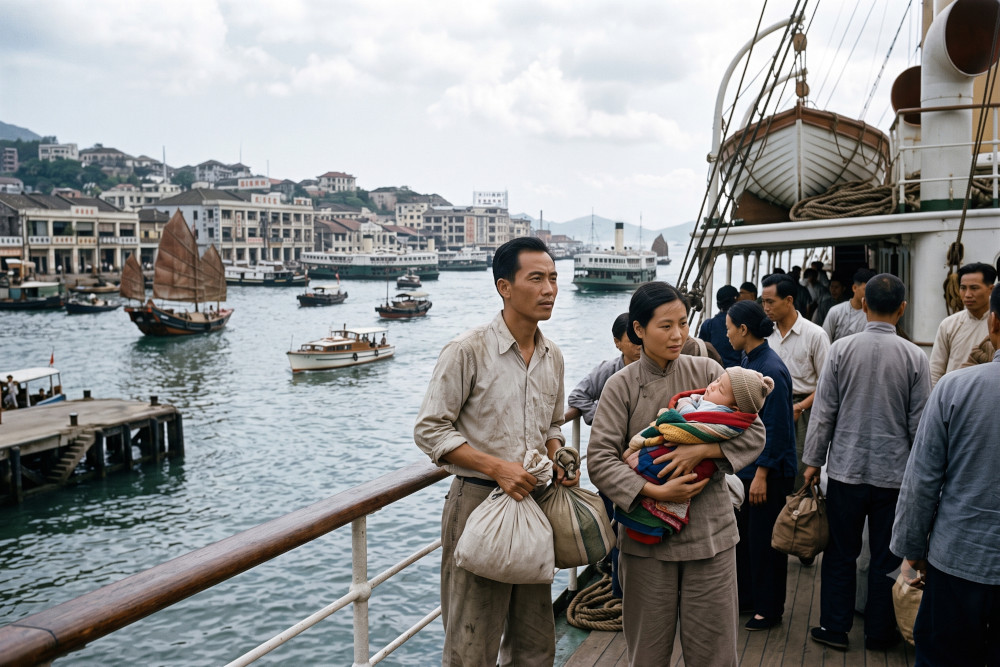
Nearly half a century later, Kent Wong can still clearly describe the five routes people used to escape from Guangdong to Hong Kong.
The central route was the shortest, requiring escapees to cross only the narrow Shenzhen River. Security there, however, was the tightest, with soldiers, guard dogs, and barbed wire. Usually, only local residents dared to attempt the crossing, often under the cover of a typhoon.
The eastern route led toward Tung Ping Chau, a Hong Kong island in Mirs Bay located close to Shenzhen. At the time, however, few people knew about it.
The western route was longer. Those who entered the water near Shekou had to swim approximately six miles to reach Hong Kong.
There was also the sampan route, which began at the Pearl River estuary and involved crossing in small wooden boats. The Macau route took escapees from Taishan through Macau, where they boarded Hong Kong fishing boats used for smuggling.
Kent Wong spent two years planning his escape, endured two failed attempts, and tried three different routes before finally reaching Hong Kong at the end of 1973. He was 25 years old.
In the summer of 1975, he arrived in the United States as a political refugee. He was later admitted to Harvard Medical School and became an anesthesiologist.
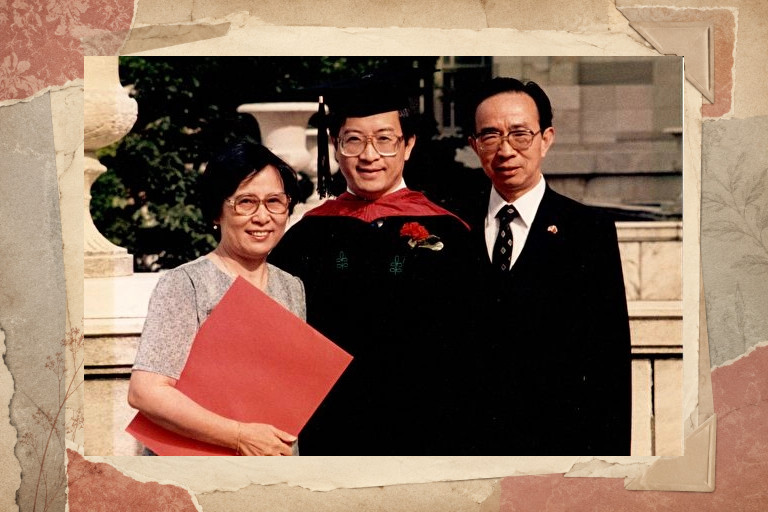
In April 2021, Kent Wong published Swimming to Freedom: My Untold Story of Escaping the Cultural Revolution in the United States. A Chinese edition was later released under the title The Illegal Immigrant.
“In the eyes of the Chinese government, we were illegal border crossers,” Kent Wong told Voice of America. “But in our own eyes, it was something glorious.”
His father’s return marked the beginning of a family nightmare
Kent Wong was born in 1948 in a small coastal town in Guangdong, China. It was the final stage of the Chinese Civil War, and the Nationalist forces were losing ground. His father, who worked for the customs service, received orders to relocate to Hong Kong.
When Kent Wong was only one month old, he boarded a passenger ship with his family and moved to an apartment in Causeway Bay.
His father, however, was deeply patriotic and did not want to work in a British colony. In 1951, he participated in what became known as the Kowloon Customs “Uprising,” organized by underground members of the Chinese Communist Party. He then brought his family of five back to communist China, which had been established only two years earlier.
The Communist Party welcomed him with great fanfare as a hero who had opposed Chiang Kai-shek. He was appointed as a section chief in Guangdong’s import-export administration.
That appointment, however, marked the beginning of a long period of suffering for the family.
During the Anti-Rightist Movement, Kent Wong’s father was labeled a “bourgeois rightist” and confined in a makeshift detention facility commonly known as a “cowshed.” In 1959, he was sent to a labor reform farm.
His participation in the customs uprising eight years earlier earned him no protection. Nearly all of his former companions in the movement were also labeled rightists.
“My father was very patriotic. He remained patriotic until the day he died,” Kent Wong said. “But the Communist Party never valued him, and he suffered politically throughout his life.”
Kent Wong excelled in school and served as a Young Pioneers brigade leader. He was being groomed as a model successor to the communist cause.
As the Party intensified its campaign of class struggle, however, his father’s rightist label cast a long shadow over his childhood. Like other children from families with politically condemned backgrounds, he learned to suppress his anger and quietly endure mistreatment.
By 1968, the Cultural Revolution launched by Mao Zedong was in full force. Kent Wong had little enthusiasm for political campaigns and often visited the home of a classmate named Xi to listen secretly to foreign radio broadcasts.
Xi lived in a small addition built on the roof of an apartment building. Those who gathered there called themselves the “Rooftop Underground Party.”
“They were very skilled at building transistor radios,” Kent Wong recalled. “It was at their home that I first heard Voice of America. Even now, I still become excited when I talk about it. Wow — to be able to hear the enemy’s voice. The more I listened, the more fascinated I became.”
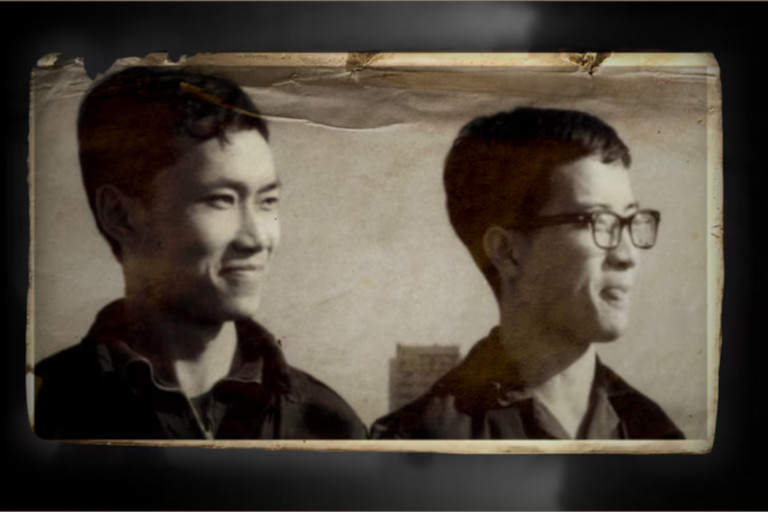
One day in 1968, Xi asked him: “We have decided to escape. Are you coming with us?”
“Escape illegally?” Kent Wong responded in astonishment.
He had heard stories about local fishermen who secretly crossed to Hong Kong in small boats. He had assumed, however, that such attempts were rare. He had never imagined that someone close to him would decide to make the journey.
The dangerous exodus to Hong Kong
Several waves of people fled to Hong Kong between the establishment of the Chinese Communist regime and the beginning of the Cultural Revolution.
The movement reached its height during the Great Famine caused by Mao’s Great Leap Forward, when tens of millions of people starved to death.
In May 1962, Tao Zhu, then the Communist Party secretary of Guangdong Province, briefly ordered the border opened as the famine worsened. Hundreds of thousands of starving people subsequently poured into Hong Kong.
Chinese author Chen Bing’an spent 22 years interviewing hundreds of people who had taken part in the exodus. In his 2010 book The Great Exodus to Hong Kong, he reported that four major waves of migration occurred between the Communist army’s occupation of Shenzhen in 1949 and the early 1980s.
According to declassified official documents cited in the book, at least 560,000 refugees fled communist China for Hong Kong.
Cai Yongmei, a former executive editor of Open Magazine who moved to Hong Kong in 1980, wrote that approximately half of Hong Kong’s population at the time consisted of refugees and their descendants who had escaped communist rule and the Great Famine after 1949.
Chinese authorities regarded fleeing to Hong Kong as “treason and defection to the enemy.”
A 2010 report in the Freezing Point weekly supplement of China Youth Daily stated: “Before the 1960s, border guards could open fire at any time if people attempting to cross the border refused to obey orders. Many were shot and killed on the mudflats or in the mountains. Only later, after strict orders from higher authorities, did the shootings gradually decline.”
Escape became his only way out
At the time, Kent Wong did not fully understand the history of those who had risked their lives to reach Hong Kong.
“I was not born a brave person,” he said. “Crossing the border illegally sounded terrifying. You had to climb mountains and swim across the sea.”
Mao had called on educated young people in the cities to “support” the countryside and border regions. Kent Wong submitted to the government’s arrangements and was sent to the countryside with his two younger sisters as part of the “Up to the Mountains and Down to the Countryside” campaign.
For a time, he put the idea of escaping out of his mind.
In the countryside, he endured discrimination and exhausting physical labor. He felt increasingly lost and distressed.
Then, one day, a letter arrived bearing a stamp with a portrait of the British queen. It brought news that Xi had successfully reached Hong Kong. An enclosed photograph showed Xi standing in the sunlight, dressed in fashionable bell-bottom pants and looking confident and full of life.
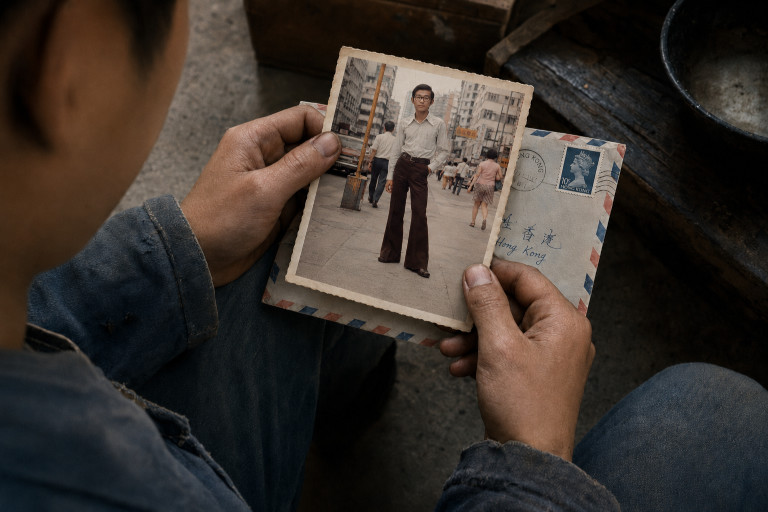
The desire to escape returned with overwhelming force.
“I had two choices,” Kent Wong later wrote in his book. “I could let China slowly grind my life into dust, just as it had done to my father, or I could follow Xi and find a beautiful world where I could begin a new life.”
The final event that pushed him toward escape was a public execution in the village. Most of the 21 people put to death were political prisoners.
“That event deeply shook me,” Kent Wong said. “It reminded me of the things we had said in the ‘Rooftop Underground Party’ and of our listening to Voice of America. If we had been caught, it certainly could have been treated as a capital crime.”
He felt cornered. Escape, he concluded, was his only way out.
“All the friends I knew who attempted to escape felt the same way,” he said. “They believed there was no longer any hope for the country. They felt they had to leave and that it was worth taking the risk.”
Returning to where his life began
Kent Wong began studying the available escape routes and practicing swimming and rowing.
At the time, many people from Guangzhou trained along the Pearl River. When they passed one another, they often exchanged knowing smiles. Escaping had become so common that nearly every family in the area knew someone who had attempted it.
Kent Wong also learned the coded language used by those planning to flee. The expression ding gai, meaning “nailing down the lid,” referred to the lid of a coffin and was used to indicate that someone had been caught.
He recalled that Hong Kong seemed dazzling to many would-be escapees. They dreamed of its fashion, perfume, horse racing, and revolving restaurants atop skyscrapers.
For Kent Wong, however, Hong Kong’s greatest appeal was its comparatively open political atmosphere and its promise of fairness and opportunity. There, he believed, he could speak freely and would no longer be punished because of his family background.
His attempts to reach Hong Kong were far from easy.
On his first attempt, Kent Wong and his companions spent seven or eight days hiking through the mountains. Before they could even reach the sea, border guards caught them, pointed rifles at them, and escorted them to a detention center.
The second attempt was even more devastating.
After hiking for several days in torrential rain, Kent Wong and his companions entered the sea at night. They swam through rough waves until morning.
At daybreak, the first light illuminated the Hong Kong skyline. Freedom appeared to be within reach.
Then a Chinese fishing boat intercepted them.
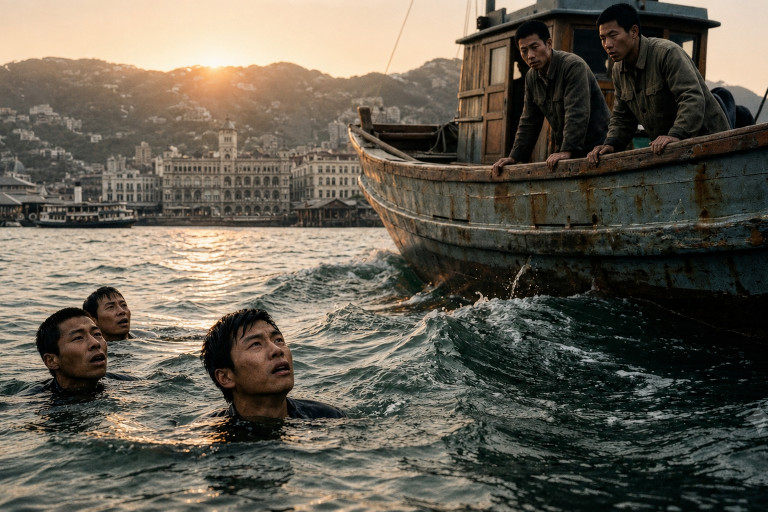
“The fishing boats entered Hong Kong waters because the government paid them,” Kent Wong recalled. “They received 50 yuan for every person they caught. That was why they were so eager to pull us from the water and take us back.”
The two failures left him discouraged for a long time.
At the end of 1973, however, he regained his resolve and set out once more.
This time, Kent Wong and his companions left Taishan in a local fisherman’s sampan. Along the way, they evaded the searchlights of Chinese naval vessels, met a human smuggler, transferred to another boat, and endured a rough passage to Hong Kong.
Kent Wong never forgot the moment when the minibus carrying him emerged from the Lion Rock Tunnel.
Under a brilliant blue sky, rows of white high-rise buildings stretched upward, while the voice of Taiwanese singer Teresa Teng played nearby.
“It was like entering heaven,” he said. “I truly felt as though I were going to cry. I thought: ‘I have come home.’”
His life had come full circle. Twenty-five years after leaving Hong Kong as a small child, Kent Wong had finally returned to the place associated with his earliest happy memories.
He believes the Communist Party has not changed
Throughout the decades-long exodus, countless people failed to reach their destination.
Of the 15 people Kent Wong personally knew who attempted to escape, three died at sea.
Half a century later, he recorded the story of how he and others of his generation risked their lives to flee China. He hoped the book would honor the friends who had died and expose the lasting trauma inflicted by an extreme and inhumane dictatorship.
Kent Wong understood that publishing the book could prevent him from ever returning to China, and he was prepared to accept that consequence.
He acknowledged that China’s economy has grown and living conditions have improved since the years when he escaped. Some of those who fled during that period now credit the Communist Party’s leadership for the country’s development, and a number have returned to China.
In Kent Wong’s view, however, the fundamental nature of the Party has not changed.
“It still insists on maintaining an absolute grip on political power,” he said, “and it still demands complete submission from the Chinese people.”
With Hong Kong’s National Security Law creating a climate of fear in the city, residents are once again leaving in large numbers — this time fleeing Hong Kong rather than fleeing to it.
“My paradise is gone,” Kent Wong lamented.
Source: Voice of America
Translated by Chua BC
Follow us on X, Facebook, or Pinterest
