
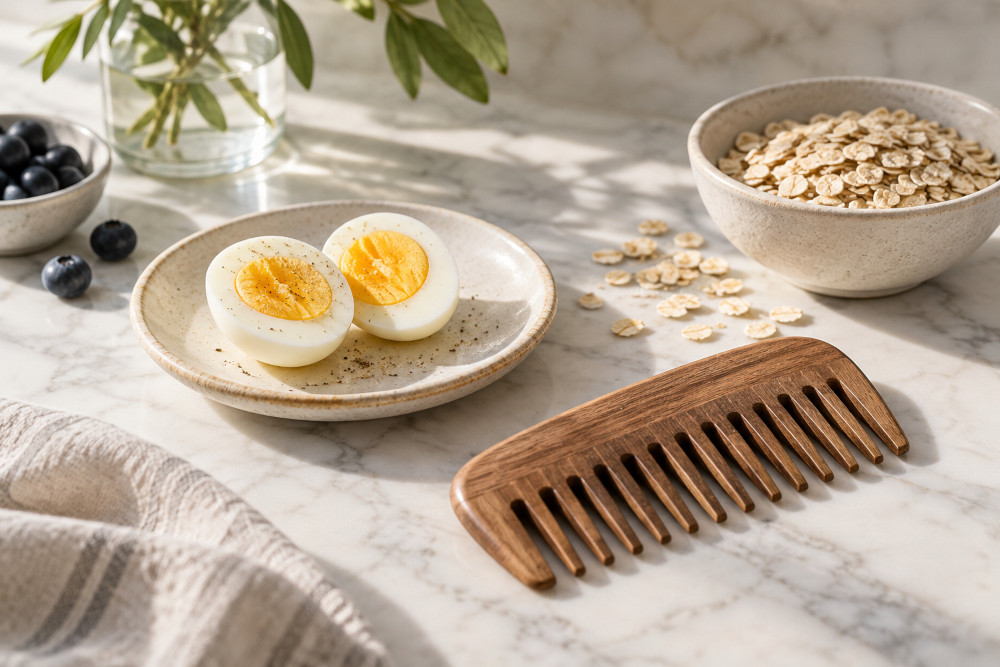
Dry hair and hair loss have a way of announcing themselves at the worst possible moment: in the bathroom mirror, first thing in the morning, with a tangle of strands coiled in the sink drain to drive the point home. Anyone who has run their fingers through hair that feels more like straw than silk knows the small jolt of alarm that follows — the quiet question of whether this is the beginning of something worse.
Most people respond the way the market has trained them. They cycle through shampoos that promise to stop shedding and stimulate growth, each more expensive than the last. They try the folk remedies that circulate endlessly online — ginger juice rubbed into the scalp, serums dabbed onto thinning patches — and often end up with an irritated, reddened scalp and the same amount of hair in the drain. In much of the Chinese-speaking world, the first answer to hair trouble is almost reflexive: black sesame paste and black soybean milk, consumed dutifully, bowl after bowl, for months. The usual result is a few extra pounds on the scale and a head of hair that carries on shedding exactly as before. None of this means food is the wrong lever; it simply means most people are pulling the wrong one.
Your hair reflects the internal health of your entire body
Hair is often described in traditional Chinese thought as the “surplus of the blood” — the visible overflow of the body’s internal condition. Modern physiology arrives at a strikingly similar conclusion from a different direction: hair is not a vital organ. When resources run short, the human body triages its biological assets. The heart, liver, lungs, and kidneys are supplied first, while hair follicles stand at the very end of the line. What you see on your head is, quite literally, a report on what your physical system could spare.
Three distinct failures most often show up in this conclusion. The first is raw undersupply. Hair fiber is roughly 90% keratin, a tough structural protein that follicles must assemble continuously from amino acids, essential vitamins, and trace minerals such as iron and zinc. Crash dieting, erratic meals, and picky eating all shrink the supply of raw material. A follicle that cannot obtain bricks cannot build a sturdy wall; the hair it produces grows thin, dry, and prone to splitting, and eventually the follicle simply downshifts into its resting phase and lets the strand go. Dermatologists call this diffuse, stress-and-deficiency-driven shedding telogen effluvium — hairs pushed prematurely out of their growth phase (anagen) and into rest (telogen), then shed in unsettling quantities two to three months after the initial trigger.
The second failure is an out-of-balance scalp environment. Chronic stress and habitual late nights disturb the endocrine system; the scalp responds by overproducing oil, which can clog sensitive follicles and drive the greasy, inflamed pattern known as seborrheic hair loss. Poor circulation compounds the problem because a follicle is one of the most metabolically active structures in the human body and quickly starves when micro-blood flow to the scalp weakens. The third failure is accumulated external damage. Every perm, every fashionable dye job, and every session with a scorching blow-dryer held too close strips away another layer of the cuticle — the overlapping, shingle-like scales that seal moisture and critical nutrients inside the hair shaft. Once the cuticle is gone, the strand loses water faster than it can be replaced, and no commercial conditioner can genuinely rebuild it. It can only be grown anew, from a well-nourished follicle.

Popular traditional remedies often fail to address root causes
Black sesame deserves its reputation as a nourishing, whole food. Traditional Chinese medicine has prized it for centuries as a tonic for the kidneys and liver — the organ systems classically associated with the vitality of human hair — and it does contain useful amounts of minerals, key B vitamins, and healthy fats. However, that last quality presents a significant catch. Sesame is, above all, an oilseed: roughly half of its total weight is pure fat.
For someone whose hair shedding is already driven by an oily, congested scalp, spooning down concentrated oilseed paste every single day can make the situation noticeably worse rather than better, feeding the very sebum overproduction that is suffocating the follicles. Furthermore, because commercial black sesame paste is usually sweetened with added sugars, months of faithful consumption tend to show up on the waistline long before they show up on the hairline. Black sesame is undoubtedly a good food, but it is not a definitive cure and is not suited to every individual. The essential nutrients hair most desperately needs come from entirely different dietary sources.
Nutritional science points toward eggs, lean meat, and seafood as optimal choices
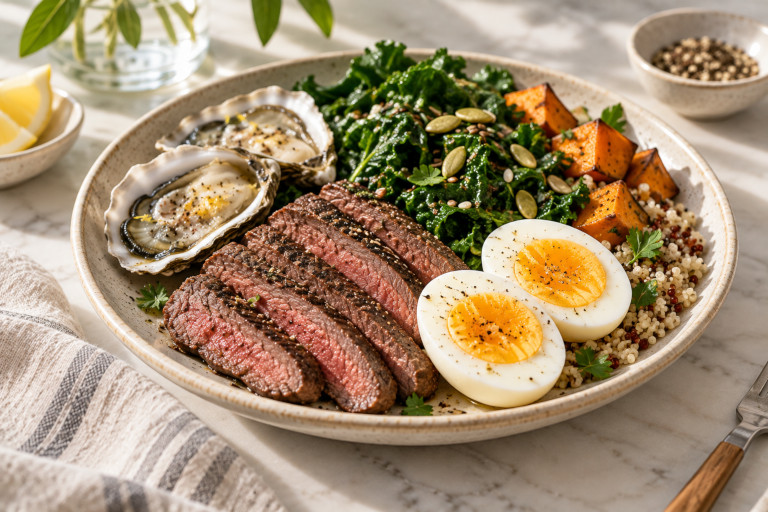
If hair fiber is built almost entirely of protein, the fundamental logic of feeding it is embarrassingly simple: provide the body with complete, highly absorbable protein alongside the specific micronutrients follicles burn through fastest. That points directly to a high-protein matrix of lean meats and poultry, deep-sea fish, and quality soy products — and at its center, the most affordable and practical pairing of all: whole eggs and lean red meat.
Eggs
Consider first the egg. Egg protein is widely regarded as one of the highest-quality natural proteins available, featuring an amino acid profile so closely matched to human physiological needs that nutrition science long used it as the reference standard against which all other dietary proteins were scored. Crucially for hair growth, eggs are rich in sulfur-containing amino acids — cysteine above all — that form the essential disulfide bonds cross-linking keratin chains together. Those molecular bonds are what give hair strands their tensile strength and elasticity; when sulfur amino acids run short, the cross-links weaken, and hair turns dry and brittle. A single boiled egg consumed each morning represents, in the most literal sense, a direct delivery of bricks to the biological construction site.
The egg yolk carries a second vital gift: biotin, also known as vitamin B7, one of the best-documented nutrients for hair and nail health. Biotin serves as an indispensable coenzyme in the metabolism of fats and amino acids — the exact biochemical processes that keratin production depends on — and a genuine deficiency reliably produces brittle, thinning hair and localized dermatitis. A single egg yolk supplies a meaningful share of the daily human requirement. One fascinating caveat belongs here: raw egg white contains a specialized protein called avidin that binds biotin so tightly the human body cannot absorb it, which is why people who habitually drink large quantities of raw egg whites have historically developed deficiency symptoms known as “egg-white injury.” Cooking denatures avidin completely, meaning the humble boiled egg is not just tradition — it is practical biochemistry done right.
Lean meat
Now consider lean meat, and with it the crucial mineral that hair loss research keeps circling back to: iron. Iron carries oxygen to every living tissue in the body, the scalp included, and it acts as a required cofactor for the enzyme that limits the rate of DNA synthesis — a cellular bottleneck that matters enormously in hair follicles, which contain some of the fastest-dividing cells anywhere in the human body. When systemic iron stores fall, follicles are among the very first tissues to experience the shortage. Clinical studies have repeatedly found that women suffering from diffuse shedding tend to have significantly lower serum ferritin — the standard medical marker of the body’s iron reserves — than women without hair loss, and extensive meta-analyses have firmly confirmed the association between low iron stores and telogen effluvium.
This is where lean beef and pork earn their prominent place at the table. The iron found in meat comes largely in heme form — bound directly into the same molecular structure that carries oxygen in blood — and the human body absorbs it at roughly 15-35% efficiency through a dedicated transport pathway that ignores most dietary interference. The non-heme iron found in plant foods, by contrast, is typically absorbed at only 2-20%, and its uptake is easily blocked by the tannins in tea and coffee or the phytates in whole grains. Gram for gram on the dinner plate, meat iron simply arrives where cellular hair machinery needs it far more reliably.
Seafood
For those who want to go further, the sea offers an exceptionally concentrated option: oysters and other shellfish deliver both heme iron and extraordinary amounts of zinc, a trace mineral essential for follicle cell division, in a form far more absorbable than plant sources. For plant-forward eaters, black beans, red beans, and other legumes remain excellent supporting players — genuinely rich in protein, iron, and B vitamins, best consumed alongside vitamin C-rich vegetables to unlock their less cooperative non-heme iron. Set against black sesame’s single-note richness in oil, the egg-and-lean-meat combination is nutritionally broader, widely available, endlessly variable in the kitchen, and carries no risk of tipping an oily scalp further out of balance. It is not exotic, and that simplicity is precisely its greatest virtue.
Healthy daily habits must protect the new hair growth that nutrition creates
No single food, however well chosen, restores a full head of glossy hair on its own; what diet builds from within, daily physical habits must protect from without. First, stop over-washing and overheating. Hair does not need daily scouring, as frequent washing with hot water and harsh surfactants strips the scalp’s protective natural oils and provokes severe rebound oiliness. Wash instead with comfortably warm water and a mild shampoo, keep the blow-dryer on a warm rather than scorching setting positioned well away from the scalp, and give chemical perms and dye treatments a long, restful hiatus. Every chemical and thermal insult the hair is spared represents precious physical cuticle preserved.
Second, go to sleep before eleven o’clock, and let the mind rest along with the physical body. Habitual late nights are among the most reliable biological accelerators of hair loss: they disorder the endocrine system, degrade micro-scalp circulation, and cut off the follicles’ nutrient supply directly at the root. Traditional Chinese medicine has long taught that late-night hours are when the liver and gallbladder systems renew the blood — the very blood of which hair is the visual surplus — and modern sleep science fully agrees that this is when deep systemic cellular repair runs highest. Unmanaged emotional anxiety carries its own severe penalty, acting as a recognized trigger for both patchy alopecia areata and diffuse stress shedding. Caring for the mind, it turns out, is an essential component of any valid hair-care regimen.
Third, round out the rest of your daily plate to support total nutrient absorption. Alongside regular eggs and lean meats, eating fresh vegetables and fruit provides natural vitamin C, which dramatically improves intestinal iron absorption. Furthermore, swapping a portion of daily white rice and refined flour for oats, brown rice, and mixed beans restores the full spectrum of essential B vitamins that polished grains have had milled away. Patience ultimately completes the prescription. Human hair grows roughly one centimeter per month, and a follicle recovering from months of severe nutritional undersupply needs time to demonstrate visible progress. The strands emerging today reflect the meals consumed and the sleep accumulated a full season ago. Feed the body properly, rest it thoroughly, and stop damaging what it produces — the report it files morning after morning in the bathroom mirror will gradually change its tone, proving that the true answer was never inside an expensive bottle, but on the breakfast table all along.
Follow us on X, Facebook, or Pinterest
