

Finding success and personal fulfillment is rarely about being flawless in every area of human effort; it’s a journey of recognizing and cultivating the specific talents you already possess. When we look at history and examine how remarkable individuals built their careers, we often discover that their achievements began not with comprehensive expertise, but with a single, unassuming strength that was recognized, nurtured, and relentlessly applied.
A humble encounter in Paris transformed a destitute young man into a literary legend
A classic story tells of a destitute young man who wandered into bustling Paris to seek out a close friend of his father, hoping to find a job that would let him scrape by in the great city. When the traveler arrived, his father’s friend asked: “Are you proficient in mathematics?” The young man shook his head sheepishly, admitting he lacked formal training. “How about history and geography?” the older gentleman inquired. The young man looked embarrassed and shook his head mechanically once more. “What about law?” As his father’s friend kept asking questions to gauge his qualifications, the young man could only shake his head blankly, despair gradually crossing his face as he realized how little he had to offer.
Seeing the youth’s despondency, the gentleman softened his tone and said: “Well, at least write down your address so I know where to find you. I really ought to help you find a job.” The young man wrote down his address in shame and turned to leave, believing his cause was entirely hopeless. Before he could reach the door, however, his father’s friend stopped him with a sudden realization: “Young man, you have beautiful handwriting — that is a strength of yours!” Astonished by the comment, the youth paused and asked: “Is writing one’s name well considered a strength?” He saw an immediate, affirmative answer in the older man’s eyes, and the older man insisted: “If you can write your name well, you are able to write beautifully enough to earn praise!”
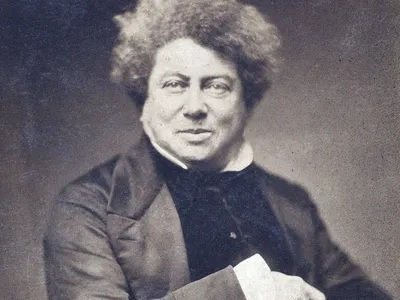
Encouraged by these unexpected words of praise, the young man walked away feeling lighter, more hopeful, and deeply inspired to pursue opportunities involving his pen. From then on, he built on this modest foundation, using his handwriting to secure clerical work, expand his knowledge, and eventually channel his creative energy into writing plays and novels. Years later, he produced literary classics that won worldwide acclaim and cemented his reputation across Europe. This young man was none other than Alexandre Dumas — a household name and a leading figure of French Romantic literature in the early 19th century.
Alexandre Dumas went on to write over a hundred novels in his lifetime, captivating readers across generations with his narrative flair and dramatic pacing. Most of his celebrated works were set against real historical backdrops and centered on the extraordinary adventures, rivalries, and triumphs of their protagonists. Characterized by intricate, vivid plots, clear structural design, and powerful, emotive language, his narratives stand as enduring masterpieces of the historical adventure genre. His most famous works, including The Three Musketeers and The Count of Monte Cristo, remain globally recognized classics. Starting with the basic ability to write his name beautifully, Alexandre Dumas gradually built on that foundation until he became a world-renowned author whose legacy endures today.
Modern organizational research demonstrates that sustainable success depends on leveraging core strengths
Gallup, the American analytics and advisory company, posits that, given specific external circumstances, individual success hinges on accurately identifying and fully leveraging one’s innate strengths rather than fixating on personal shortcomings. So, what are our true strengths, and where do our core capabilities lie? Grasping these foundational concepts is the necessary starting point and the ultimate key to achieving sustained success in any field. When individuals spend their energy developing areas where they naturally excel, they build confidence and mastery far faster than when they focus solely on remediating their vulnerabilities.
To understand how to apply your capabilities effectively, it helps to realize that human abilities can be categorized in various distinct ways based on how they function in real-world environments:
- Cognitive abilities: The capacity to learn, research, comprehend, generalize, and analyze complex information. This domain includes learning aptitude, long-term memory, abstract reasoning, and analytical skills.
- Social abilities: The interpersonal skills demonstrated during daily social interactions and collaborative work. This category encompasses verbal communication, active listening, organizational management, empathy, and social adaptability.
- Operational abilities: The capacity for physical manipulation, artistic creation, and precise movement. This includes manual dexterity, technical craftsmanship, spatial coordination, and athletic performance.
Observing your natural reactions and learning speed reveals hidden talents waiting to be developed
Discovering your true strengths requires careful self-observation and an awareness of how you respond to everyday tasks and challenges. There are several clear clues that point directly to your natural talents:
- Spontaneous reactions: The rapid, intuitive choices and responses you make when confronted with an unexpected situation or problem.
- Rapid learning: The extraordinary speed with which you pick up certain skills or grasp specific concepts compared to other topics.
- Eagerness and desire: A genuine, intrinsic motivation to engage with certain subjects or activities even when no outward reward is promised.
- Deep satisfaction: A sense of psychological fulfillment, pride, and energy upon completing a task, rather than feeling drained.
- Attempting challenging tasks: A natural willingness to push boundaries and test your limits within a specific domain.
While you actively leverage your existing, obvious strengths to achieve success, be careful not to overlook the latent abilities just beneath the surface. By consistently taking on tasks and activities that challenge you and unleashing your full potential, you can achieve remarkable results that far exceed your initial expectations. Unlocking these hidden reserves often requires stepping out of your comfort zone, but the rewards — both in performance and personal growth — are well worth the discomfort.

Unused talent remains valueless until it is actively applied to meaningful goals
Once you have discovered your strengths, you must know how to utilize them effectively within your personal and professional life. Otherwise, those talents go to waste and hold no practical value to you or society. Think of a raw diamond: if it lies hidden at the bottom of the ocean, it is functionally no different from scrap metal or an ordinary pebble. Only when it is retrieved, carefully cut, and put to functional use does its true value, brilliance, and worth emerge for everyone to see.
Because time and energy are finite resources, you should devote far more effort to maximizing your greatest strengths than to compensating for every minor weakness. When job hunting or navigating career transitions, many people mistakenly fixate on their deficiencies, worrying about skills they lack while completely failing to see the unique value they bring to the table. Statistically speaking, very few individuals are either entirely flawless or completely devoid of merit. Most successful people excel in one or two areas and build their careers around those strengths.
Understanding your personal capabilities provides the essential foundation for long-term career planning
Therefore, you don’t need to constantly worry about your weaknesses or feel insecure about areas where you perform average work. The true key to career fulfillment and professional growth is to highlight your core strengths, refine them through deliberate practice, and place yourself in environments where those strengths are valued. In comprehensive career planning, acquiring a realistic understanding of one’s abilities is the most crucial aspect of self-awareness, providing the baseline for long-term achievement and lasting success.
Translated by Patty Zhang and reviewed by Laura Cozzolino
Follow us on X, Facebook, or Pinterest
