

Being born into a poor family inevitably limits a person’s horizons and resources. Yet many people who fail to get ahead end up blaming their parents. As the old saying goes: “One sigh can bring three years of poverty.” Rather than complain about your background, it is better to find ways to change yourself and break the cycle of poverty.
A person’s destiny may begin with the family, but it need not end there. For those born into poverty, some of the best ways to change their destiny are surprisingly simple.
Education: The lowest-cost path to success
Today, no matter how poor a family may be, you can still find opportunities to learn. If you cannot afford books, you can borrow them. If you cannot afford a lamp, you can borrow a candle. If you cannot afford tuition, you can seek financial assistance or accept help from society. From an economic standpoint, education remains one of the least costly paths to success.
Sun Kang of the Jin Dynasty loved reading from an early age, but his family was extremely poor. He had to work during the day, and at night, because the family could not afford oil for a lamp, he had little choice but to go to bed early.
One winter night, however, Sun Kang noticed light shining outside his window. He immediately got up, took his book, and began reading by the doorway. Snow had fallen, and its reflected light was bright enough for him to see the words on the page.
Years later, Sun Kang became a government official. The place where he had once studied became known as the “Hall of Reading by Reflected Snow.” His son, Sun Boyi, also advanced through learning and later served on the staff of the Prince of Poyang, the General of Agile Cavalry.

People often admire families that can boast of “three successful imperial examination candidates under one roof,” yet few think about the bitter winters such families may have endured before they prospered — the years when books were unaffordable and tuition was hard to pay.
Kuang Heng bored a hole through a wall so he could study by the light from his neighbor’s home. Li Mi hung a book from an ox’s horn so he could read while traveling. Su Xun did not begin studying seriously until middle age. All of them came to the same conclusion: persistent study can carry a person from obscurity to achievement.
If you have read a few books but have yet to accomplish much, do not be discouraged. Perhaps you simply have not read enough, or deeply enough. When you truly understand a book, wisdom can flow like a spring, nourishing your life and helping you glimpse the dawn of a different future. With each step forward, you draw closer to good fortune and happiness.
The more thoroughly you digest what you read, the stronger the stepping stones beneath your feet become. Then you can travel farther and leave poverty behind.
Filial devotion: Virtue accumulates blessings
Children raised in poverty sometimes say impulsively: “I wish I had never been born.” Others bitterly declare: “When I grow up, I will cut all ties with my parents.” They may feel that their parents’ poverty has ruined their entire lives.
The ancients, however, taught that among all virtues, filial devotion comes first. Honoring one’s parents can itself become an opportunity to change one’s destiny. When children remain devoted to their parents despite the hardships of an impoverished household, that devotion is especially precious and may bring them greater opportunities.

Zhu Yuanzhang’s family was desperately poor. When members of his family died, they could not even afford land in which to bury them. With no other choice, he went from place to place borrowing money. His filial devotion earned others’ respect and, over time, helped lay the groundwork for the support he later received when he raised an army.
Those familiar with Chinese history may also know the ancient practice of recommending people for government service based on filial devotion and integrity. A person widely recognized for honoring his parents might attract officials’ attention and gain opportunities to enter public service.
Mencius said: “Only by being filial to one’s parents can one be free from sorrow.”
Caring for one’s parents requires considerable time and energy, but it also accumulates blessings. Because you want your parents to live better, you will look for ways to earn more. You may learn to be more tolerant when conflicts arise within the family. By becoming known for filial devotion, you help establish good family traditions. When others recognize that devotion, more people may be willing to help you.
As another old saying puts it: “Those who follow the Way receive abundant help.”
Giving: Good deeds bring good returns
Some poor people go from place to place hoping others will give them assistance. Yet after receiving help from those who are better off, some fail to feel grateful. Instead, they take such assistance for granted: “You have so much money — why shouldn’t you give some of it to the poor?” Such thinking is misguided.
Those most worthy of help are those who know gratitude. True nobility often belongs to those who, despite living in poverty themselves, are still willing to help others. In today’s society, most people can spare a bowl of rice. The question is whether they are willing to give it.
A story tells of a young man from the countryside driving his ox to plow a field when he came across a small cart stuck in the mud. Without hesitation, he used his ox to pull the cart free.
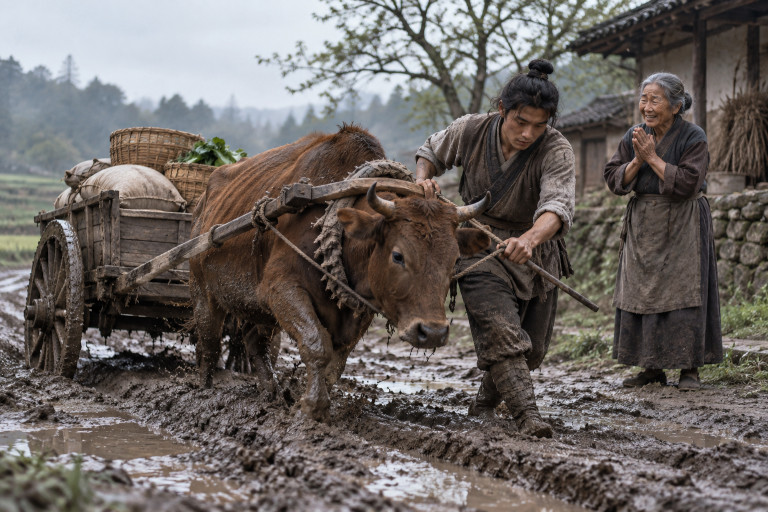
The owner, an elderly woman, asked: “How can I thank you?”
The young man replied: “There is no need to thank me. Just go and do two good deeds for someone else.”
A few days later, the young man’s wife went to the city looking for work and found a job at a small company. It turned out the elderly woman was the mother of the company’s owner.
Good deeds bring good returns. Cause and effect may not always be obvious, but what we do can return to us in another form. Share a little food with someone poorer than yourself. Do what you can to help people in difficulty, whether they are poor or wealthy. Life may bring you rewards you never expected.
An old Chinese saying goes: “The flowers planted with care may fail to bloom, while the willows planted unintentionally may flourish into shade.” When a person carries goodwill in the heart, even seemingly small or unplanned acts of kindness can bear fruit, and good fortune may arrive in unexpected ways.
Drawing on a parable in the Gospel of Matthew, American sociologist Robert K. Merton introduced the term “Matthew Effect” in 1968. The concept was later applied in many other fields, including discussions of socioeconomic inequality, to describe a tendency for advantage to accumulate while disadvantage deepens—the rich becoming richer and the poor becoming poorer.
But poverty is not only a matter of money. A person can also become impoverished in spirit. If you want to escape poverty, do not keep your eyes fixed only on money. Enrich your inner life as well.
Poverty is a condition, and it can also be only one stage of life. But if you insist on remaining where you are and continually label yourself as poor, even abundant opportunities may fail to change your circumstances. Being born into poverty is not the most frightening thing. What is truly dangerous is spending one’s life blaming fate and others.
Pick up a book. Love your parents. Care about the society around you.
Any of these can be the beginning of a better path.
Translated by Joseph Wu
Follow us on X, Facebook, or Pinterest
