

In ancient China, the scholar-official Fan Zhongyan once wrote: “Be the first to worry about the world’s troubles, and the last to enjoy its happiness.” This line, which has become a timeless expression of public service, captured Fan’s belief that true leadership means putting the well-being of others before oneself. He was admired not only for his moral integrity and political courage but also for his ability to recognize and promote talented individuals.
One year, Fan left the imperial capital on an official journey to Zhangjia Village in Luzhou Prefecture. His goals were twofold: to scout for scholars who might serve the court and to reunite with his sworn brother, Zhang Hao, whom he hadn’t seen in years. Enchanted by the tranquil countryside, Fan strolled through the village until he came across a run-down private school tucked beneath a large tree. Inside, the sound of students reciting their lessons rang through the air. Curious, Fan stepped closer — and was astonished to find Zhang Hao himself serving as the school’s teacher.
A chance to rise again
Fan stepped into the school. “Brother,” he said warmly, “do you still recognize me?”
Zhang Hao dismissed his students and looked closely. “Brother Fan! It’s been so long — how have you been?”
“I’ve just been promoted to Hanlin Scholar,” Fan replied. “And you?”
Zhang gave a weary smile. “I’ve been struggling. At least I can fill my stomach these days. That’s something.”
“With your talent, why haven’t you taken the civil service exams?” Fan asked.
“I’ve wanted to,” Zhang admitted, “but I haven’t had the money to travel and register.”
“Then listen,” Fan said. “The court is actively seeking capable people. Write a policy essay — something well-argued — and I’ll present it to the emperor myself.”
Zhang needed no more encouragement. As if divinely inspired, he immediately prepared his ink and brush and wrote a lengthy essay outlining national policy. Fan read it with delight. “This is outstanding! You’ll definitely be put to good use.”
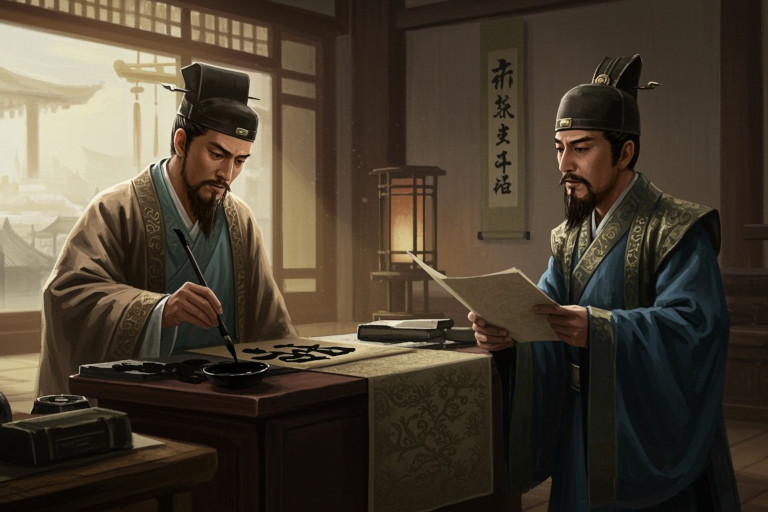
Concerned by the shabby state of Zhang’s school, Fan added, “You can’t stay here. I’ll write letters to three of my trusted friends. They’ll help you.” He handed Zhang three letters — one for a gentleman named Huang in Luoyang, one for a military official in Huangzhou named Liu Shilin, and one for the prefect of Yangzhou — before continuing on his journey.
Three destinations, three misfortunes
Two days later, Zhang closed the school, packed his belongings, and set out. His first stop was Luoyang — but when he arrived, he found a funeral in progress.
“May I ask who has passed away?” he asked a woman dressed in mourning clothes.
“My husband, Mr. Huang,” she replied.
Zhang sighed. “Truly, life is unpredictable.” With nowhere to go, he spent the night in a quiet temple.
The next day, he pressed on to Huangzhou. It was summer, and the heat was punishing. To conserve his meager funds, Zhang avoided stopping or spending. Upon arrival, he asked for directions to Liu Shilin’s home. A young monk pointed him toward a grand house — but was striking a large bell as he did so.
“What’s the bell for?” Zhang asked.
“It’s called the ‘bell of impermanence,’” said the monk. “We ring it when someone passes away.”
“Who died?”
“The vice commander Liu Shilin,” the monk replied.
Zhang was stunned. Two letters down, both recipients dead. As clouds gathered, he decided to rest at a nearby abandoned temple. Before he could reach it, the skies opened in a torrential downpour.
Frustrated, he muttered to himself: “This cursed weather!”
Inside the temple, he found a statue of the Dragon God and a container of fortune sticks. He knelt and prayed earnestly. “Please, Dragon God, help me. Grant me a sign of good fortune.” But no matter how many times he shook the container, he drew only the worst omens.

Furious, he hurled the divination blocks aside and shouted at the statue: “You scaled worm! Armored mudfish! You mock me? You think you can toy with me?” In his anger, he grabbed a brush and scrawled a bitter poem on the temple wall, blaming the god for his misfortune.
A divine warning
From the clouds above, the Dragon God stirred. “Such insolence!” he rumbled. “You suffer because of your fate, not because I failed you. Yet you curse me?” But moved by Zhang’s scholarly status, the deity chose not to retaliate directly. “Instead, I’ll give him a warning — may he come to understand that good and evil each bring their own reward.”
Meanwhile, Fan Zhongyan presented Zhang’s essay to the emperor, who was deeply impressed. He immediately appointed Zhang as a county magistrate. But a mix-up led to another man — also named Zhang Hao — being given the post. That man came from a prominent family and accepted the appointment, but his deception would not go unpunished.
Lightning strikes the stele
Back in the real Zhang Hao’s journey, he eventually arrived at Jianfu Temple, penniless and discouraged. The abbot noticed his gloomy face and asked: “Traveler, what troubles you?”
“I’ve run out of money and don’t know how to get home.”
“I have an idea,” said the abbot. “There’s a stone stele here with an inscription. Copy the text onto paper with ink, and I’ll send the copies out. We may raise enough silver for your journey.”
Zhang agreed. “But let’s wait until morning — it’s already getting dark.”
That night, a thunderstorm unlike any the monks had seen broke out. Lightning cracked through the sky and struck the temple stele, splitting the stone in two. The next morning, Zhang approached the stone — and saw new words seared into its surface: “This is punishment for slandering the gods.”
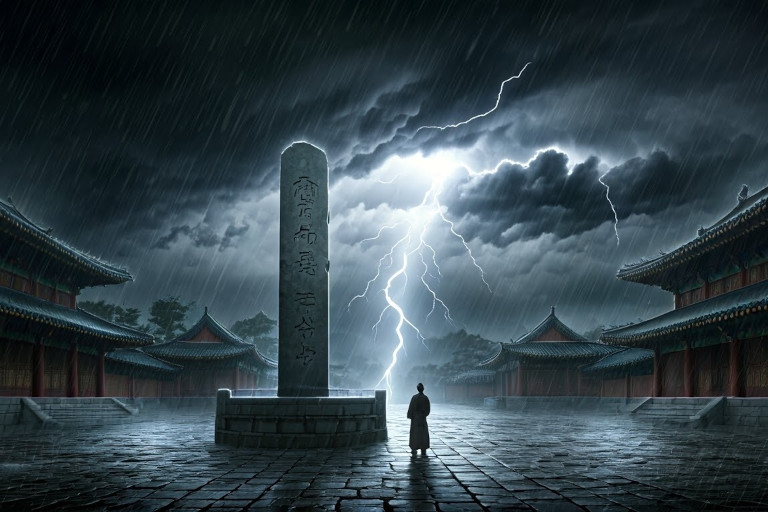
Shocked and humbled, Zhang fell to his knees. “Thank you, Dragon God, for your warning. I swear — I will never again blaspheme the divine.”
Zhang remained at the temple for a time, earning enough by doing calligraphy for donations. When he finally returned home, he resumed his life as a teacher — but now, he taught his students to honor the gods as well as the classics.
Justice and redemption
Eventually, Fan Zhongyan discovered the truth: the man appointed to office was not his sworn brother. He informed the emperor, and the impostor was sentenced to death for deceiving the court.
Fan traveled to Zhang Hao’s village and found him teaching with renewed purpose and humility. This time, Fan brought with him an imperial decree. Zhang Hao was finally appointed magistrate of Jiyang — and went on to marry the daughter of the prefect of Yangzhou, one of the very men Fan had originally written to.
Translated by Joseph Wu
Follow us on X, Facebook, or Pinterest
