

In the stories passed down through traditional Chinese culture, actions were never seen as isolated. What a person did — good or bad — would eventually return to them, often in ways they did not expect.
One such account appears in The Second Collection of West Lake Tales, a compilation of Qing Dynasty folklore. It is not a gentle story, but it was never meant to be. Its purpose was to warn.
A crossing on the sixth day
During the Qing Dynasty, a fisherman named Gong Zuan made his living on the Yangtze River near Zhenjiang, casting his nets around Jinshan and Jiaoshan.
On the sixth day of the sixth month, strong winds churned the river early in the morning. His boat was anchored at Guazhou Ferry when an elderly man appeared on the shore, carrying a long cloth sack slung over his shoulder. He asked for passage across the river.
Gong Zuan welcomed him aboard and took the heavy sack into the cabin.
Seasoned travelers usually kept their belongings close, especially if they carried valuables. But the old man did not know such precautions. When Gong Zuan lifted the sack, he immediately felt its weight. Seeing that the man was alone and elderly, a thought formed in his mind.
He rowed the boat out into open water, where the waves were rough, and no other vessels were nearby. Then he set down the oars, entered the cabin, seized the old man, and flipped him upside down — head down, feet up — before throwing him into the river.
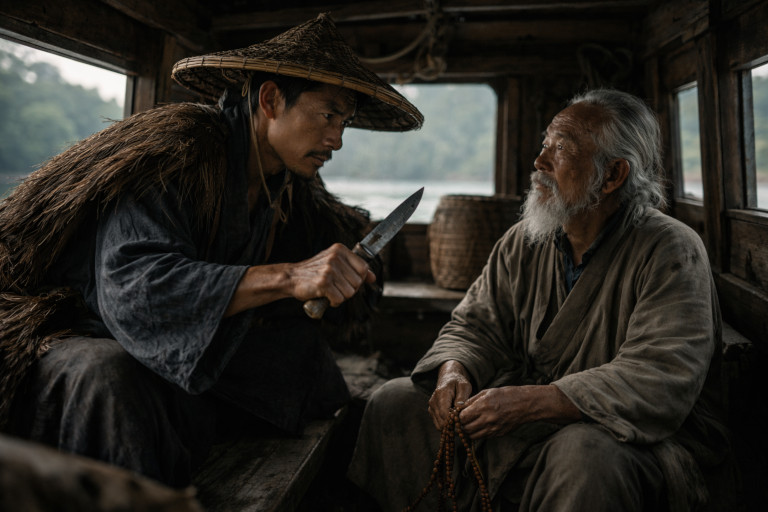
The old man drowned in the Yangtze that morning.
Sudden wealth
When Gong Zuan opened the sack, he found it filled with silver — large and small ingots totaling 200 or 300 taels.
He brought it home in secret and showed it to his wife. She was stunned.
After hearing what had happened, she did not recoil. Instead, she spoke of a dream from the night before — of being covered in filth and seeing blossoms form in the lamplight — signs she took to mean unexpected fortune.
“This is enough for us to live well,” she said. “You should make offerings and give thanks.”
Gong Zuan agreed. He went to the market, bought animals for sacrifice, fruits, and wine, and the couple offered thanks together. That night, they drank freely, their mood transformed.
In the past, they had lived in poverty and spoke little. Now, they laughed, poured wine for one another, and examined the silver piece by piece. Eventually, they fell asleep with the sack beneath their heads.
His wife, who had never conceived before, became pregnant that very night.
Gong Zuan soon abandoned fishing and began a new trade. His wealth steadily increased, and when their son was born, the household was filled with joy.
A household undone
Over the next 10 years, the family prospered. They accumulated thousands of taels of silver and bought a home on Fourth Street. Gong Zuan even adopted a new name — Gong Jichuan — and left behind his identity as a fisherman.
But after their son turned 10, his behavior began to change.
He became hostile and defiant, hurling insults — calling his father “old scoundrel” and “old dog” — while showing nothing but anger toward both parents.
As the years passed, his temper worsened. He threatened them with violence, brandishing knives and clubs. By his mid-teens, he had taken up gambling and frequented brothels, draining the family’s wealth.
Again and again, he shouted the same words — “I will kill this old thief to avenge this arrow’s grudge,” a bitter expression of vengeance his parents could not understand.

Day and night, the household was filled with shouting and conflict. There was no peace.
Gong Zuan considered reporting him for unfilial conduct — a serious offense at the time — but could not bring himself to act. He hoped his son might still change.
Instead, the situation only grew worse.
The truth revealed
One day, a neighbor invited a spirit medium who was said to be channeling Xu Zhenjun, a revered Taoist immortal known for answering questions with accuracy. Desperate, Gong Zuan went to consult him.
At the altar, he prayed silently: Why had he been given such a son, and would the boy ever change?
In response, four lines were written:
On the sixth day of the sixth month, the south wind blew fiercely;
In the Yangtze’s heart, one thought went wrong.
The old man’s grudge in the fish’s belly cannot fade;
The gold was never yours to claim.
Gong Zuan stood frozen.
When he returned home, he told his wife what he now understood — that their son was the reincarnation of the old man he had drowned.
From that moment on, everything fell into place.
When he looked at the boy, he thought he could see the old man’s face within his features — teeth clenched, voice filled with rage.
Overcome with fear and guilt, Gong Zuan and his wife abandoned their home and fled, leaving their son behind.
In time, the boy squandered what remained of the family’s wealth and died.
What the story leaves behind
The tale ends with a simple question: Was this a coincidence, or something else?
For those who told and preserved this story, the answer was clear. What had been done on the river had returned, only in another form.
Even small details in the story point back to that moment — the wife’s dream, which she mistook as a sign of fortune; the silver used as a pillow on the night their son was conceived; and the son’s repeated cry of vengeance for a “grudge” his parents could not understand.
The wealth gained that day did not bring peace. What was taken by force did not remain secure.
Stories like this were not meant to comfort. They were meant to be remembered.
Translated by Eva
Follow us on X, Facebook, or Pinterest
