
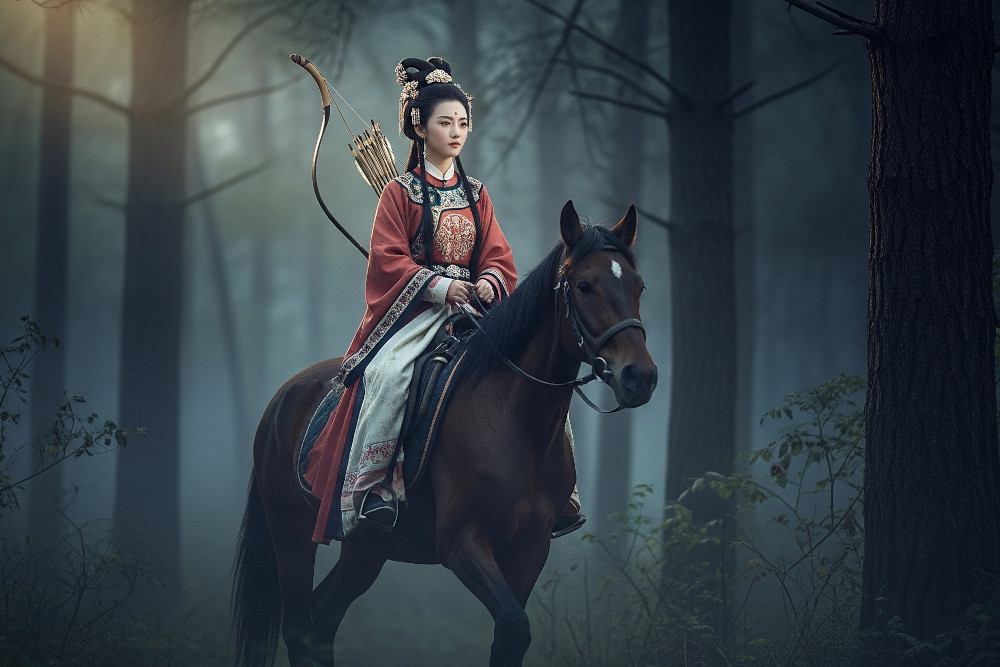
During the Qing Dynasty, a man surnamed Nie from Henan was wrongly accused of murder. After being tortured into a false confession, he narrowly escaped execution thanks to an honest and upright judicial inspector. The official worked tirelessly to investigate the case and eventually cleared Nie’s name.
Once released, Nie returned home and told his daughter, Shuer: “That official saved our family. From now on, your duty is to serve him. Protect him and his household — no matter what.”
The next day, Nie brought his daughter to the official’s residence. Kneeling respectfully, he explained: “Sir, your life-saving kindness is beyond anything I can repay. Please allow my daughter to serve you and your wife as a maid.”
The official, moved by Nie’s sincerity, agreed.
Enduring beatings in silence
Shuer quickly proved herself hardworking and cheerful. She was skilled at cleaning and serving, and her mistress grew fond of her. But when it came to needlework — a skill every young woman was expected to master — Shuer struggled. She constantly dropped her needles, and her stitching was sloppy. The mistress, who believed firmly in discipline and traditional women’s work, beat her daily as punishment.
Though the beatings left her bruised and humiliated, Shuer never protested. Remembering her father’s words, she lowered her head and endured in silence. “He saved us,” she thought. “I must not complain.”
When bandits attacked
Some time later, the official lost his position after being misled and blamed for a mistake. With no choice, he and his family prepared to return to their native Guangdong.
As they traveled through a dense forest one evening, a sudden flurry of arrows whistled from the trees. Panic swept through the caravan. The official turned pale. “It’s them,” he said, trembling. “The bandits.”

These were no ordinary thieves. The leader, Sai Zhangqing Liu Biao, was infamous for his deadly projectiles — small iron weapons he could launch five at a time with pinpoint accuracy. His second-in-command, Iron-Crutch Zhu Jian, had once shattered a stone drum at the temple gates with a single swing of his iron staff. Even local officers were powerless against them.
Servants fled. The mistress was frozen in fear. But Shuer stepped forward, calm and collected. “These scoundrels wouldn’t dare harm your carriage,” she said. “But if they do, I’ll deal with them myself.”
The official stared in disbelief. “You? You’re just a girl.”
“I may be a girl,” she replied, “but please — give me a horse.”
With no better option, he handed her the reins. In a flash, Shuer mounted and disappeared into the woods.
Unleashing her hidden strength
Facing the bandits, Shuer shouted: “Do you know who I am? Nie Shuer from Henan!”
The men burst into laughter. “We want silver, not little girls.”
“Fools,” she snapped. “Your lives are forfeit, and you mock me?”
The leader fired a projectile. With two fingers, Shuer caught it midair. A second flew — she grabbed it with her other hand. The third she bit between her teeth, grinning as if playing a game. A fourth projectile came, and she leaned back across the horse, catching it cleanly with her feet. When a fifth came, she kicked it midair, sending both projectiles clattering to the ground 30 paces away.
Leaping upright, she spat the projectile from her mouth. “Is that all you’ve got?”
A second bandit charged with a heavy iron staff. Shuer snatched it barehanded, snapped it into three pieces, then rubbed the metal until it softened like cotton. She tossed it aside. “Your mother’s firewood stick? Pathetic.”
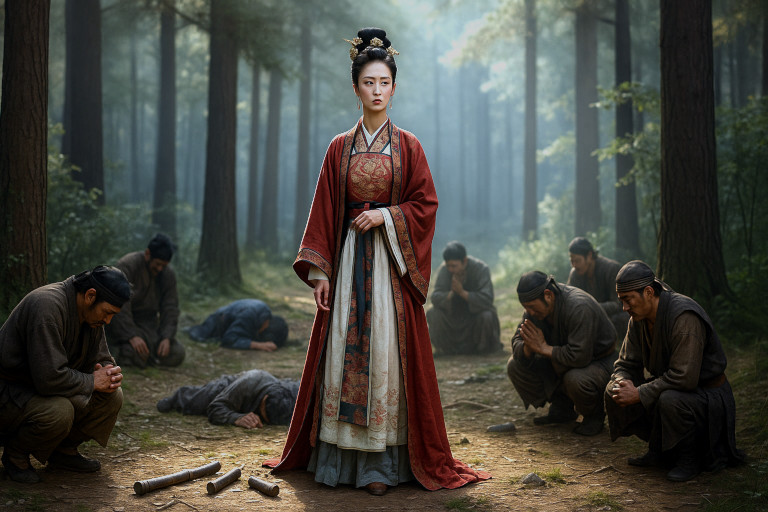
The bandits stood frozen in shock. Before they could react, Shuer drew her bow and fired two arrows — one left, one right. Both bandits dropped, slain instantly.
The remaining thugs fell to their knees, begging for mercy. “You’re not worth dirtying my hands,” Shuer said. “Be gone!”
She rode back to the caravan, calm and composed. The official and his wife were stunned.
“By your grace, the bandits have been dealt with,” Shuer said, then recounted everything.
“How could you possess such skill?” they asked.
“I’ve been training with spears and swords since I was a child,” she said with a smile. “Needlework, though — I never learned.”
The mistress asked: “Then why did you never complain when I beat you?”
Shuer replied: “My father told me to repay your kindness. If I lashed out, wouldn’t that be repaying gratitude with resentment? I could never do that.”
A legacy of courage
After returning to Guangdong, the mistress urged her husband to take Shuer as a concubine. Shuer later gave birth to a son, who grew up to become a magistrate in Yunnan. As an adult, he personally led constables into the mountains to capture bandits — just like his mother once did.
Nie Shuer possessed immense skill and courage, yet never showed off or demanded recognition. When danger struck, she acted without hesitation to protect others. She was the embodiment of traditional Chinese martial virtue — brave, loyal, and quietly powerful.
Translated by Joseph Wu
Follow us on X, Facebook, or Pinterest
