
At some point in 2023 — or was it 2024? — we collectively learned how to type the words “make me a landing page” into a box and receive back, in under a minute, a reasonable facsimile of a website. And then, for about four seconds, we were impressed.
Look at it! Big bold headline, purple gradient, reassuring “Get Started” button. Clean as a dentist’s waiting room. And then a few minutes later, someone else typed the same thing into a different AI box, and their page looked almost identical. The revolution arrived, but it all looked like Inter font on a white background.
This is the story of what happens after the initial magic. It’s a story about the difference between generic AI slop (a phrase only an exhausted designer could coin) and the strange, messy, idiosyncratic choices that make a website feel human. It’s about how designers like Meng To — founder of Aura, a tool that teaches AI to design less like a robot — navigate the uncanny valley of AI-generated creativity. And ultimately, it’s about what happens when the invisible systems that build our cultural surfaces are themselves built by invisible systems.
The manager, the programmer, and the prompt
Imagine three people in a room.
- The manager, freshly armed with LinkedIn buzzwords, says: “Can’t AI just build the website? I heard it can build websites now.”
- The programmer groans and adjusts their chair, muttering: “It’ll be HTML, but it’ll be cursed HTML.”
- The designer quietly pulls up Aura, a little tool they’ve been tinkering with, and says: “Watch this.”
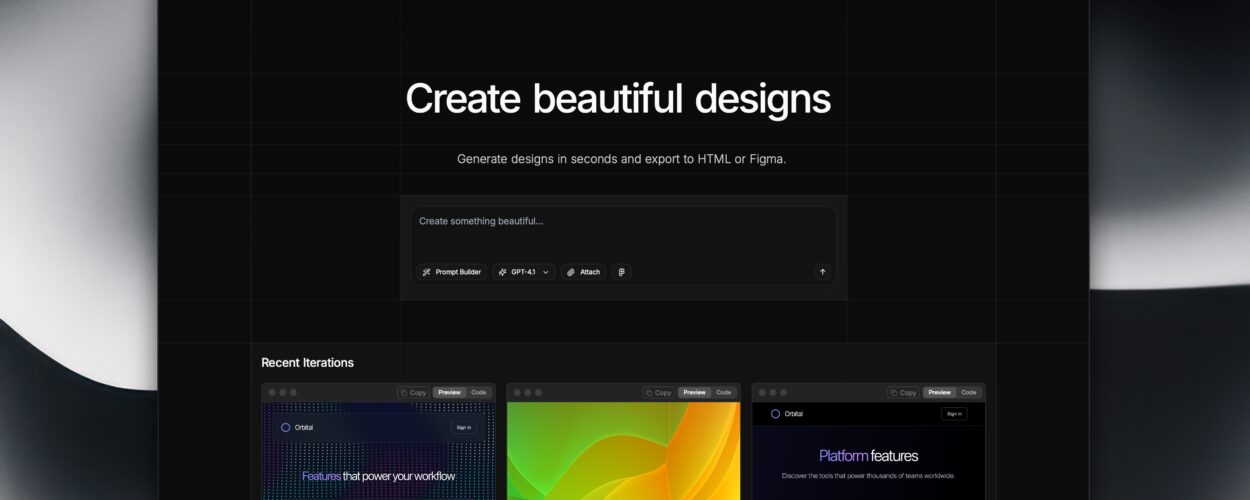
The designer types in a prompt: “Create a beautiful landing page for a new AI browser.” Seconds later, there it is: the Inter font, the purple gradient, the big bold headline. It’s the web equivalent of Ikea furniture — perfectly functional, aggressively beige in spirit. Everyone nods politely. But then the manager squints: “It looks… generic.” And there it is, the problem of our AI moment in one syllable: gen-er-ic.

AI as the new baseline
For decades, the “generic” website was an accident of taste and tooling. In the 2000s, we all used Arial because it came free with Windows. In the 2010s, we all used Bootstrap because no one wanted to hand-tune CSS ever again. Now, in the 2020s, millions of AI models trained on millions of Bootstrap-era websites regurgitate those choices back to us, polished and resized for mobile.
AI doesn’t just produce the baseline — it is the baseline. And when billions of people are pressing the same “make me a website” button, that baseline calcifies fast. Which is why designers like Meng To insist on the “last ten percent.”
That’s the part where you stop letting the model decide and start making the choices that, frankly, a computer has no reason to understand: the slightly off-kilter serif font, the hero image that makes no sense unless you know the founder grew up in Reykjavik, the animation that feels gratuitous but sparks delight. “Use AI for 90 percent,” Meng says. “But if you don’t take ownership of the last 10 percent, you’ll stay generic forever.”
The hidden characters: Fonts, shadows, and animations
Paul Ford once said that technology is just “the stuff that doesn’t quite work yet.” By that measure, web design is essentially a technology-driven field. Let’s personify some of the invisible forces here.
- Fonts are like actors — some endlessly versatile (hello Inter), others temperamental divas (looking at you, Instrument Serif).
- Shadows are stagehands: invisible when done right, distracting when they drop the set mid-scene.
- Animations are the jazz musicians in the pit: thrilling, risky, sometimes unnecessary, but unforgettable when they land.
Aura gives each of these characters their cues. Instead of typing “give me a cool button” and waiting 45 seconds for an AI to misinterpret your intent, you can browse a catalog of buttons like you’re at a farmers’ market. “Ah, yes, this one has the right drop shadow.” Copy, paste, remix. Suddenly, the invisible becomes visible, and the designer feels like they’re conducting, not begging.
The culture of templates
Here’s where things get sociological. Templates — whether in Figma, Unsplash, or Aura — aren’t just tools. They’re the cultural canon of design. Think of them as jazz standards. Everyone plays “Autumn Leaves” before they improvise. Everyone tries an Apple-inspired glass effect before they discover their own style. Templates embody the accumulated taste of the web: the collective decisions of thousands of designers, compressed into snippets of CSS.
AI, of course, has slurped all this up. Midjourney’s ability to spit out high-fashion portraits or abstract 3D flowers is possible only because human designers produced so much to begin with. Every AI button owes a debt to some underpaid UI intern circa 2016. When Meng To builds Aura, he’s essentially creating a curated jukebox of these cultural riffs, giving beginners a way to sound good fast without repeating the same Inter-plus-purple tune everyone else is playing.
The last ten percent is cultural work
Why does that last 10 percent matter? Not because end users consciously notice font weights or glass effects. Most won’t. It matters because difference is cultural currency. If every SaaS startup had the same website, investors would scream: “Commoditized!” If every personal portfolio looked alike, no one would get hired. If every e-commerce shop were built from the same AI prompt, shoppers would trust none of them.
The last 10 percent is what signals taste. And taste is the invisible institution that separates “generic AI slop” from “beautiful comet landing page.” It’s the same reason why a chef adds salt at the table, why musicians add an extra beat live, and why people still buy clothes instead of wearing identical jumpsuits. Human creativity isn’t about efficiency. It’s about wasteful, irrational, delightful choices.
Humor in the margins
There’s a cosmic joke here: AI promises infinite variety, yet delivers uniformity. It’s like hiring a jazz band and getting Muzak. Or, like asking your friend to “just surprise me” for dinner, and they hand you plain pasta because, technically, you didn’t specify a sauce.
The web is littered with these inside jokes. Every time a designer complains about “Inter font and purple gradients,” what they’re really saying is: “We’ve automated ourselves into a new Helvetica Hell.” And the truth is, AI doesn’t care. It will happily crank out a billion more Helvetica Hells because the machine is optimized for probability, not taste. Taste is irrational. Probability is boring.
The invisible labor of designers
To outsiders, AI-assisted design appears effortless: type a prompt, and you get a page. But insiders know the hidden labor. Every polished Aura demo hides dozens of discarded versions: the background that looked like a 1998 screensaver, the button that disappeared against the gradient, the animation that made the hero text unreadable.
Designers don’t just curate assets; they curate failure. They develop taste muscles by discarding what doesn’t work. That’s the work AI can’t (yet) do for you. And this is where Meng’s advice lands: Don’t give up after the first ugly output. Iterate, remix, adapt. The difference between “generic slop” and “this looks like Apple could have made it” is often just stubbornness and a sound template library.
What this means for work
Step back and you see the institutional consequences.
- For managers, AI promises faster websites, cheaper design budgets, and fewer freelancers. But they risk flooding the world with genericness — hardly a selling point.
- For programmers, AI-assisted design tools mean more “copy-paste this code” scenarios and fewer hours spent wrangling divs. But they also risk dealing with inconsistent, AI-generated spaghetti.
- For designers, AI is both a threat and an opportunity for liberation. The baseline is automated, which means they can spend more time on the cultural work of taste. But if they don’t, they risk being replaced by someone willing to accept the baseline.
In other words, the institution of design is being re-negotiated. The last 10 percent is the new job description.
Why it matters beyond websites
This isn’t just about websites. It’s about how AI reshapes every creative field.
- In writing, the baseline is a 500-word blog post with SEO keywords. The last 10 percent is voice, humor, and the choice of metaphor.
- In music, the baseline is AI-generated beats. The last 10 percent is the weird guitar squeal that makes the song unforgettable.
- In film, the baseline is a script with a three-act structure. The last 10 percent is the actor’s pause, the director’s cutaway shot.
Everywhere AI sets the floor, humans set the ceiling. The question is whether we’ll climb it.
The thoughtful twist
So here’s the irony: AI is supposed to free us from drudgery, but it turns out the “drudgery” was never the problem. Designers weren’t bored by buttons; they were bored by having no choice in buttons. Coders weren’t bored by HTML; they were bored by explaining to managers why the HTML couldn’t look like Apple.com in a day.
What AI really automates is the generic. And what it leaves us with is the work of difference. That last 10 percent? It’s not just design. Its identity. It’s what tells the world: This is us, not them.
Follow us on X, Facebook, or Pinterest
