

Picture this: It is Chinese New Year’s Eve, and a grandmother sits at a wooden table, carefully tucking crisp new bills into a red envelope adorned with gold characters. Later that night, she will press the envelope into her grandchild’s small hands, hold them gently, and whisper a blessing for the year ahead. That simple gesture, repeated in countless homes across China and throughout the Chinese diaspora, carries over a thousand years of love, protection, and hope.
The Chinese red envelope tradition, known as hongbao in Mandarin, is far more than a gift of money. It is a living expression of some of humanity’s deepest values: the desire to protect those we love, to honor our elders, and to pass blessings from one generation to the next. Whether you are preparing for your first Lunar New Year celebration, attending a Chinese wedding, or simply curious about one of the world’s most enduring cultural customs, this guide will help you understand both the rich meaning and the practical etiquette behind this beloved tradition.
The ancient origins of the red envelope
Like many of China’s most enduring traditions, the red envelope has roots in mythology. According to ancient folklore, a demon called Sui terrorized children on New Year’s Eve, touching their heads as they slept and causing fever, illness, and fright. Parents stayed up all night, keeping candles lit to protect their young ones.
One New Year’s Eve, a couple gave their child eight coins to play with, hoping to keep the child awake and safe. When the child finally fell asleep, the parents placed the coins on red paper beneath the pillow. That night, when Sui crept toward the sleeping child, the coins emitted a powerful golden light that drove the demon away.
Word spread quickly. The eight coins, it was said, were actually the Eight Immortals in disguise, watching over children. Families across China began placing coins wrapped in red paper under their children’s pillows on New Year’s Eve. The money became known as ya sui qian — literally “suppressing Sui money” — a wish that the child would be safe, healthy, and protected for another year.
The practice of giving protective money evolved gradually over centuries. During the Han Dynasty (206 BCE – 220 CE), people wore amulet-shaped coins as charms against evil. By the Tang Dynasty (618-907 CE), the imperial court scattered coins during springtime celebrations. The custom of giving children money during festivals became well established during the Song and Yuan Dynasties (960-1368).
It was during the Ming and Qing Dynasties that the practice began to resemble what we know today: coins threaded onto red string or wrapped in red paper. By the Republic of China era (1912-1949), families gave 100 coins wrapped in red, symbolizing the wish “May you live a hundred years.” Today, the coins have become paper bills, and the red paper has become the ornate envelope we recognize. But the core intention remains unchanged: a tangible expression of love, protection, and hope for the future.

The deep meaning behind the red envelope
In Chinese culture, the color red is far more than decorative. It represents fire, the sun, and the vital life force of yang energy. Red symbolizes happiness, prosperity, and good fortune. More practically, red was traditionally believed to repel evil spirits and negative energy.
According to another well-known legend, a fearsome beast called Nian (meaning “year”) terrorized villages at the end of each year. The villagers eventually discovered that the creature had three weaknesses: loud noise, bright light, and the color red. They used firecrackers, bonfires, and red decorations to drive Nian away, and these customs became central to Chinese New Year celebrations. The red envelope, then, is not simply a convenient container for cash. Its very color carries the weight of centuries of belief in red’s power to protect, bless, and bring good fortune.
Traditional Chinese culture views the red envelope primarily as a vehicle for blessings, not for wealth. The money inside is symbolic. The true gift is the intention behind it: the elder’s wish for the child’s safety, the parent’s prayer for a peaceful year, the family’s collective hope for health and happiness.
This is rooted in Confucian values that have shaped Chinese society for millennia. Filial piety, the deep respect between generations, flows in both directions. Elders bless the young through red envelopes, and younger family members honor their parents and grandparents with envelopes of their own. As a common saying goes, the importance of the hongbao lies not in the cash it holds. It is the envelope itself, and the love it represents.
Who gives and receives red envelopes?
Understanding who gives and who receives is one of the most important aspects of red envelope etiquette, and the rules may surprise those unfamiliar with the tradition.
- Married couples give red envelopes: Once you are married, you are expected to give red envelopes to unmarried younger family members, children of friends and colleagues, and your own parents and grandparents. Both spouses typically give envelopes separately rather than together.
- Unmarried adults receive red envelopes, regardless of age: If you are 35 and single, you are still on the receiving end during Chinese New Year. This can create some lighthearted (and sometimes awkward) moments at family gatherings.
- Employers give to employees: Small amounts in the workplace are a gesture of appreciation and good wishes for the new year.
- Children and students always receive particular attention: Gifts, particularly from parents, grandparents, aunts, uncles, and family friends.
There is one compassionate exception: if you have experienced a close bereavement within 100 days of the Lunar New Year, you are not expected to give red envelopes. The community understands and respects the period of mourning.
How much money should you put in a red envelope?
This is perhaps the most common question people ask about the Chinese red envelope tradition, and the answer depends on several factors: your relationship to the recipient, your region, and the occasion.
While exact amounts vary by family and region, here are widely observed guidelines in China:
- Your own children: 100-1,000+ yuan (US$15-$150+), depending on the family’s means
- Parents and grandparents: 500-2,000 yuan (US$75-$300), as an expression of filial respect
- Relatives’ children: 200-1,000 yuan (US$30-$150), based on the closeness of the relationship
- Acquaintances’ children: 50-100 yuan (US$8-$15)
- Employees or service workers: 50-500 yuan (US$8-$75)
For Chinese weddings, the amounts tend to be higher and are often chosen to help cover the cost of hosting your attendance at the banquet.
Chinese numerology plays a significant role in choosing the right amount. The general principle: even numbers are preferred, while odd numbers are associated with funerals and mourning.
- 8 is the most auspicious number: In Chinese, eight (ba) sounds like the word for prosperity (fa). Amounts like 88, 188, 288, 688, and 888 yuan are all excellent choices.
- 6 represents smooth sailing and good fortune: Numbers like 66, 166, and 666 are associated with wishes for everything to go well.
- 9 symbolizes longevity and lasting relationships: Therefore, 99 or 999 yuan is particularly fitting for weddings.
- 4 is considered deeply unlucky: This is because the word for four (si) sounds almost identical to the word for death (si). Never give amounts like 40, 400, or 444 yuan.
- Odd amounts in general should be avoided: These numbers are traditionally reserved for funeral gifts.
In Southern China, people tend to favor symbolic amounts like 88, 666, or 888 yuan. In Northern China, whole round numbers such as 100, 200, or 500 yuan are more common.

The etiquette of giving
There is a charming tradition that the bills inside a red envelope should be crisp and new, never wrinkled or worn. New bills represent a fresh start and show the recipient that you have taken special care with the gift. In the weeks before Chinese New Year, long queues form outside banks across China as people wait to exchange their old bills for fresh ones. Giving dirty or crumpled money in a red envelope is considered poor taste and shows a lack of thoughtfulness.
Knowing the etiquette of giving red envelopes shows respect for the tradition and the people you are honoring:
- Present with both hands: This is a fundamental gesture of respect in Chinese culture. Hold the envelope with both hands when offering it.
- Use only new, crisp bills: Old, wrinkled, or torn currency is considered disrespectful.
- Prepare extras: You may encounter unexpected guests or children at gatherings. Having a few additional envelopes ready shows generosity and thoughtfulness.
- Choose the right envelope: Red envelopes come in many designs. Select one appropriate to the occasion, whether it features New Year greetings, wedding wishes, or birthday blessings.
Receiving a red envelope carries its own set of meaningful customs:
- Accept with both hands: Receive the envelope just as the giver presents it. This reciprocal gesture shows mutual respect.
- Never open a red envelope in front of the giver: This is one of the most important rules. Opening it immediately would appear greedy and disrespectful. Wait until you are in private.
- Express gratitude verbally: A warm thank-you and well-wishes in return honor the spirit of the exchange.
- Children traditionally bow or kowtow: This is done to show respect to elders, though this formal gesture is becoming less common in modern families.
Red envelopes beyond the Lunar New Year
While the Lunar New Year is the most common occasion for red envelopes, the tradition extends to many of life’s most important moments:
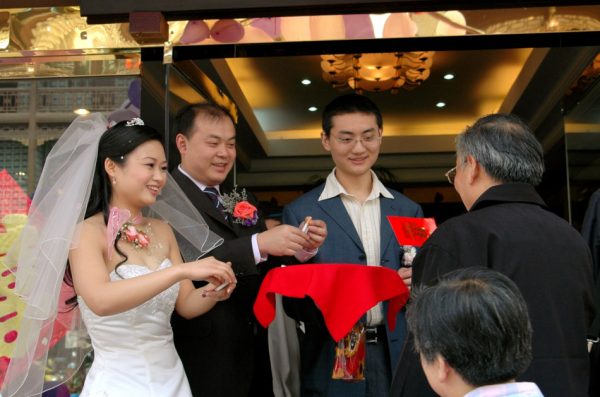
- Weddings: Weddings often involve the largest red envelope amounts. Guests give hongbao to the newlyweds as both a blessing and a practical contribution toward the celebration’s costs. The amount typically reflects your closeness to the couple and the cost of the wedding banquet.
- Birthdays: Milestone ages like 60 (symbolizing a full cycle), 70, and 80 are marked with red envelopes from younger family members to honor the elder.
- Births and “full moon” celebrations: One month after a child’s birth, these occasions feature red envelopes that welcome the new arrival and wish the baby health and prosperity.
- Graduations and business openings: This also calls for red envelopes, symbolizing new beginnings and best wishes for success.
- Funerals: White envelopes containing odd amounts are given to the bereaved family. It is important never to confuse the two, as the color and amount carry very different meanings.
From paper to pixels: The digital red envelope revolution
In 2014, WeChat introduced a feature that would transform a thousand-year-old tradition overnight: the digital red envelope. During that first year, 16 million digital hongbao were sent through the platform. By 2015, that number had grown to 1 billion.
The breakthrough moment came during the 2014 CCTV New Year’s Gala, China’s most-watched television broadcast. WeChat partnered with the show to let viewers win digital red envelopes in real time, introducing hundreds of millions of people to the concept in a single evening.
By 2016, over 32 billion digital red envelopes were exchanged during the Chinese New Year holiday alone, a tenfold increase from the previous year. On Lunar New Year’s Eve in 2024, WeChat users recorded approximately 5.08 billion digital hongbao transactions.
The success of WeChat’s innovation sparked fierce competition. Alibaba quickly added a similar feature to its Alipay payment platform, and the rivalry between the two tech giants during Chinese New Year became known as the “red envelope wars.” Both companies spent billions on promotions, subsidies, and partnerships to win user loyalty during the holiday season.
The rise of digital hongbao has sparked a meaningful cultural conversation. Some argue that the ease of tapping a screen reduces the personal warmth and thoughtfulness that comes with selecting an envelope, choosing new bills, and placing them carefully inside. The physical ritual, they say, is part of the blessing.
Others see digital red envelopes as a beautiful evolution. A grandmother in Beijing can now send a hongbao to her grandchild studying in London or Sydney in seconds, bridging thousands of miles with a single gesture of love. The tradition adapts and endures precisely because it is not trapped in one form.
The modern tension: When tradition meets financial pressure
While the red envelope tradition is rooted in generosity and goodwill, it has become a source of genuine financial stress for many in modern China. According to a 2023 survey of 1,000 young respondents, 93 percent feel pressured by the custom of giving cash gifts, with 51 percent reporting both financial and social pressure.
During wedding season, which runs from May through October, multiple invitations can arrive within a few weeks. Young professionals sometimes call wedding invitations “red bombs” because they can devastate savings. When combined with regional minimum amount expectations, the financial burden can become overwhelming.
Red envelopes have also been misused in more serious ways. Under China’s ongoing anti-corruption campaign, officials have scrutinized the use of hongbao as a discreet method of bribery. Digital red envelopes, sent via mobile payments, pose new challenges for monitoring because the transactions are private and instant. A Chinese financial website once published the minimum acceptable red envelope amounts by province, revealing enormous social pressure to give generously, regardless of one’s financial situation.
Not everyone is resigned to the financial pressure. In 2025, a practice called the “corner-folded red envelope” began gaining widespread attention on Chinese social media. Wedding guests fold the corner of a red envelope to symbolically accept the tradition’s goodwill and blessings while respectfully declining the cash inside.
The movement has resonated deeply, particularly with younger Chinese who want to honor the tradition without the financial strain. It represents something genuinely hopeful: a culture finding creative ways to preserve what matters most about a custom (the human connection and the blessing) while letting go of what has become burdensome (the escalating monetary expectations).
The enduring beauty of the red envelope
The Chinese red envelope tradition has survived for over a thousand years not because of the money it contains, but because of the values it embodies. At its heart, a red envelope is a wish made tangible: the wish that someone you love will be safe, healthy, and blessed in the year ahead.
Whether a grandmother carefully selects crisp new bills on New Year’s Eve, a tech worker taps “send” on a digital hongbao across the ocean, or a wedding guest folds the corner of an envelope in a gentle act of cultural reform, the core intention remains the same. It is an act of love, dressed in red.
In a world that moves faster every year, perhaps the most meaningful thing about the red envelope is its reminder to pause, to think of the people who matter, and to offer them something beyond words: a small, bright vessel of hope.
Follow us on Twitter, Facebook, or Pinterest
