
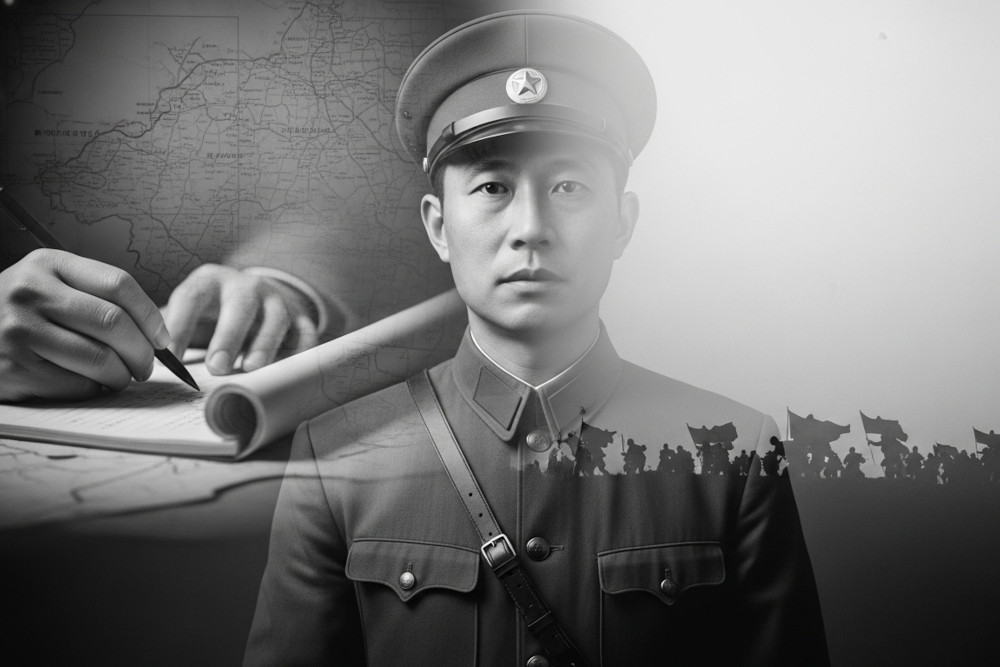
In 1945, as the smoke of the Sino-Japanese War cleared, China plunged into the vortex of civil war between the Nationalists and the Communists. The Nationalist government possessed a clear superiority in manpower and equipment. Yet, just four short years later, in 1949, Chiang Kai-shek retreated to Taiwan in defeat, while Mao Zedong ascended the Tiananmen Gate. A key factor in this reversal was the presence of multiple Communist spies occupying high-ranking positions within Chiang Kai-shek’s command structure.
Guo Rugui, one of Chiang’s most favored disciples and a top strategist in the Nationalist army, secretly delivered top-secret military intelligence to Yan’an, the Communist base. This action severely crippled Chiang’s final defenses in the southwest. As one Taiwanese newspaper later described his impact: “One spy undercover swayed the heavens; the outcome of the war was decided long before the final battle.”
Today, we delve into the story of this pivotal figure who caused Chiang Kai-shek such bitter regret: What were his original convictions? How did he endure decades of political turmoil under the new Communist regime?
Early idealism and political education
Born in 1907 into a scholarly family in Sichuan, Guo Rugui grew up surrounded by books and exhibited a strong sense of intellectual curiosity, but had a rebellious streak that found its outlet in reformist zeal. In 1919, influenced by the burgeoning May Fourth Movement, the young Guo became intrigued by socialism, viewing political activism as a crucial path to save the fractured nation.
This passion was initially channeled through student activism. Guo led a successful protest against Chengdu United Middle School’s traditionalist head teacher. But the subsequent chaos under the new, corrupt principal led to widespread disappointment among the students, who turned on Gao, forcing him to leave the school in disgrace. In his memoirs, he later expressed a sense of “inner turmoil and profound embarrassment,” acknowledging the unintended consequences of his early activism. However, Gao Rugui did not learn his lesson. Instead, he strayed further down the path of anti-traditionalism.
Rising star of Whampoa, Chiang Kai-shek’s favorite
In 1925, Guo Rugui passed the entrance exam for the fifth class of the Whampoa Military Academy, the start of a formidable military career. During this period, marked by the first KMT-Communist collaboration, Communist instructors profoundly influenced Guo and became convinced that their ideals offered the true path for national salvation.
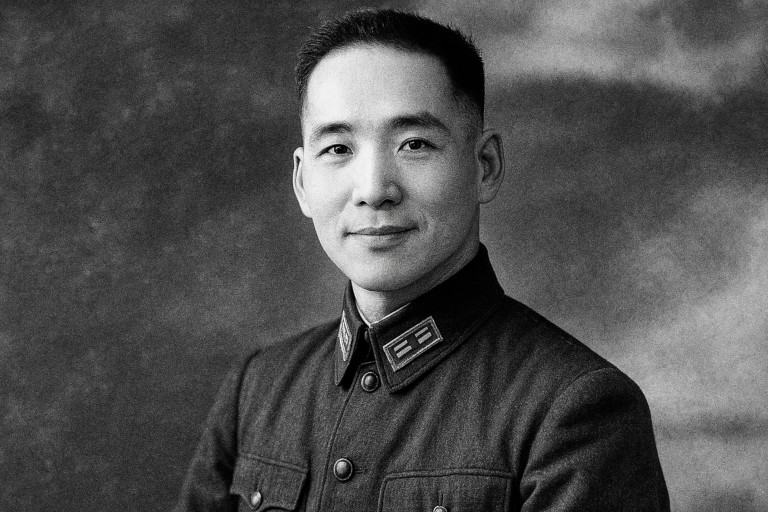
He secretly joined the Chinese Communist Party (CCP) through his Whampoa classmate and close friend Yuan Jingming. After the Nationalist purge of Communists in 1927, he attempted to mount several failed military uprisings and narrowly avoided revealing his part in the action. In 1930, to protect him, his cousin, Guo Rudong, arranged for him to study military science at the Japanese Military Academy. Guo lost contact with the CCP during this time. Outraged by the Japanese invasion of Manchuria in 1931, Guo left the Academy and returned to China. Through his cousin, he enrolled in the National Army University, where he became a direct student of Chiang Kai-shek.
His comprehensive training at Whampoa, the Japanese Military Academy, and the Army University forged him into the Nationalist Army’s “academic star general” — fluent in foreign languages, a master of military theory, and a respected instructor.
The Battle of Shanghai: Military genius recognized
In 1937, at the outset of the War of Resistance Against Japan, Guo Rugui served as Chief of Staff of the 14th Division under Chen Cheng and joined the Battle of Shanghai. During relentless Japanese bombing, Guo voluntarily led troops to defend a crucial line. His farewell letter to Chen Cheng expressed heroic resolve: “If the position remains intact, I shall return alive… If the position falls, I shall stain the battlefield with my blood.” For seven days and nights, Guo’s forces held the position, though at a tremendous cost. Of the eight thousand troops, only two thousand remained.
This heroic stand brought Guo Rugui overnight fame. Chiang Kai-shek and Chen Cheng took notice, and his career advanced rapidly. Before the Battle of Wuhan, Guo proposed a bold, effective strategy: “Hold Wuhan without fighting in Wuhan.” This meant trading space for time to wear down the Japanese forces, exhausting the Japanese advance, and preserving the Nationalist main forces — a testament to his genuine military acumen.
Hidden agendas: The revival of the undercover agent
Following Japan’s surrender in 1945, Guo Rugui, disillusioned by the deep corruption within the Nationalist general staff, renewed his search for contact with the Chinese Communist Party. The CCP, recognizing the immense value of such a high-ranking officer, sent representatives to meet with him. Dong Biwu, a leader in the CCP Southern Bureau, instructed Guo to remain inside the Nationalist forces as an “inside man” to feed crucial intelligence to the Communists.
Thus, Guo Rugui began his double life. By day, he served as Director of the Fifth Bureau of the Ministry of National Defense, a trusted confidant of Chiang Kai-shek, overseeing army organization. By night, he meticulously transcribed top-secret strategic plans. His diaries document hundreds of clandestine meetings. The intelligence he delivered included: the Shandong offensive plan, troop deployments in Xuzhou, the Yangtze River defense formations, and the overall command structure for Southwest China.
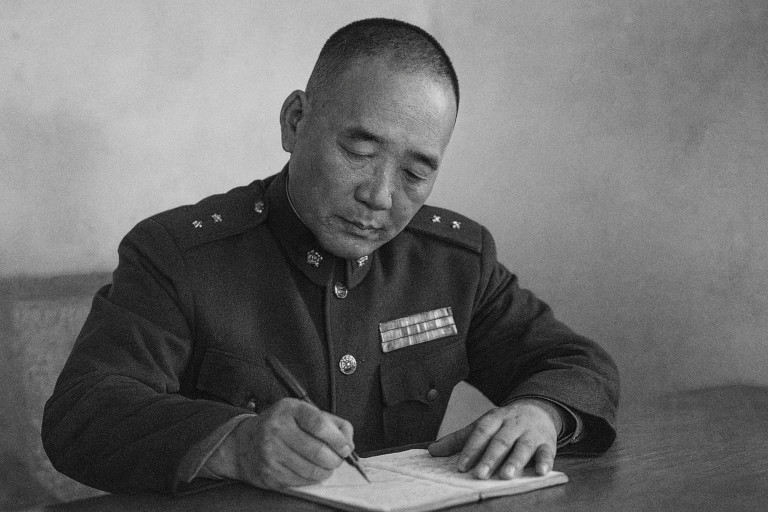
In 1947, before the Battle of Menglianggu, Guo Rugui copied the Nationalist Army’s operational plans for the Communists and even warned them to be wary of the firepower from American-made equipment. Armed with this intelligence, the Communist forces set up ambushes. They resorted to brutal tactics — using landlords, wealthy peasants, and families of Kuomintang (KMT) members as “human shields” to deplete Nationalist ammunition and demoralize their troops; a betrayal that contributed directly to the annihilation of the elite 74th Division and the death of its anti-Japanese war hero, General Zhang Lingfu.
Later, before the decisive Huaihai Campaign in 1948, Guo persuaded Chiang Kai-shek to engage in a battle near Xuzhou, which proved disastrous for the Nationalist forces and left them in a desperate situation. He Yingqin, one of the most senior generals of the KMT in Nationalist China and a close ally of Chiang Kai-shek, proposed the “defend the Huai to secure the Yangtze” strategy. But before Nationalist forces could move, Mao Zedong had already obtained the plans from Guo Rugui.
The renowned anti-Japanese general Qiu Qingquan was so enraged that he shouted at a meeting: “Your deployment is no different from Xiang Yu courting death at Gaixia!” Sure enough, Qiu Qingquan was killed in action, and the Nationalist forces suffered a crushing defeat.
The mask of integrity: Chiang Kai-shek’s blind trust
Guo Rugui’s commitment to austerity served as an effective cover for his clandestine activities. Guo not only leaked secrets but also sowed discord within the Nationalist ranks, orchestrating flawed deployments and spreading false intelligence. General Du Yuming once reported his suspicion of Guo to Chiang Kai-shek, noting Guo’s unusually frugal lifestyle for a high-ranking bureau chief. Chiang, who believed that frugality did not imply that Guo was a Communist spy, sent Chiang Ching-kuo to investigate covertly.
Chiang Ching-kuo’s surprise visit found Guo consuming only simple vegetarian dishes while diligently studying tactical plans. Deeply impressed, Chiang Ching-kuo reported that Guo was “as clean as a whistle — a model for all.” This report solidified Chiang Kai-shek’s faith, leading to Guo’s promotion to brigadier general in 1948, a fatal measure of trust.
The Yibin defection: Shattering the southwest dream
In 1949, the Nationalist forces suffered consecutive defeats in the Three Major Campaigns, prompting Chiang Kai-shek to plan a retreat to the southwest. Guo Rugui seized the opportunity, volunteering to lead troops into Sichuan. Chiang immediately appointed him commander of the 72nd Army, supplying ample weapons, ammunition, and veteran soldiers. Guo stationed his forces at Neijiang and Yibin, strategically blocking the Yangtze River waterway from the Communist advance. He placed loyalists throughout the army, securing firm control.
In December 1949, Guo defected to the Communists with his troops in Yibin. This defection irrevocably shattered Chiang Kai-shek’s final defensive plans in the region. Only then did Chiang, retreating to Taiwan, realize the extent of the betrayal by the man he had trusted the most.
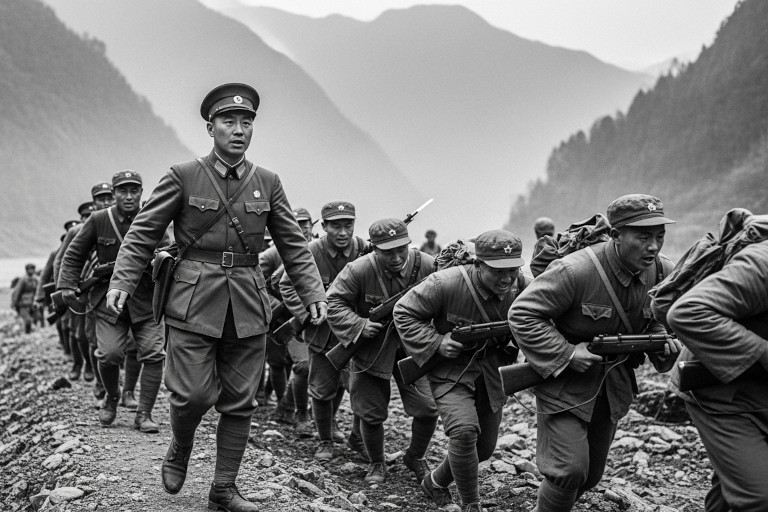
The bitter later years: An idealist purged
Despite the immense service rendered to the CCP, Guo Rugui was not given important responsibilities after the establishment of the People’s Republic of China. He was assigned the low-level post of Director of Transportation for the South Sichuan Administrative Office. When he sought to reinstate his party membership, the CCP required him to find his original sponsor to testify — but that person had long since passed away. In 1951, he was transferred to serve as an instructor at the PLA Military Academy in Nanjing. His status as a former KMT general meant he was never fully trusted, and from then on, he was caught up in every subsequent Communist Party campaign, becoming a “veteran of political purges.”
The 1957 Anti-Rightist Movement, part of Mao’s Hundred Flowers campaign, brought further suffering, including the ransacking of his home, public humiliation, and extreme hardship. His remarks advocating for “democracy and the rule of law” led to his being labeled a “rightist” and sent for reeducation. Many of his former subordinates who had joined the uprising with him — from division commanders down to squad leaders — were branded as “spies,” subjected to investigations, and executed in horrifying ways.
In 1979, at the age of 71, Guo Rugui was finally permitted to “rejoin the Party.” In his later years, he devoted himself to writing, publishing A History of Chinese Military Affairs and The Frontline Campaigns of China’s War of Resistance Against Japan.
These works objectively documented the Nationalist Army’s extensive contributions to the war against Japan. During the War of Resistance, the Nationalist Army fought 22 major battles, over 1,100 significant engagements, and nearly 30,000 minor skirmishes. The Air Force lost over 4,000 personnel and almost 2,500 aircraft.
In 1997, Guo Rugui died in a car accident while driving his daughter to the airport. After his passing, his son received several letters from his father’s old Army University classmates, each containing only a blank sheet of paper — a traditional gesture symbolizing the complexity of their shared past and the difficulty of articulating the painful emotions surrounding loyalty and betrayal.
Epilogue: The cost of conviction
Guo Rugui’s story serves as a tragic case study of idealism colliding with political reality. He believed betraying the KMT would bring a brighter future. He despised the KMT’s corruption, yet after the Communists seized power, corruption only grew worse. Despite his sacrifices, Guo was rewarded with suspicion, political isolation, and decades of persecution under the very regime he helped establish. His subsequent suffering — and that of his men — stood in stark contrast to the immense trust Chiang Kai-shek had placed in him.
Guo Rugui’s life illustrates the fate of countless undercover agents like him who committed their lives to Communism during the Chinese Civil War, only to be marginalized and crushed by the political purges that followed the victory.
Translated by Audrey Wang
Follow us on X, Facebook, or Pinterest
