

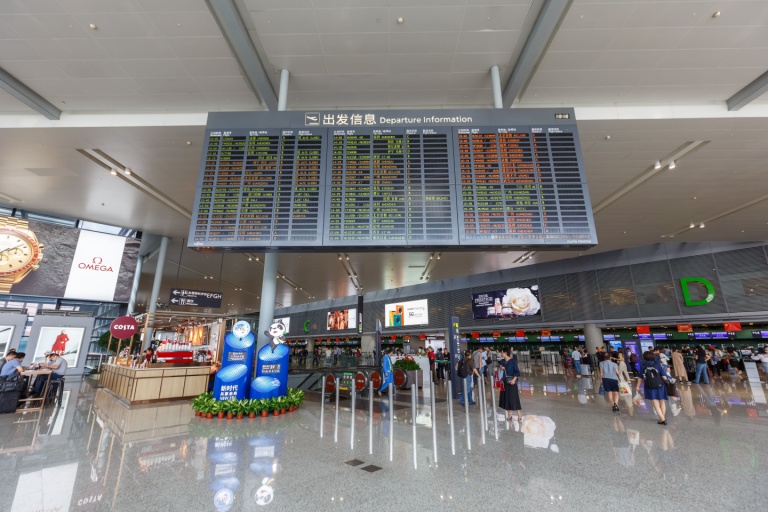
Every Lunar New Year, crowds surge through Pudong International Airport and the nation’s border checkpoints. On the surface, it appears to be a long-awaited rebound in tourism after the pandemic. Departure halls buzz with activity, duty-free shops gleam, and suitcases glide across polished floors in a steady rhythm. But beneath this picture of prosperity, a quiet, unsettling current flows — the need to escape for survival.
Independent commentator Hu Liren recently pulled back the veiled curtain. Data from Shanghai’s travel industry suggest that many high-spending travelers heading to Thailand this Spring Festival were not seeking sunshine or beaches. For a significant number, this “vacation” was far more deliberate — a carefully calculated exit. Travel is no longer about relaxation. It is about survival.
Thailand — from holiday haven to a modern ‘Noah’s Ark’
There was a time when Thailand was simply the most cost-effective backyard getaway for China’s middle class. Affordable luxury. Friendly smiles. A warm sea — and even warmer mango sticky rice. Today, it carries a heavier meaning. As relations between China and Western developed countries have deteriorated, visa barriers have risen sharply. Direct emigration to Europe or North America has become exponentially more difficult. In this climate, Thailand has emerged as an ideal “springboard” to escape.
Inside many of those suitcases lie not swimsuits or sunscreen, but evidence of liquidated assets and the documents needed to secure a new life abroad. Some purchase long-term residency programs, invest in property, or secure elite visas — establishing a foothold in Southeast Asia while quietly planning their next move to a third country. This is no spontaneous getaway. It is a one-way migration of escape.
A psychological turning point
The resilience of the Chinese people is widely admired. But resilience often rests on a quiet inner contract: As long as the economy grows, political rigidity can be endured. As long as tomorrow promises improvement, today’s grievances can be swallowed. For years, many in the professional and educated classes believed in a gradual path forward — that economic liberalization would eventually lead to political reform, and that the nation would one day emerge from “abnormality” toward a more modern and open trajectory. Reality has delivered a sobering blow to that hope of escape.
Instead of moving toward an open, modern civilization, the system appears to be tightening its grip. Reform has stalled, and in many ways, the country is accelerating backward — returning to the distorted, closed, and fanatical era of Mao Zedong. For many, this perceived historical reversal has shattered the middle class’s last psychological line of defense. And when hope shatters, something far deeper than comfort is lost.
Four hard realities in a system under strain
What drives people to leave is not only political pressure, but an economic unraveling. First, there is the issue of shrinking prosperity. As foreign capital withdraws and supply chains relocate, the high-income consumers who once sustained major cities are dwindling. In Shanghai, for example, it is not merely vacant storefronts that trouble observers — but vanishing confidence.
Second, there is the issue of education no longer guaranteeing security. Prestigious degrees have lost their protective power. Even graduates of elite programs struggle with prolonged unemployment or steep pay cuts, with some forced to deliver takeout just to survive. When education can no longer ensure stability — let alone upward mobility — the ladder of opportunity and survival is pulled away.
A third issue is that what was once the dream of home ownership has become a crushing burden. Real estate, once regarded as a near-sacred investment, has turned into a graveyard for wealth. In cities such as Shanghai and Hangzhou, sharp price corrections of 40-50% have wiped out vast amounts of household savings. Families who spent decades building assets now face heavy debt, and the security of the middle class has vanished almost overnight.
Finally, there is the reluctant return to the countryside. Big cities are no longer incubators of dreams, but relentless drains on people’s finances. For the unemployed, survival increasingly means leaving expensive urban centers and returning to ancestral rural homes. This is not laziness disguised as minimalism; it is a sober, calculated assessment of cost and sustainability.
A crisis of trust
Economic strain can be endured, but moral erosion cuts to the bone. Widespread concerns about counterfeit goods, rampant unsafe food products, and vanishing social trust have created an atmosphere of anxiety. When public institutions are seen not just as failing, but as tools for exploitation and plunder, fear spreads — subtle, unrelenting, inescapable. In this climate, leaving is no longer a luxury — it is instinct. Escape becomes a survival mechanism, a way to safeguard one’s future and that of the next generation. Not everyone leaves because they want more. Some leave because they want to breathe without fear.
The certainty of despair
Amid the macro trends of diplomatic isolation, increased political centralization and suppression of human rights, and an increasingly fragmented economy, the emotional spectrum of Chinese society has undergone a fundamental shift. In earlier times, uncertainty was the great fear — the sudden crisis, the unexpected shock that rattled life without warning. Today, what suffocates is not the unknown, but the certainty of despair. When people become convinced of the course the ship is taking, terror no longer flickers — it settles in, heavy and absolute.
A plane ticket to Thailand is no longer just a travel document. It carries a quiet, aching farewell to a homeland that can no longer promise safety or opportunity. For those who leave, the choice is painful but deliberate. Leaving is no longer about desire — it is a desperate grasp for even the smallest glimmer of hope.
Translated by Katy Liu and edited by Tatiana Denning
Follow us on X, Facebook, or Pinterest
