
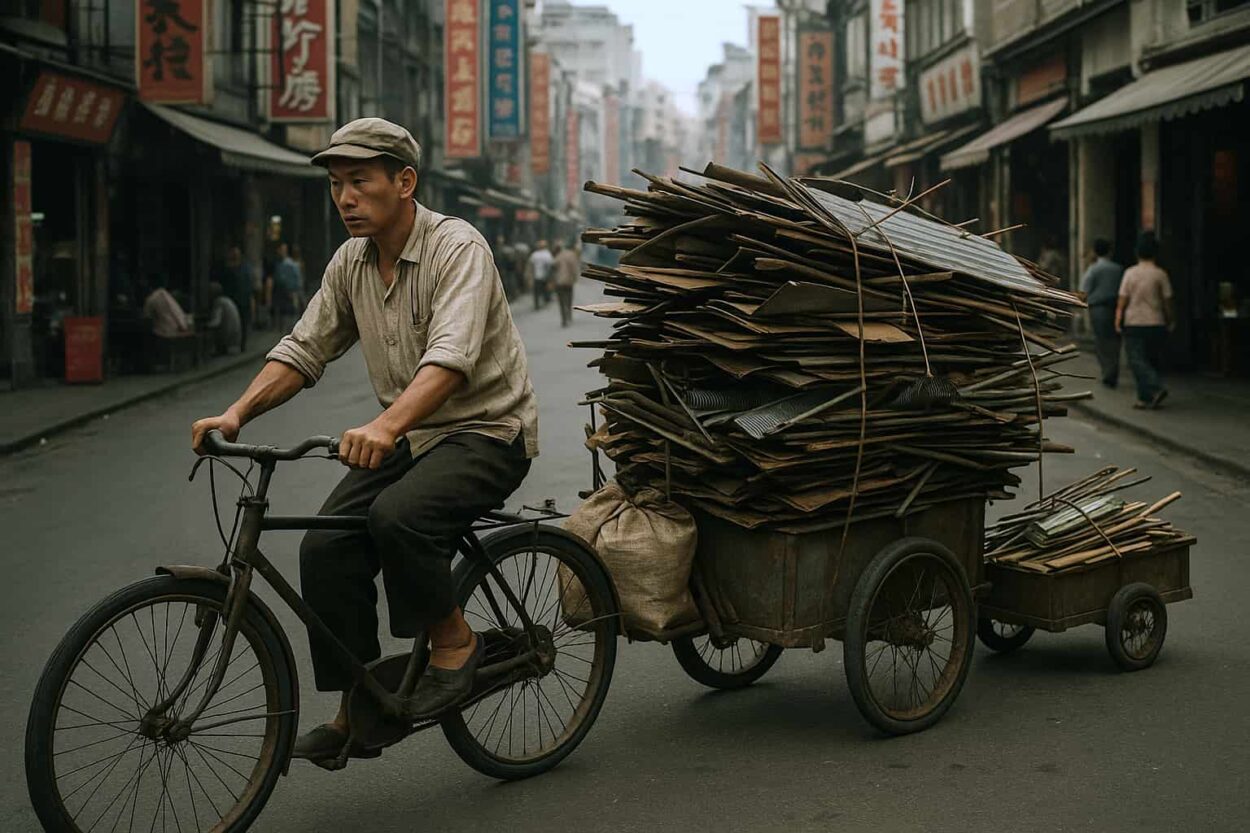
In ancient China, Wu Xun’s “begging to fund education” became a celebrated historical tale. Yet in Taiwan during the last century, a “modern Wu Xun” emerged — the venerable Mr. Wang Guanying.
The modern Wu Xun
Wang Guanying’s life was nothing short of legendary. Born in 1901 in Shandong Province, China — the same hometown as Wu Xun — he studied at a private school and developed a deep passion for traditional culture, particularly the Four Books and Five Classics. Later, amid strained Sino-Japanese relations, he joined the army. He started with fighting in the war against Japan, then participated in the anti-communist campaigns, spending half his life in military service. Finally, in 1950, he made his way to Taiwan.
Guiding away from Communist Ideologies
Upon arriving in Taiwan, his first act was anti-communist. He observed that Taiwanese people, at the time, had little understanding of the Communist Party or communism, nor could they clearly distinguish between friend and foe. Thus, riding a dilapidated bicycle and carrying his self-authored “Anti-Communist Three-Character Classic,” he began touring the island to spread anti-communist propaganda.
Publishing his first book
His book was simple and easy to understand, proving highly effective. Consequently, in 1950, the U.S. Information Service reprinted 20,000 copies for one dollar each, earning Wang Guanying a tidy sum. As everyone knows, 20,000 dollars in those days was no small amount, but he donated all of it to the impoverished people he encountered during his island tour.
Collecting scrap for a greater purpose
Later, to make ends meet, Wang Guanying took up a second job: collecting scrap and recycling resources. Like many veterans, he lived in an illegal structure. Each day, he pedaled his tricycle through what is now Taipei’s Ximending District gathering waste, enduring a life of extreme frugality.
Yet, Wang Guanying harbored a persistent dream. Though he had only completed elementary school, he never forgot the importance of education and traditional culture. He observed that Taiwan remained relatively poor at the time, with many families unable to afford their children’s schooling. Moreover, most adults had never had the opportunity to read books, resulting in limited literacy. He thus resolved to pursue a third endeavor: “promoting education.”
This goal, though, required money. Starting in 1955, Wang Guan-ying wrote sixteen characters on his tricycle: “Accumulate virtue through charity, nurture talent through education. Please donate waste materials — merit beyond measure.” He sold scrap daily, scrimping and saving every penny. By 1961, he had finally accumulated enough for his first educational initiative: donating books. He gifted over 300 books to the then-located Renwen Middle School in Xiluo, Yunlin.
Founding the Waste-to-Education Promotion Association
From that point onward, Wang Guanying steadily saved money, purchased books, and donated them to the libraries of numerous colleges. In 1966, he established the “Taipei City Waste-to-Education Promotion Association,” aspiring to found an institution that would give more people the opportunity to study. In 1968, however, Taiwan implemented the “Nine-Year Compulsory Education System,” enabling most children to attend school. Consequently, Wang Guanying decided to set up libraries instead and created the “Loyalty and Filial Piety Scholarship” to support young people from impoverished families in their studies.
In April 1978, Wang Guanying’s small library finally opened in a basement, housing over 12,000 volumes. He hoped more children and adults could gain access to books. Wang spared no expense in buying and donating resources while living in extreme frugality. To save money, he even refused to discard moldy food.
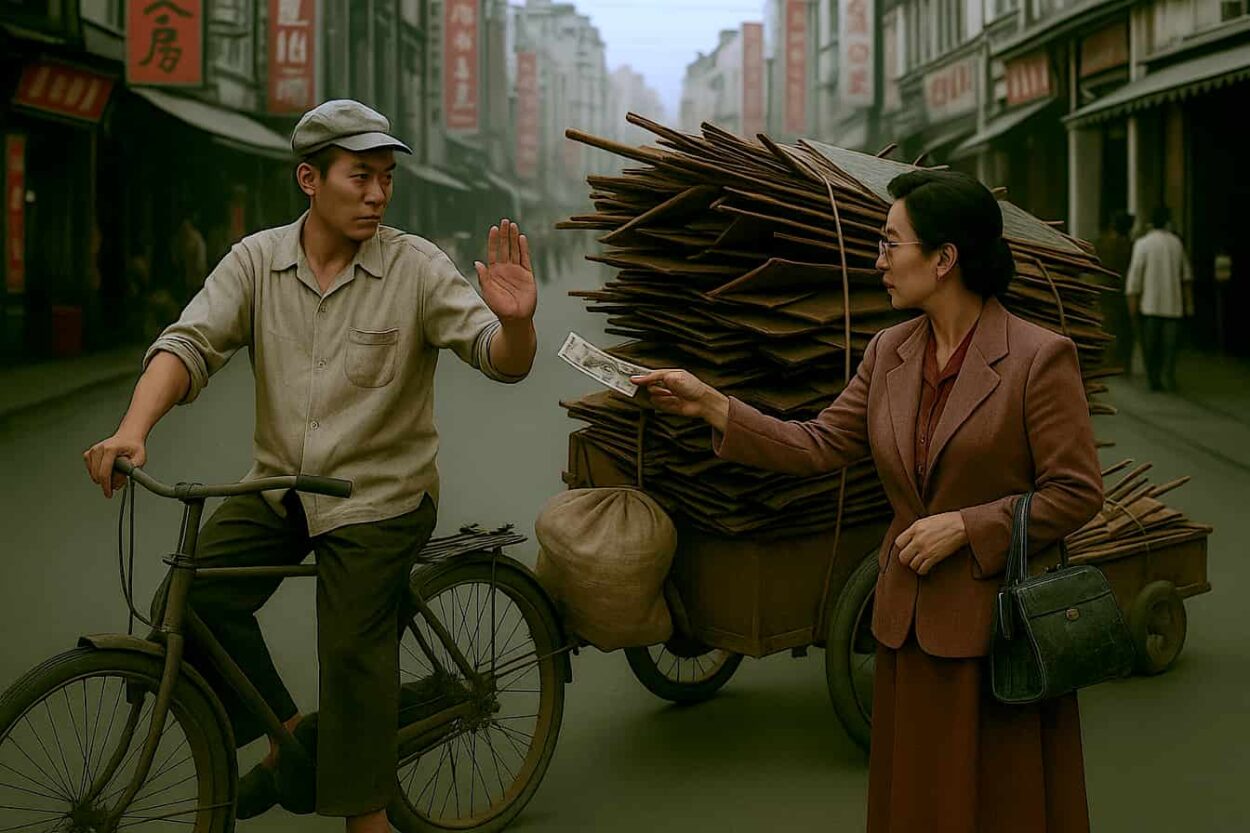
Once, a woman stopped Wang Guanying on the street, trying to press a hundred-yuan note into his hand to support his book donations. But Wang pointed to the sign on his tricycle bearing the four characters “Waste to Education” and smiled as he politely declined her kindness.
On his cart, Wang also inscribed eight characters: “Waste-to-Elderly Education, Dedicated Cart for Advanced Learning,” declaring his life’s grand aspiration.
Wang not only delivered books to schools, but also donated to institutions like the Confucius Cultural Foundation in the United States, St. John’s University in New York, and the Sun Yat-sen Memorial Hall in Taiwan. What books did he donate? You’d never guess — primarily works like the Comprehensive Mirror for Aid in Government, the Twenty-Five Histories, the Thirteen Classics with Commentaries, and the Kangxi Dictionary. These are relatively obscure texts. He explained that precisely because they are niche, they represent the essence of Chinese culture.
Creating ripples in society
Wang Guanying’s noble deeds garnered widespread societal support and attention. Many people began donating books to his library, and Wang Guanying was honored with titles such as “National Model Citizen for Good Deeds” and “Honorary Citizen of Taipei City.” In 1996, then-President Lee Teng-hui presented him with a plaque inscribed with the words “Diligence and Frugality Promote Education.”
In 1990, Wang Guan-ying ceased collecting due to his declining health. By 1997, he had been admitted to a nursing home, leading to the closure of his library. President Lee Teng-hui and his wife personally visited him at the facility. Wang passed away in December 1998 at the age of 97. His passing drew widespread condolences across Taiwanese society, with prominent figures from both the Kuomintang and Democratic Progressive Party — including Lien Chan, Sun Yun-suan, Chen Shui-bian, and Ma Ying-jeou — attending his memorial service.
A lasting memory of greatness
In 1999, to commemorate Wang Guanying’s lifelong philanthropic endeavor of “building education from waste,” the Taipei Public Library renamed its Guting Branch as the “Mr. Wang Guanying Memorial Library.” This ensures the spirit of “modern Wu Xun” — dedicated to supporting education — will endure forever.
Key Words: Wang Guanying, library, Wu Xun, donate, education, school, poor families, communism, anti-communism, waste, waste-to-education, frugal, Wu Xun, scrap collection,
Translation by Audrey
Edited by Laura Cozzolino
Follow us on X, Facebook, or Pinterest
