
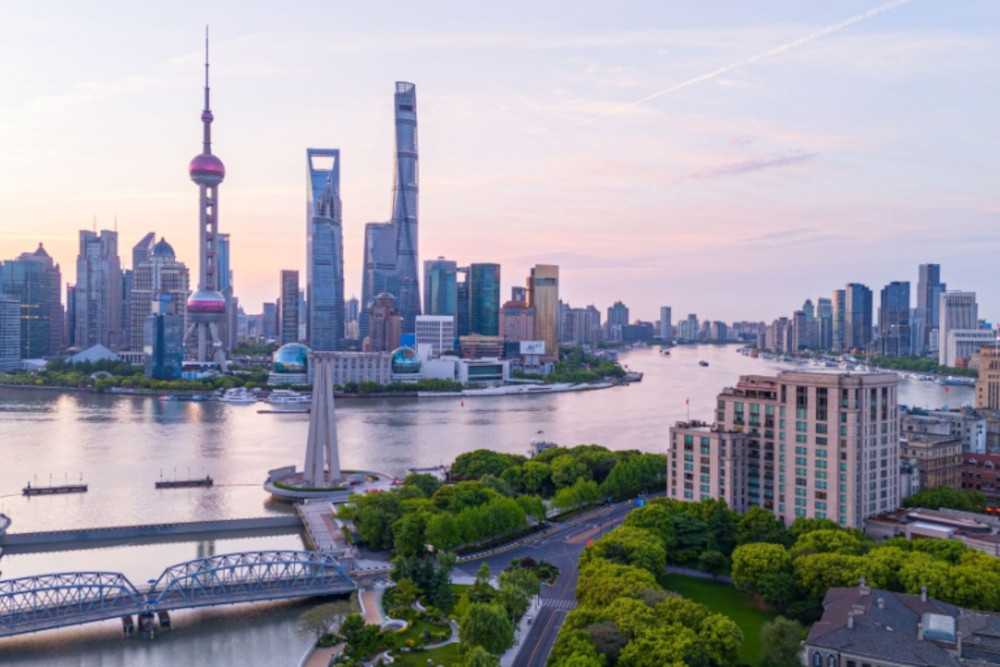
Shanghai was once China’s window to the world — cosmopolitan, confident, ambitious. Foreign companies filled gleaming office towers, international schools flourished, and young professionals felt they were living in the country’s most promising city. But since the pandemic lockdown and the enforcement of the National Security Law, the city that symbolized China’s rise has entered a deep decline. Foreigners have departed, companies have withdrawn, and many locals have moved overseas. What remains is a city marked by recession, unemployment, and shuttered storefronts.
Cao Peng, a white-collar professional who worked in Shanghai for more than twenty years, witnessed this transformation firsthand. His own life mirrored the city’s trajectory: he went from a comfortable middle-class career to becoming a political dissident targeted by the authorities. Earlier this year, he fled China.
How a promising career began to unravel
Cao Peng is originally from Jiangsu Province. Although he scored above the undergraduate cutoff on the college entrance exam, his parents insisted that he enroll in the Jiangsu Police Academy. He disliked political courses but excelled in English and physical training. After graduating, he was assigned to a local branch of the Taizhou Public Security Bureau. While taking statements each day, he noticed that the police chief consistently favored wealthy individuals. Disillusioned, he soon resigned.
Seeking a fairer environment, he studied at Shanghai International Studies University and later entered the world of foreign-invested enterprises. He said he came to Shanghai because it was still “a place where people were more or less reasonable,” and because Western companies treated their employees humanely.
His initial salary jump reflects how transformative that environment felt. He went from earning 1,300 yuan a month — about US$185, barely enough at the time to rent a shared room — to earning 3,000-5,000 yuan (US$425-700), which in early-2000s Shanghai felt like moving from subsistence-level work to a solid entry-level corporate job with a stable future. The five-day work week alone made him feel, in his words, “like a real person.”
His final position was at the French company Aden Services, where he worked for six years. The monthly salary exceeded 20,000 yuan (about US$2,800), and benefits included over 400 yuan per day in hotel allowances for business trips, as well as meal and taxi reimbursements. For a white-collar worker in Shanghai at that time, this combination of income and benefits provided an unusually comfortable standard of living.

Foreign companies begin to collapse
That era is now gone. Cao Peng explained that when he was at the Aden Group from 2019 to 2021, the company occupied three floors and employed more than 100 foreign staff. When he recently contacted a former colleague, he was told that only about 10 foreigners remained. Ninety percent had left.
The French owner, who had operated in Shanghai for two decades, is reportedly struggling to keep the company alive. His funds have been steadily drained, and he even returned to France to sell property to cover financial losses in China. Whether the business can survive is uncertain. Many foreign firms are already shifting operations to Southeast Asia, where the political climate is less hostile and the economic outlook is more stable.
Technology theft and political interference
Cao Peng believes European and American companies are withdrawing for two reasons: technology theft and political control.
According to him, the people foreign firms interact with today are far less open or cooperative than those they met in the early 2000s. Many, he said, join Western firms specifically to learn advanced technologies before joining companies like BYD, Huawei, or SMIC. If foreign companies do not agree to transfer technology, competitors attempt to obtain it through employee turnover.
Political interference further complicates operations. Foreign companies in China have their networks monitored, phone calls and emails intercepted, and recruitment influenced by internal Party committees. If a Party branch cannot be established, authorities pressure companies to appoint HR managers who reliably favor politically compliant candidates.
“Under these conditions, the values guiding hiring in foreign companies are no longer reliable,” Cao Peng said. “There is nothing to be optimistic about. The wisest choice now is to reduce contact. A foolish dictator runs the country.”
A city consumed by recession
Shanghai’s strict lockdown and national security policies have reshaped daily life. Entire districts once filled with shoppers and restaurants have grown empty. Cao Peng recently drove to Chuansha and Zhoupu, former commercial hubs. A mobile phone shop owner told him that the street once hosted 37 or 38 phone stores. Now only five remain; two plan to transfer ownership, and two are preparing to close.
Restaurants that once required reservations now sit half empty. Residents who remain in Shanghai live frugally, often surviving on discounted vegetables, two eggs, and a bowl of rice — meals costing about US$0.50-$0.70. The lively atmosphere that once defined the city has vanished.

Middle-class retreat and intensifying job competition
The recession has forced middle-class families to drastically reduce spending. Dining out has shifted from weekly to monthly. Children have left international schools for public ones. Seasonal clothing that was once replaced each year is now worn until it falls apart. Vacations to Japan, South Korea, or Southeast Asia have replaced trips to Europe. Plans to purchase luxury cars such as Mercedes or BMW have been abandoned in favor of keeping older BYD or Volkswagen models.
For migrants who came from other provinces, life has become even more difficult. High-quality jobs are scarce, and hiring practices increasingly favor fluent Shanghainese speakers. As higher-paying positions disappear, residents now compete with migrant college graduates for jobs paying only 10,000-20,000 yuan (US$1,400-$2,800). For comparison, these salaries once represented respectable white-collar earnings; now they are the last remaining foothold into middle-class life.
Many newcomers are left with only “007” jobs — working around the clock — or physically demanding “triathlon” work: food delivery, courier routes, and ride-hailing.
A growing number of Shanghainese, especially the wealthy, are moving abroad to Tokyo, Singapore, the United States, and Europe. They are not the lower classes, Cao Peng emphasized, but upper-middle-class families taking significant wealth with them.
Part 2 continues the account, documenting the collapse of Shanghai’s housing market, the harsh reality of ride-hailing work, and the stark contrast between China’s social protections and those in Europe.
Translated by Chua BC
Follow us on X, Facebook, or Pinterest
