
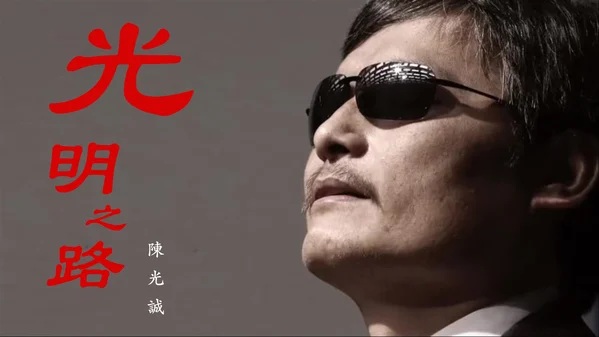
Between 2010 and 2012, an unusual pilgrimage began. From across China and around the world, people from all walks of life traveled to a small, dusty village called Dongshigu in Shandong Province. They were there to visit a blind man, Chen Guangcheng, held under a brutal, illegal house arrest.
These visitors were met with state-sponsored violence — intercepted, verbally abused, and beaten by hired thugs. In a powerful display of solidarity, many began wearing dark sunglasses or black blindfolds, symbolically mirroring the man they supported as they called for his freedom.
A childhood defined by shadows
Chen Guangcheng was born on November 12, 1971. A single surviving photograph from his infancy shows a child with healthy eyes, but that reality was fleeting. At just five months old, a high fever ravaged his system. With his father away and his mother working in a production team, the abnormality went undetected until it was too late. The damage was irreversible.
From that moment on, Chen Guangcheng lived in a world of faint light and blurred silhouettes. Trees were merely vague green patches; people were hazy, shifting shadows. As the fifth of five brothers, he was an inconspicuous boy in the eyes of his village. Few could have guessed that this child, seemingly sidelined by disability, would eventually become a global symbol of resistance.
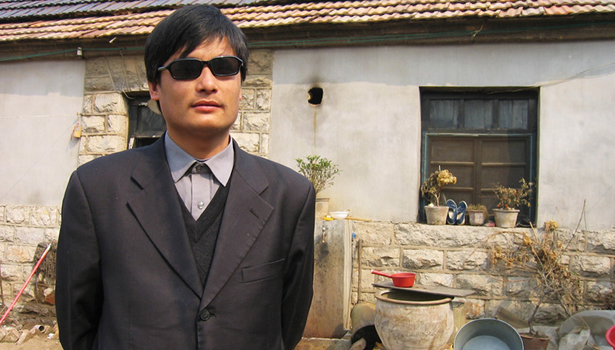
The world through the airwaves
In 1989, at age 18, Chen Guangcheng entered the Linyi School for the Blind. Though he started his formal education late, he possessed a fierce intellectual independence. He didn’t just study his textbooks; he interrogated them. His real education, however, came from a medium-wave radio. Since the mid-1970s, he had tuned into forbidden signals from Taiwan.
Chen Guangcheng still recalls the crisp opening: “The voice of Guanghua, the voice of free China.” When his brother caught him listening and warned him that he could be arrested, the young Chen Guangcheng didn’t feel fear — he felt curiosity. He began to wonder: “Why is the government so afraid of information?” This curiosity would eventually lead him to study acupuncture and massage in Nanjing, but his true passion had already shifted toward the law.
Rise of the “Barefoot Lawyer”
Having personally experienced the systemic unfairness faced by the disabled, Chen Guangcheng began teaching himself the law to defend his neighbors. By 2001, he made a life-altering choice: he abandoned his medical career. He realized that society’s deepest wounds weren’t physical, but institutional.
He became a “Barefoot Lawyer,” a self-taught advocate for those with no voice. His work was so effective that by 2002, he was featured on the cover of Newsweek. During this time, he also met Yuan Weijing, a teacher who shared his convictions. They married in 2003, beginning a partnership that would soon be tested by the full weight of the state.
The Linyi investigation: A dangerous truth
In 2005, Chen Guangcheng and his friends began investigating the violent forced abortion incident that occurred during the implementation of family planning by the Chinese Communist Party (CCP) in Linyi City. According to him, the local Party Secretary took the lead and organized joint actions involving multiple departments, including the Family Planning Commission, the Family Planning Office, and other units.
They mobilized personnel day and night to remove those who were found to have violated the family planning policy. According to their statistics, more than 600,000 people in Linyi were illegally detained or forced to have abortions or sterilizations that year, of which more than 130,000 were subjected to abortions, sterilizations, or terminations of pregnancy.
Chen Guangcheng asked the judicial authorities to investigate the relevant officials for dereliction of duty and publish the information obtained on the Internet. This move caused high tensions among local governments. Starting on August 11, 2005, a large number of personnel have been stationed in Dongshigu Village and imposed illegal restrictions on his personal freedom. Guards were stationed around his residence and at various intersections within the village, turning Dongshigu Village into a fortress.
Dozens of other working groups entered the homes of villagers to persuade them not to support him and spread claims such as “in contact with hostile foreign radio stations” to create pressure, threatening anyone who dared to support the “blind man.” His family was also implicated. His brother, Chen Guangfu, once received a threatening phone call, saying that if there is any “problem” in the family planning work, Chen Guangcheng and both family members would be implicated.

The radio in the milk carton
The authorities eventually moved from harassment to imprisonment. In 2006, Chen Guangcheng was sentenced to four years and three months on fabricated charges of “destroying property” and “disrupting traffic.” Within the suffocating walls of Linyi Prison, information was the only currency of hope. To bypass the “clearance” searches, Chen Guangcheng turned to a clever ruse: he would carefully unseal milk cartons sent by his family, drain them, and slide a shortwave radio inside.
By resealing the packaging to look untouched, he hid his connection to the outside world in plain sight. Amidst the clanging of iron doors, the faint crackle of foreign airwaves remained his only tether to the freedom he sought. Through those hidden airwaves, Chen Guangcheng stayed connected to the world that the prison walls were devised to make him forget.
From the small prison to the big prison
On September 9, 2010, Chen Guangcheng was released, but he soon realized he had merely traded a cell for a village-sized cage. The local authorities had constructed a “big prison” around his home. The security was a sophisticated “mesh structure.” Guards were arranged in a radial pattern centered on the Chen Guangcheng residence. Each intersection was manned by personnel in a cross-supervision system; guards were required to keep their colleagues in constant sight to ensure no one relaxed their watch or showed mercy.
In February 2011, a video secretly filmed by Chen Guangcheng and Yuan Weijing was smuggled out to the world. The response from the authorities was a brutal, hours-long beating of Yuan Weijing, leaving her with broken ribs and a fractured eye socket. High-definition cameras were installed, and a total blockade was enforced. Even relatives were barred from approaching. The blind man was isolated, watched, and silenced — or so the authorities thought.
See Part 2 here
Translated by Chua BC and edited by Helen London
Follow us on X, Facebook, or Pinterest
