

Traditional Chinese accounts contain many stories in which people escaped serious disasters because of their moral conduct. Among them are several tales about merchants whose honesty was said to have protected their homes, businesses, and families from devastating fires.
One such account concerns a fire that broke out in Yangzhou in 1846, during the Qing Dynasty.
At the time, the area around Yuanmen Bridge was one of the city’s busiest commercial districts. Restaurants and shops lined the streets, which were crowded each day with merchants, customers, and travelers.
One day, a catastrophic fire swept through the district. The flames spread rapidly, reducing many large buildings and storefronts to ashes. Yet amid the ruins, one general store remained completely untouched.
Nothing around the shop appeared capable of shielding it. According to the account, people saw numerous black flags appear above its roof just as the flames approached. The flags seemed to form a barrier that prevented the fire from reaching the building.
After the fire was extinguished, neighbors examined the shop. The owner, his family, and the dozens of people who worked there had already escaped, and none of the merchandise inside had been damaged.
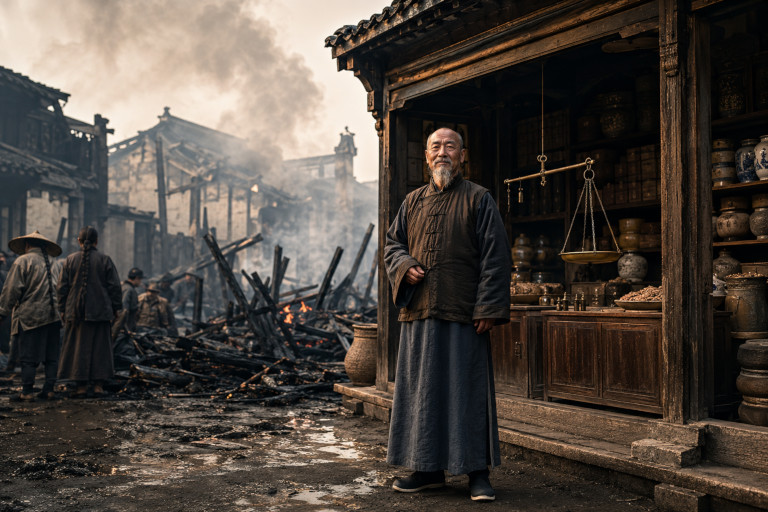
People naturally wondered why this particular shop had been spared.
The owner was an elderly man surnamed Wang. There was nothing outwardly remarkable about him, but during more than 30 years in business, he had never been known to deceive anyone in either word or deed.
Those who heard the story believed that his long-standing honesty had moved Heaven and protected his shop during the disaster.
Granny Li gave customers more
A similar account dates to 1185, during the Southern Song Dynasty.
In Ezhou, in what is now Wuhan, Hubei Province, there was a prosperous market known as Nancao Market. An elderly woman called Granny Li earned her living there by selling salt.
One day, a fire swept through the market, destroying thousands of homes and businesses. When the flames finally died down, nearly everything in the area had been reduced to ashes.
Only one salt shop remained intact.
It belonged to Granny Li. Even the two salt stalls outside the shop and a straw mat wrapped in blue cloth hanging against the exterior wall showed no signs of fire damage.
News of the strange occurrence soon spread throughout the city. Two local officials summoned Granny Li to the government office and questioned her.
“The fire was so fierce that the buildings throughout the market were destroyed,” they said. “Why was your salt shop spared?”
Granny Li replied that she possessed no unusual abilities. She then explained how she conducted her business.
Under the traditional system, one standard measure was divided into 16 parts. Whenever customers paid for that amount of salt, Granny Li gave them 18 parts instead. Rather than trying to profit by giving buyers less than they had purchased, she quietly gave them a little more.
“I have relied on that scale to live until today,” she told the officials.
They were deeply impressed by her answer. They rewarded her generously and respectfully escorted her from the government office.
To those who preserved the story, Granny Li’s scale represented more than an instrument for weighing merchandise. It revealed how she treated the people who depended on her honesty.
What the traditional scale represented
According to Chinese folklore, the craftsman Lu Ban designed an early steelyard scale marked with 13 stars. After Qin Shi Huang unified China’s system of weights and measures, three additional stars were said to have been added.
Tradition associated these three stars with fortune, prosperity, and longevity.
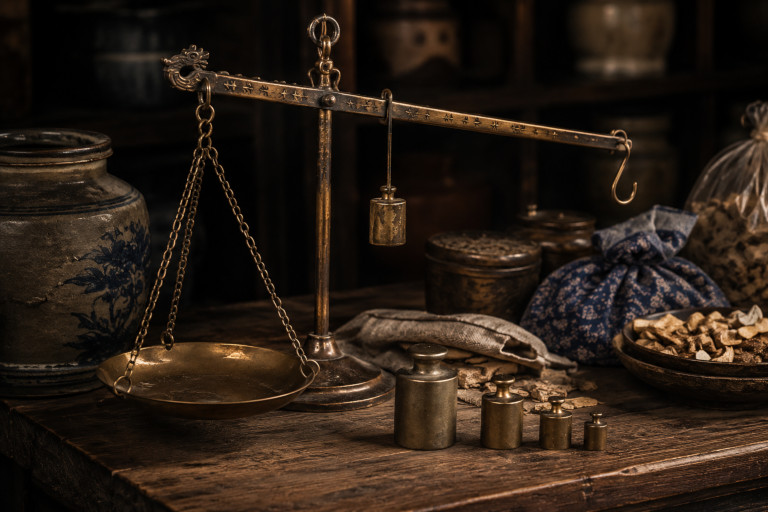
Merchants were therefore warned that using dishonest weights would not only harm their customers but also diminish their own blessings. Giving a customer one part less was said to damage one’s fortune. Withholding two parts harmed prosperity, while withholding three shortened one’s life.
These teachings impressed upon merchants that every act of dishonesty carried a cost, even when the customer never discovered the deception.
Another account from the Song Dynasty illustrates the opposite side of this principle.
Dishonest measures brought misfortune
In a village in Yugan County, Jiangxi Province, there lived a man named Zhu Juchuan. Zhu was preoccupied with making money and frequently used dishonest methods to enrich himself.
One day, a stone was thrown into his home in broad daylight. Believing that someone was playing a trick on him, Zhu searched outside but found no one.
Several days later, a much larger stone fell into his courtyard. Soon afterward, the boxes and chests in which the family stored its clothing suddenly caught fire from within, reducing everything inside to ashes.
Zhu initially believed that ghosts or other spirits were tormenting his household. He invited a local shaman to perform a ritual, but the disturbances only became more frequent.
Members of his family felt as though unseen hands were choking, striking, or beating them. Some cried out in pain, while others appeared to be tied up and suspended in the air. The household descended into fear and confusion.
Convinced that the shaman lacked sufficient ability, Zhu brought in a Taoist priest to conduct another ritual.
As soon as the altar was prepared, a ball of fire appeared beneath it. The priest continued reciting incantations, but stones soon began falling around him. He was forced to abandon the ceremony.
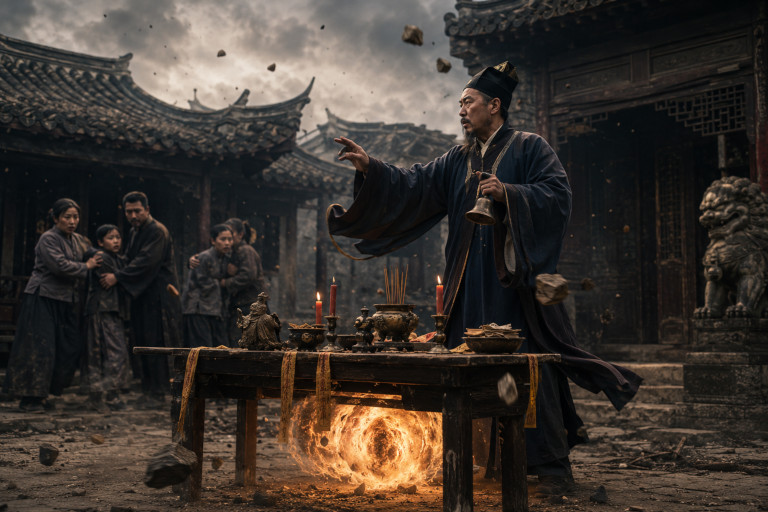
By then, the fire beneath the altar had spread to the house. Before long, the entire property had burned to the ground.
Zhu moved his family to another home more than three miles away, but the strange disturbances continued. By this time, the disasters had consumed more than half of his wealth.
Later, a traveling sage visited Zhu and offered a different explanation.
“These events are not the work of ghosts,” he said. “They are the consequences of your own conduct. You have used dishonest measures and repeatedly taken advantage of others. Had you not behaved this way, these calamities would not have come upon you.”
The sage told Zhu that although human methods could not easily avert a disaster once it had arrived, Heaven cherished life and allowed people an opportunity to repent.
“If you sincerely recognize your wrongdoing and correct your behavior,” he said, “these disasters will gradually disappear.”
Zhu was deeply shaken. He abandoned his former greed and deceit and began conducting his business more honestly. According to the account, the strange events then ceased.
Honesty as a form of protection
Whether these accounts are read as history, folklore, or moral instruction, they express a principle that has long held an important place in Chinese culture: A merchant’s scale measures more than goods. It also measures character.
Dishonesty may produce a small and immediate profit, but it damages trust and can bring consequences far greater than the amount gained. Honest dealing, by contrast, builds confidence, strengthens relationships, and allows a business to endure.
The stories of Wang and Granny Li portray honesty as a form of protection, while the experience of Zhu Juchuan presents deceit as a source of misfortune.
A merchant may be able to conceal a dishonest transaction from a customer, but according to the traditional teaching behind these stories, no action is ever entirely hidden. Those who refuse to take unfair advantage of others preserve not only their good name but also the blessings that accompany a clear conscience.
Translated by Chua BC
Follow us on X, Facebook, or Pinterest
