

The air conditioner vs. fan question used to be a quiet curiosity in German households and a non-question across most of Europe — until this summer. It is three in the morning now, and the room has not cooled. The window has been open for hours, and nothing comes through it but more of the same air that has been standing over the city since noon. You have turned the pillow to its cold side, and then turned it again, until there is no cold side left. Below the street a delivery bike passes, and for a moment you envy the moving air around it.
This was the week the question stopped being academic. A heat dome parked itself over the continent and drew air up from North Africa, pushing temperatures as much as 15° above the seasonal norm. Germany’s weather service issued red alerts for Bonn, Frankfurt and Cologne; the United Kingdom logged its hottest June day on record; technicians in France and Spain spent the week bolting condenser units onto walls that had never held one. None of it is a peak. The warm phase of the Pacific climate cycle — El Niño — re-formed in mid-2026 after a brief La Niña and a neutral spring, and it is still strengthening, with forecasters expecting it to intensify through the Northern Hemisphere winter. In the language of the season: this is the beginning, not the crest.
The health authorities have stopped being diplomatic about what that means. The World Health Organization’s European office reported that the continent lost roughly two hundred thousand people to heat across four years, and called nearly all of those deaths preventable. Europe, its regional director said plainly in Berlin this month, is warming faster than any other continent, and is paying for it in lives. The detail that matters most for anyone lying awake at three in the morning is this: the danger is not only the afternoon high. It is the night that fails to cool. When the minimum temperature stays up, the body never gets the recovery window it is built to take during sleep — which is why, in the assessment of heat-health specialists, the overnight low is often a better predictor of harm than the headline daytime peak. The fan does not cool the room. The air conditioner does. Almost every mistake people make this summer begins by forgetting that one sentence.
Air conditioner vs fan: Two machines that do completely different jobs
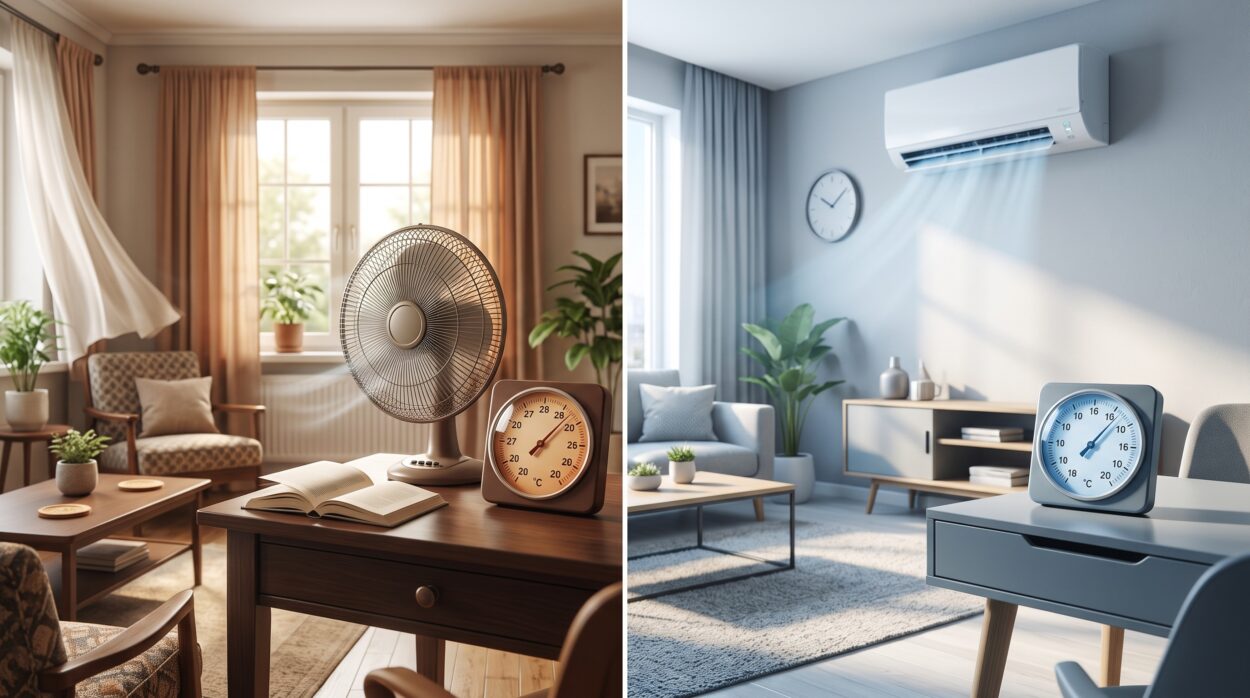
Put a thermometer in the middle of a closed room and switch on a fan. Wait an hour. The reading will not have dropped — and, if anything, it will have crept up slightly because the motor itself is adding heat. A fan does not remove warmth from a room. It moves air, and moving air does two things to the human body: it sweeps away the thin layer of humid air that collects against the skin, accelerating the evaporation of sweat, and it carries heat away from the skin by convection. Both are real cooling. Both happen to you, not to the room.
An air conditioner does the opposite thing in the opposite place. It runs a refrigeration cycle — a compressor, a refrigerant, a cold indoor coil, and a hot outdoor one — and physically carries heat from inside the room to outside. The thermometer in the middle of the room does drop. This is the whole distinction, and it has a price attached: Shifting heat against its natural direction takes a great deal of energy. A fan draws somewhere between thirty and fifty times less electricity than an air conditioner doing comparable comfort work. That ratio is the reason the fan has been Europe’s default for a century, and the reason the air conditioner is now arriving anyway.
There is a second, sharper reason the difference matters. Skin sits at roughly 35°C. As long as the surrounding air is cooler than that, air blown across the body carries heat away. Once the air is hotter than the skin, the same moving air begins delivering heat to you instead — convective cooling turns into convective heating, and the fan starts working the wrong way, like the fan in a convection oven. Sweat evaporation still helps for a while above that line, but the margin narrows fast, and it narrows fastest for the people least able to spare it.
The line where a fan quietly stops helping
This is where the honest answer gets more interesting than the marketing one. For years, public-health bodies have disagreed about exactly when a fan becomes counterproductive, and they still do. The United States Centers for Disease Control and Prevention advises against relying on a fan once the air temperature drops below about 32°. The WHO has set the limit closer to 40. The gap between those two numbers is not sloppiness; it is humidity.
A 2021 Biophysical Journal study suggested fans could be recommended for almost everyone across the overwhelming majority of real hot-weather days, including at temperatures most Europeans would call extreme. A 2024 review in The Lancet Planetary Health pushed back hard, arguing that above roughly 35° the cooling a fan provides is too small to meaningfully lower core body temperature — especially for adults over 65, whose sweating capacity is reduced. More recent thermoregulation modeling splits the difference and explains why both can be right: in dry air, a fan keeps helping to surprisingly high temperatures, while in hot and humid air, or at high fan speeds in severe heat, the convective heat gain wins and the fan turns detrimental somewhere past the low 40s.
The practical reading is this. Below about 35°, a fan is genuinely useful and almost free. Between roughly 35 and 40, it depends on humidity and on who you are — fine for a healthy adult in dry heat, unreliable for an older person or anyone whose body struggles to sweat. Above 40, stop trusting it to protect anyone vulnerable, and especially do not point a fast fan at a frail person in still, hot air. When the air is hotter than your skin, more airflow is not more cooling.
Reading a fan by its numbers
If you decide a fan is the right tool — and for most European nights it still is — the box will offer a small constellation of figures. The one that matters most is airflow, the volume of air the fan actually moves, given in cubic meters per hour (m³/h) on European packaging or cubic feet per minute (CFM) on imported boxes. They are not interchangeable: one cubic meter per hour is about 0.59 CFM, so a spec sheet quoting 1,000 m³/h and one quoting 1,000 CFM describe very different machines. Typical household fans move somewhere between 500 and 1,000 m³/h; a pedestal fan generally pushes more air than a slim tower of the same price.
Airflow alone is not what you feel, though. What you feel is air velocity — speed at your body, in meters per second — and this is where most pedestal fans quietly under-deliver. The studies that found fans useful at high temperatures assumed roughly 3.5 to 4.5 m/s arriving at the skin, a brisk wind that many marketed fans cannot sustain a couple of meters away. So sit closer than you think, and do not assume a high airflow rating guarantees a strong breeze where you actually are.
Then the quieter virtues. Motor type decides both efficiency and noise: a modern DC or BLDC motor can deliver the same breeze on a fraction of the power of an old AC motor — think 28 watts against 110 — and runs noticeably quieter, which is the difference between a fan you can sleep beside and one you cannot. Blade sweep (300–450 mm on most pedestal fans) sets the size of the air column; noise, in dB(A) or sones, decides whether the machine disappears at night or dominates the room; and oscillation, speed steps, a timer, and a remote are the small comforts that determine whether you use the thing well. A fan is a consumable-grade purchase: cheap, simple, replaceable every few summers as the motor tires.
Reading an air conditioner by its numbers
An air conditioner is the opposite kind of purchase — a piece of fixed capital you live with for a decade — and it rewards reading the label properly. The first number is capacity, given in kilowatts of cooling in Europe or BTU per hour on imported units (one kilowatt is about 3,412 BTU/h, so the 2.1 kW mobile unit Germans buy most often is roughly a 7,000 BTU machine). Capacity is the number people get wrong most. A rough starting point is 60 to 100 watts of cooling per square meter of room, adjusted up for sun, top floors, large windows, and poor insulation. Resist the urge to oversize: a unit too big for the room cools the air fast, switches off before it has wrung out the humidity, and leaves you in a clammy, short-cycling room that wears its compressor out early.
The second number is efficiency. EER measures cooling delivered per unit of electricity at a single operating point; SEER averages it across a season; the EU’s A-to-G energy label compresses all of it into one letter you can read at a glance. Pay for the highest you can, because unlike a fan, this machine’s running costs are a real line item in your life. Closely related is the compressor: an inverter (variable-speed) unit modulates its output to maintain a steady temperature rather than slamming fully on and off, which makes it quieter, gentler on the room, and dramatically cheaper to run. In Germany, nearly half of new installations are now high-efficiency inverter models, and roughly two-thirds of residential buyers choose a split system over a window or portable unit — for good reason.
The form factor decides the rest. A split or mini-split — a quiet indoor head and an outdoor compressor — is the most efficient and quietest, and for Europe’s older ductless apartment stock, it is also the cleanest retrofit. A portable unit needs no installation but is the noisiest and least efficient, since its compressor sits in the room with you and its exhaust hose pulls warm replacement air in behind it. Beyond that, watch the noise rating in dB(A) — logarithmic, so small differences are large at the pillow — the refrigerant and its global-warming potential, and the genuinely useful modes: a true sleep mode that lets the temperature drift gently up overnight, and a dry mode for humid nights.
What to read on an air-conditioner box
| On the box | What it actually tells you | Sensible target |
| Capacity (kW or BTU/h) | How much heat the unit can remove from the room each hour. The single most important number — and the one most often wrong. | Roughly 60–100 W of cooling per m²; ~2–2.6 kW (7,000–9,000 BTU/h) for a typical bedroom. |
| SEER / EER + EU energy label | Efficiency. EER is the instantaneous ratio; SEER is the seasonal average. The A–G label folds this into one letter. | EER ≥ 3.0, the highest SEER you can afford; A or B on the EU label. |
| Compressor type | Inverter (variable-speed) units modulate output instead of cycling fully on and off — quieter, steadier, far cheaper to run. | Inverter, not fixed-speed. |
| Form factor | Split / mini-split: most efficient, quietest. Portable: noisiest, least efficient, vents through a hose. Window: in between. | Split where you can install one; portable only if you cannot. |
| Noise (dB(A)) | Measured logarithmically, so a few points matter at night. Indoor and outdoor figures are listed separately. | Under ~45 dB(A) indoors at the speed you will actually use. |
| Refrigerant (GWP) | The global-warming potential of the gas inside. R32 sits near 675; propane-based R290 near 3. | Low-GWP refrigerant (R32 or lower) where available. |
One honesty is owed here because it belongs in the article, not in the small print. An air conditioner does not destroy heat; it relocates it. The warmth pulled out of your bedroom is dumped onto the street, and in dense cities, that adds up—one study of Paris found that air conditioning could lift the outdoor temperature by 2 ° to 4 °, which is to say, each cooled room makes its neighbors’ nights a little worse. Cooling worldwide accounts for around four per cent of greenhouse emissions, roughly double aviation’s share. None of this is an argument against owning one. It is an argument for sizing it correctly, running it at a sane temperature, and — where possible — pairing it with rooftop solar that peaks exactly when the machine is working hardest.

The night, and the place where cooling turns against you
The body sleeps best slightly cool. Core temperature naturally falls as you drift off, and the descent into deep sleep is easier in a room somewhere around 16° to 19°. That is the case for cooling the bedroom. But both machines have a way of overshooting into discomfort, and the brief that brought you here — how much is healthy, and when does it tip over — deserves a precise answer.
A fan run all night against the face tends to dry the membranes of the nose, throat and eyes over seven or eight hours, which is why some people wake with a scratchy throat or a blocked nose; it also stirs dust and pollen through the room, which matters if you have allergies or asthma, and a cold draught held on the same muscles for hours can leave them stiff by morning. None of this makes a healthy person ill. The fixes are small: oscillate rather than aim, keep the breeze off your face, leave a little water in the room or run a humidifier, and drink before bed so dehydration doesn’t compound the dryness.
An air conditioner’s risks are the mirror image. Because it dehumidifies as it cools, it can dry skin and airways the same way, and its real hazard is the temptation to set it too low. A bedroom driven down into the chilly teens overnight is the classic source of the dry throat, the stiff neck, and the morning headache people blame on “air-conditioning sickness.” The sensible setting is higher than instinct suggests: many clinicians point to roughly 24° to 26° overnight, which removes the dangerous heat and humidity without freezing you, and pairs it with a sleep mode that drifts upward through the night. And the filters must be kept clean, because a neglected unit recirculates whatever grows inside it. On an ordinary warm night, the dry-throat worry is the thing to manage. On a genuinely dangerous one, it is a rounding error against the harm of a body that cannot cool down at all.
That asymmetry is the heart of it. For a healthy adult on a 24° night, the question is mostly comfort, and a fan with a glass of water beside it is a perfectly good answer. For an older person, someone with a heart or lung condition, a very young child, or anyone in a top-floor room where the temperature simply will not fall, a tropical night is a medical event — and on those nights, the modest dryness of an air conditioner is not remotely in the same weight class as the risk of lying in heat the body cannot shed.
Which one — a decision, not a verdict
So the choice is not fan versus air conditioner as rival philosophies. It is a matter of matching the machine to the night. Below the mid-30s, in the moderate heat that still describes most German summers, a good fan — high airflow, a quiet DC motor, placed close — does almost everything you need for a few watts and a few euros. It is the right tool for the common case, and there is no virtue in overbuying for it.
The air conditioner earns its keep on the nights at the edges of the new normal: the still, humid, top-floor nights that do not break before dawn, and the household that includes someone the heat can actually hurt. There, the capital cost, the energy bill, and the environmental honesty are all real, and they are all outweighed. The most resilient setup, for those who can manage it, is not one or the other but both — a fan for the ordinary majority of nights, a correctly sized inverter split held at a humane temperature for the dangerous minority — which is roughly the calculus a fifth of German households have already run, with another fifth about to.
Europe spent a century treating cooling as a luxury and shade as a substitute for it. That settlement is ending, not because anyone changed their mind, but because the nights changed. The honest task now is not to feel guilty about the machine or romantic about the fan. It is to understand exactly what each one does to the air and to the body, to read the right number off the box, and to keep the most vulnerable person in the house on the safe side of a line the weather keeps moving.
Which brings it back to three in the morning, and the window that lets in nothing but more of the same. The fan on the sill is not failing you; it is doing precisely what a fan does, which on a hot enough night is no longer enough. Knowing the difference between not enough and not working — that is the whole of it. The pillow has no cold side left, but you, at least, now know which switch to reach for, and why.
Follow us on X, Facebook, or Pinterest
