

When the dry season arrives in parts of Africa, rivers shrink, the ground hardens, and many animals struggle to survive.
Yet the African lungfish has an extraordinary way of enduring drought. It burrows into the riverbed and surrounds itself with a protective layer of mucus, remaining dormant until the rains return. Then it awakens and resumes its normal life.
This ability to endure difficult conditions rather than escape them offers a useful metaphor for raising children.
Parents cannot remove every hardship their children will encounter. What they can do is help them develop the independence, foresight, and self-discipline needed to face difficulties when they come.
Different parenting approaches can produce very different results.
A firm mother teaches independence
Life eventually requires children to stand on their own.
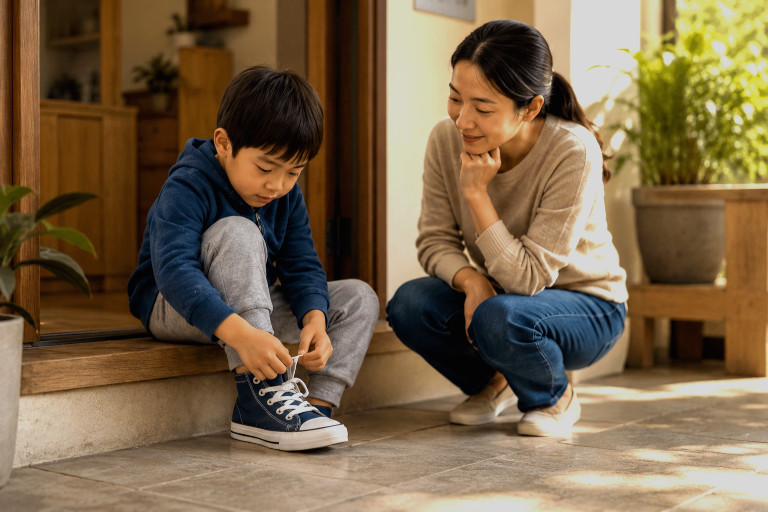
From school to work and adult responsibilities, they will encounter competition, setbacks, and problems that no parent can solve for them forever. Yet out of love, some mothers try to remove every obstacle from a child’s path.
When parents continually step in, children may reach adulthood without learning how to solve problems, manage disappointment, or discipline themselves.
Allowing children to handle age-appropriate difficulties can therefore be an important form of preparation.
A traditional story about Northern Song Dynasty official Lü Mengzheng illustrates the idea.
According to the account, Lü’s father cast him out as a boy, and he lived in poverty with his mother. Around the New Year, when the family had almost nothing to eat, his mother sent him to relatives to ask for help. They refused, fearing the family would never be able to repay them.
Disappointed, Lü wrote an unusual couplet:
“Two, three, four, five;
Six, seven, eight, nine.”
Across the top he wrote: “North and South.”
The joke depended on Chinese wordplay. The numbers 1 and 10 were missing. “One” (yī) sounds like the word for clothing (yī), while “ten” (shí) sounds like the word for food (shí). “North and South,” meanwhile, omitted east and west. The Chinese expression for “east and west” (dōngxi) can also mean “things” or possessions.
In other words, the family had no clothing, no food, and virtually nothing to their name.
The story says Lü later passed the imperial examinations and became a high-ranking official. When relatives who had once rejected him came to congratulate him, he wrote another couplet recalling that no one had helped during his years of hardship, but everyone appeared once he was successful.
Whatever the historical details of the story, the lesson is clear: children eventually need to rely on their own judgment and effort.
A loving home should always offer support, but it should not become a permanent shelter from responsibility.
A mother with foresight teaches children to think ahead
The lungfish does not wait until drought has already defeated it. Its survival depends on responding to changing conditions at the right time.
The same principle applies to preparing for the future.
A saying attributed to the strategist Liu Bowen advises people to prepare a boat during a drought and winter clothing during hot weather. The point is not to act irrationally, but to prepare before a need becomes urgent.
Parents naturally think about a child’s immediate needs — schoolwork, meals, activities, and daily problems. But good parenting also requires looking farther ahead.

What kind of adult will this child become? Can he make decisions independently? Does she understand the consequences of her choices? Has the child begun thinking about education, work, money, and responsibility?
Another traditional story concerns Kou Zhun, a prominent official of the Northern Song Dynasty.
Before his mother died, according to the account, she created a painting known as “Teaching My Son by the Cold Window” and entrusted it to a servant. Years later, after Kou had risen to high office, he prepared an elaborate birthday celebration.
The servant then presented him with his mother’s painting and the words she had left behind, reminding him of the hardships she had endured to educate him and urging him to remain diligent, frugal, and mindful of those less fortunate even after attaining wealth and status.
Moved by the reminder, Kou canceled the extravagant celebration.
The story reflects a broader principle: prosperity is easier to handle wisely when people remember that circumstances can change.
Teaching children to think beyond the present can help them make better choices when opportunities and difficulties arise.
A frugal mother teaches the value of money
Many parents want to give their children everything they can. Some willingly sacrifice their own comforts so their children never feel deprived.
But constant abundance can have an unintended effect. A child who never sees the work behind money may struggle to understand its value.
One man recalls growing up in China in the 1970s, when his mother rarely gave him spending money.
One day, after the two had spent hours selling vegetables at a market, he saw a shop selling rice noodles and begged for a bowl. His mother agreed, but bought only one.
She watched him eat without taking any herself.
Only after they returned home did he realize that she had spent much of the day working while consuming little more than water. She had used part of their small earnings so that he could enjoy the meal.
Later, she explained how little money a load of vegetables brought in and how much labor was required to grow them. She also helped him understand where the family’s money came from and how it had to cover their expenses.
The lesson was not that poverty itself was desirable. Rather, he learned that money represented time, work, patience, and sacrifice.
Children do not need to be deprived in order to learn financial responsibility. But they do need opportunities to understand that money is limited, that earning it requires effort, and that spending involves choices.

A mother who teaches both how to use money and how to earn it gives her child skills that can last a lifetime.
Preparing children for life
No parent can prevent every crisis, disappointment, or setback.
The goal of parenting, then, cannot be to construct a life in which nothing difficult ever happens. It is to help children become capable of meeting difficulties when they do.
That means allowing them to solve problems, teaching them to think ahead, helping them understand the value of work and money, and giving them gradually increasing responsibility.
A mother may be a child’s first teacher, but she cannot remain the only one.
As children grow, experience also becomes a teacher. So do mistakes, setbacks, responsibilities, and the choices they make for themselves.
Like the lungfish waiting beneath a dry riverbed for conditions to change, children cannot always choose what circumstances they will face. But with the right preparation, they can learn how to endure difficult seasons and be ready to move forward when opportunities return.
Translated by Katy Liu
Follow us on X, Facebook, or Pinterest
