
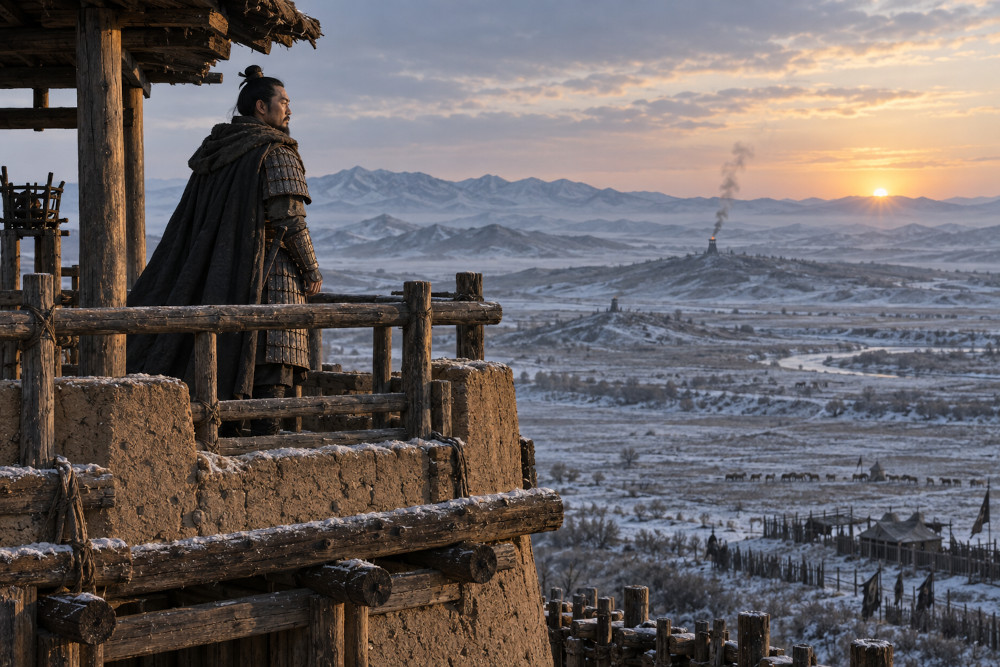
During the Warring States period, the Xiongnu — a powerful nomadic confederation north of the State of Zhao — once again sent a large army south. Their ruler, known as the Chanyu, had little reason to worry. The Zhao general guarding the northern frontier, Li Mu, was widely regarded as a coward. Whenever the Xiongnu attacked, Li Mu withdrew behind his fortifications and refused to fight.
This time, the Chanyu expected another easy raid. What he did not know was that the “coward” who had endured years of ridicule had been preparing a trap. When the Xiongnu army advanced, Li Mu struck. More than 100,000 Xiongnu cavalry were defeated, and for years afterward, the Xiongnu did not dare launch another major attack on Zhao’s northern frontier.
The commander behind that extraordinary victory was Li Mu, one of the Four Great Generals of the Warring States period and a man later remembered as Zhao’s “Great Wall.” Yet the general who could stop the Xiongnu cavalry would ultimately prove unable to overcome suspicion within his own court. Zhao’s Great Wall would not fall to an enemy on the battlefield. It would be torn down from within.
Years of “cowardice” conceal a strategy
Little is recorded about Li Mu’s early life. By the time he emerges clearly in the historical record, he was already an experienced commander stationed in the Dai region and at Yanmen, guarding Zhao’s northern frontier against the increasingly powerful Xiongnu.
The Xiongnu raided south year after year, burning settlements, killing residents, and seizing livestock and property. Defending the frontier had become one of Zhao’s most persistent problems.
Li Mu governed his forces according to his own carefully devised system. The royal court granted him considerable discretion, and taxes collected from the cities under his protection were used to support the army. Each day, cattle were slaughtered to provide food for the soldiers. Li Mu trained his men in horsemanship and archery, maintained strict vigilance at the beacon towers, and sent spies to gather intelligence on the enemy.
Yet he also issued an uncompromising order: whenever the Xiongnu invaded, the army was to retreat immediately behind its fortifications. Anyone who went out to engage the enemy without authorization would be executed. So whenever the warning beacons were lit, Zhao’s soldiers withdrew. No matter how much the Xiongnu taunted them from outside the defenses, they refused to come out and fight.
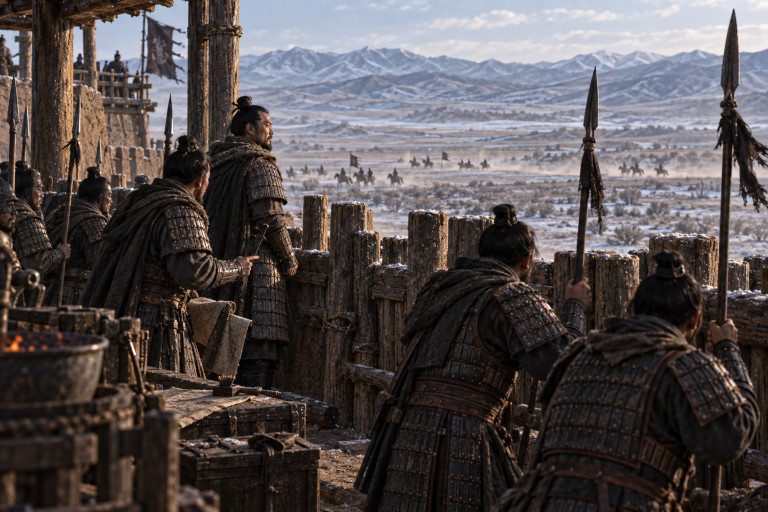
Li Mu was not afraid of battle. He simply refused to fight on the enemy’s terms. The Xiongnu cavalry depended on speed, striking quickly and withdrawing with their plunder. A rash pursuit would have played directly to their strengths. Li Mu instead kept his forces rested and secure while denying the Xiongnu the decisive engagements they wanted. Again and again, the raiders came south only to find little opportunity for gain.
Years passed, and Zhao’s frontier suffered remarkably little damage. Farmers cultivated their fields, and herders tended their livestock in relative peace. But Li Mu paid a price for his restraint. The Xiongnu began to regard him as a coward, and even his own soldiers came to believe their commander was timid and unwilling to fight.
The King of Zhao eventually lost patience. He repeatedly rebuked Li Mu for avoiding battle, but Li Mu refused to change his strategy. Angered, the king recalled him and appointed another general in his place.
The new commander took the opposite approach. Whenever the Xiongnu appeared, he led his troops out to fight. The results were disastrous. For more than a year, Zhao suffered repeated defeats and heavy losses, and conditions along the frontier deteriorated so badly that people could no longer safely farm the land or graze their livestock. Only then did the king realize the value of Li Mu’s strategy and ask him to return.
Li Mu agreed on one condition: he had to be allowed to use the same tactics as before. The king had little choice but to accept. Back on the frontier, Li Mu resumed his old methods. For several more years, the Xiongnu gained virtually nothing from their raids and became even more convinced that Zhao’s commander was afraid to fight.
Meanwhile, Li Mu’s soldiers were well fed, well trained, and increasingly eager for battle. After years of receiving rewards without being permitted to fight, their desire to confront the enemy had reached its peak. That was exactly what Li Mu had been waiting for.
He selected 1,300 chariots, 13,000 warhorses, 50,000 warriors prepared for close combat, and 100,000 skilled archers and crossbowmen. He trained them intensively and in secret.
Then he set the trap.
He released large herds of cattle and sheep into the countryside, with herders spread across the fields and hills. When a small Xiongnu force approached, Li Mu deliberately allowed his troops to suffer an apparent defeat, abandoning several thousand men and livestock. Believing Zhao vulnerable, the Chanyu led his main army forward.
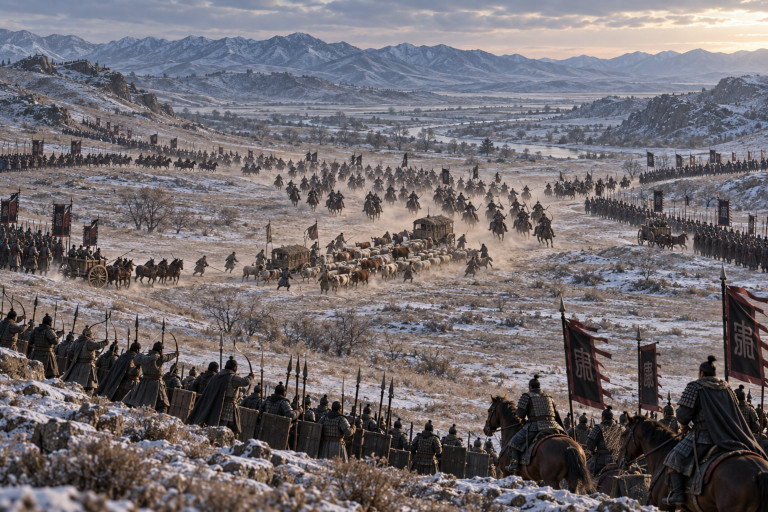
Li Mu then deployed his forces, extending his left and right wings to encircle the Xiongnu. The result was devastating. More than 100,000 Xiongnu cavalry were defeated. Li Mu then pressed his advantage, defeating or subduing several neighboring groups, including the Donghu and Linhu, and forcing the Xiongnu Chanyu to retreat far from Zhao’s frontier.
Li Mu’s use of infantry, chariots, crossbowmen, and cavalry together against highly mobile steppe cavalry was remarkable for its time. Similar principles later appeared in the campaigns of Han Dynasty generals Wei Qing and Huo Qubing against the Xiongnu.
Li Mu’s genius lay not simply in winning a battle, but in thinking years ahead. He endured ridicule that others might not have tolerated because he understood that patience was part of the strategy.
Zhao’s last line of defense
By the third century BC, Zhao faced an even greater threat from the west: the rapidly expanding State of Qin. In 234 BC, the Qin general Huan Yi attacked Zhao and inflicted a crushing defeat near Pingyang. The Zhao general Hu Yi was killed, and Zhao suffered another severe blow.
The following year, Qin forces again advanced deep into Zhao territory. As the situation grew more dangerous, the King of Zhao recalled Li Mu from the northern frontier, appointed him grand general, and placed him in command against Qin.
At Yi’an and Feixia, Li Mu’s forces defeated Huan Yi and forced the Qin army to retreat, relieving the immediate threat to Zhao. The king rewarded Li Mu with the title Lord of Wu’an. When Qin invaded again the following year, Li Mu repelled its forces at Fanwu and then moved south to block the forces of Han and Wei.
As long as Li Mu remained in command, Qin’s advance could not easily break through Zhao.
A general defeated by slander
Four years later, in 229 BC, the Qin general Wang Jian launched another major invasion of Zhao. The timing could hardly have been worse. Zhao had suffered drought, earthquake, and famine, leaving the state greatly weakened. Nevertheless, Li Mu and his deputy, Sima Shang, held their positions and prevented the Qin army from making decisive progress for months.
Wang Jian understood the problem: as long as Li Mu commanded Zhao’s army, a rapid victory would be extremely difficult. So Qin turned from the battlefield to the Zhao court.
Agents were sent to Handan, Zhao’s capital, where they bribed Guo Kai, a favored courtier of King Qian of Zhao. Guo Kai then spread rumors that Li Mu and Sima Shang were secretly communicating with Qin and planning a rebellion. King Qian accepted the accusations without properly investigating them and ordered Zhao Cong, a member of the royal family, and the general Yan Ju to replace Li Mu and Sima Shang.
Li Mu understood the danger of changing commanders in the midst of a critical campaign. Zhao’s survival was at stake, and he believed that surrendering command at such a moment would leave the state defenseless against Wang Jian. Invoking the principle that “a general in the field need not obey every command of his sovereign,” Li Mu refused the order.
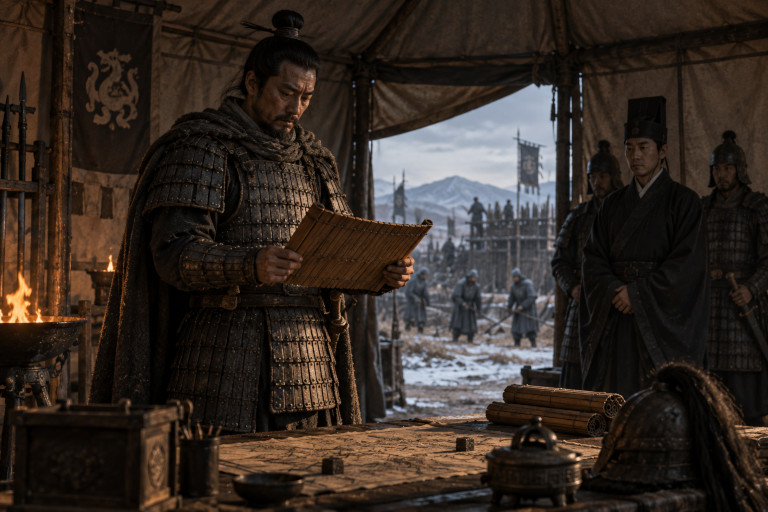
His refusal was not presented as an attempt to preserve his own position. He believed that Zhao itself depended on keeping an experienced commander at the front. But military skill could not protect him from suspicion at court.
King Qian secretly arranged for Li Mu to be seized. The general who had defeated the Xiongnu and repeatedly stopped Qin was captured and executed by his own state, while Sima Shang was also removed from command. Li Mu did not die amid thousands of soldiers on the battlefield. He died because his own king believed the accusations made against him.
With Li Mu gone, Zhao’s defenses quickly collapsed. Only three months later, Wang Jian advanced, defeated the Zhao army, killed Zhao Cong, captured Handan, and took King Qian prisoner. The State of Zhao came to an end.
Looking back on Li Mu’s life, his achievements were extraordinary. In the north, he held back the Xiongnu. In the west, he stopped Qin’s armies. Whether attacking or defending, he demonstrated both courage and strategic patience.
Yet the man remembered as Zhao’s “Great Wall” — a commander who defeated more than 100,000 Xiongnu cavalry and whom Qin could not easily overcome on the battlefield — ultimately fell to slander, a corrupt courtier, and a suspicious king. His fate left later generations with a lasting warning: Even the strongest defenses can be destroyed from within when rulers allow suspicion and false accusations to prevail over judgment.
Translated by Audrey Wang
Follow us on X, Facebook, or Pinterest
