
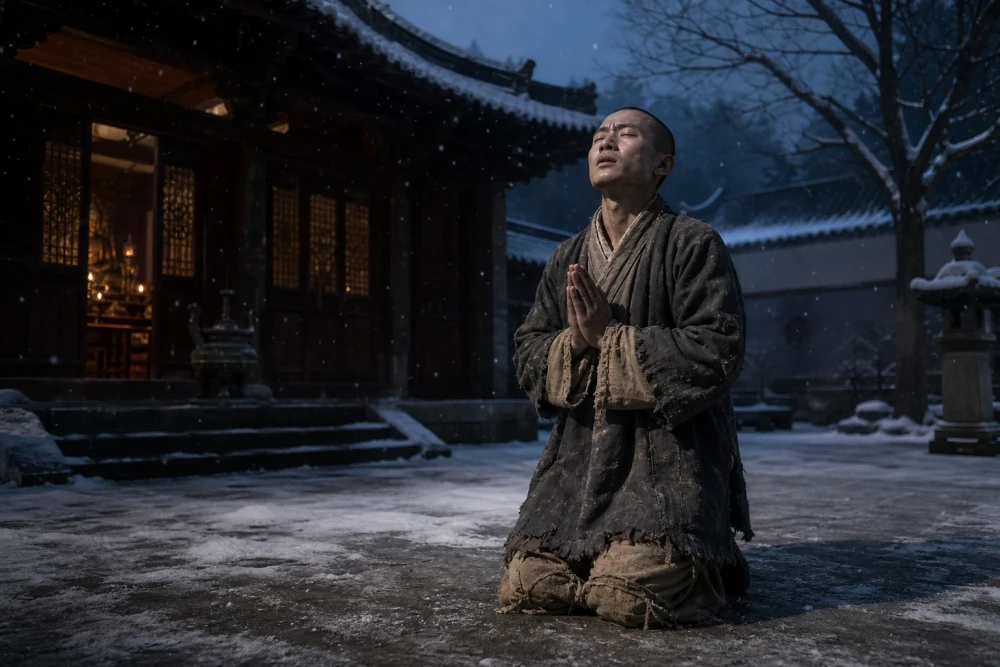
During the Republic of China era, a monk named Baoguang lived at Guangren Temple in Zhejiang Province. His lay surname was Chen, and his given name was Youqing. He resided in Chaodong Fang in Shaoxing City. From childhood, Youqing possessed wholesome roots and a naturally sincere disposition. At 14, inspired by others’ guidance, he felt drawn to spiritual cultivation. At 19, he opened a tobacco shop and treated his employees with great kindness, encouraging them to maintain long‑term vegetarian diets and paying them fair wages. But that autumn, disaster struck. Youqing suddenly developed an illness in both eyes and lost his sight completely. The following year, he developed a lump on his neck — tuberculosis of the lymph nodes — and also suffered from “crane‑knee wind,” a form of tuberculous arthritis that caused severe swelling in his knees.
Praying through the bitter cold
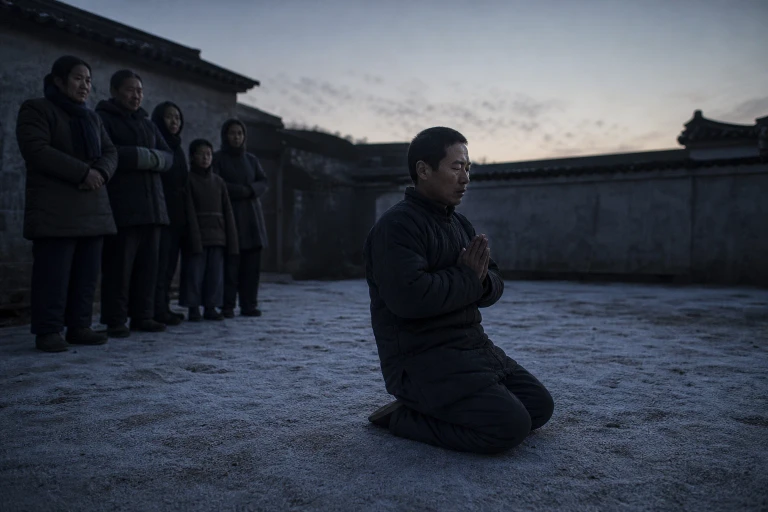
To cure his illnesses, beginning on the first day of the twelfth lunar month, Youqing knelt in the courtyard at the fifth watch every day, praying to the Bodhisattva under the open sky. Forty‑nine days passed, but there was still no improvement. The twelfth lunar month was bitterly cold. His family feared his condition would worsen and urged him to stop. But Youqing said: “If my time on earth has come to an end, I am willing to die quickly. If my lifespan is not yet over, I pray Heaven will grant me a swift recovery. And if I recover, I vow to become a monk.” His devotion was so sincere that he continued kneeling and praying for an entire year.
A mysterious dream brings enlightenment
At the end of the first month of the following year, during the fifth watch of the night, Youqing was praying as usual when he suddenly fainted. In a daze, he saw a man approach him. “Mr. Chen, are you ill?” the man asked. Then he added: “Illness is karmic retribution for sins committed in a past life. Come with me.” Youqing followed him. On both sides stretched long, yellow sandy beaches lined with many houses. They walked for more than one li until they reached a large hall consisting of seven rooms. One room contained an altar and two chairs. To his surprise, two old women sat before the altar, not a monarch or high official. The white‑haired woman sat on the left; the black‑haired woman sat on the right.
The black‑haired woman rose and walked into the inner room. The white‑haired woman motioned for Youqing to sit in the chair on the right and asked: “Since you wish to cultivate the Dao, do you know how to write the character ‘Dao’?” Youqing replied: “It is the first character with the ‘walk’ radical added — 道.” The white‑haired woman shook her head. “No. The ‘Dao’ I refer to consists of three ‘vertical’ characters.” She meant: 直 + 直 + 直 = 矗.
The meaning of 直 and 矗
The character 直 (zhí) means upright, straight, and honest. Ancient commentary says “直” is what is seen by ten eyes — meaning the deities of the Ten Directions watch every thought, word, and action. Stacking three “直” forms 矗 (chù), whose ancient meaning includes lush vegetation, abundance, and uprightness multiplied. Symbolically, the three “直” represent: upright body, upright speech, and upright mind. This is the moral foundation of cultivating the Dao. Youqing, however, looked bewildered. He did not understand.
He mentioned that he ran a business, had earned considerable money, and had accumulated wealth at home. Upon hearing this, the white‑haired woman immediately stood up, glanced left and right, then sat down again. Youqing still did not understand. His guide explained: “The old lady means that everything in this world is fleeting and ultimately empty.” Her gesture symbolized emptiness — nothing on either side. She was reminding him not to cling to worldly possessions, for in the end, one returns to where one came from, unable to take anything along.
A glimpse of the Underworld
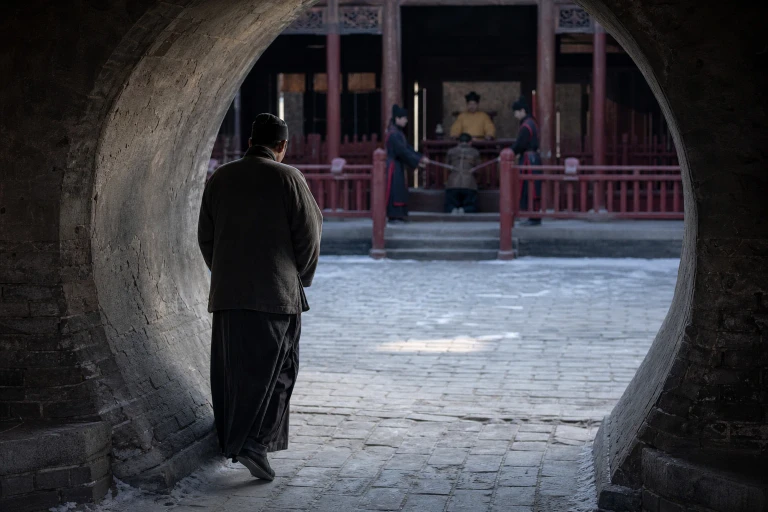
The white‑haired woman pointed to the moon‑shaped archway outside the hall and told Youqing to look. He stepped into the courtyard and felt a chill that pierced his bones. Loud voices came from a house at the back. Walking further, he saw five large halls surrounded by red wooden railings, with a judge’s bench in the center. A man in a yellow robe sat upon it, while another knelt before him. Two men dragged a burly man into the enclosure and forced him to kneel, ordering him to stick out his tongue. Two underworld officials appeared — one looking like an ordinary person, the other with dark‑purple skin. One pulled an iron hook from his bag and hooked out the man’s tongue. The other took a small knife and cut the man’s back. Perhaps in life, the man had failed to guard his speech, committing grave karmic offenses through his words, and was now repaying them. The scene was horrifying. Youqing could not bear to watch. Suddenly, a figure rushed toward him. Terrified, he fled — only to find his path blocked by a vast river. With no escape, he leaped across with all his strength. At that moment, he jolted awake.
A miraculous recovery
The day after awakening, Youqing suffered alternating chills and fever for more than half a month. Yet his condition gradually improved, and the vision in one eye returned. He had vowed to become a monk once he recovered, but his elderly mother did not agree. In August of the first year of the Republic of China, his mother passed away. In February of the following year, Youqing went to Guangren Temple, had his head shaved, and became a monk at twenty‑six. This story is recorded in The True Record of Cause and Effect and Reincarnation. At the time of its recording, Youqing was still alive at forty‑four.
The lessons from the dream
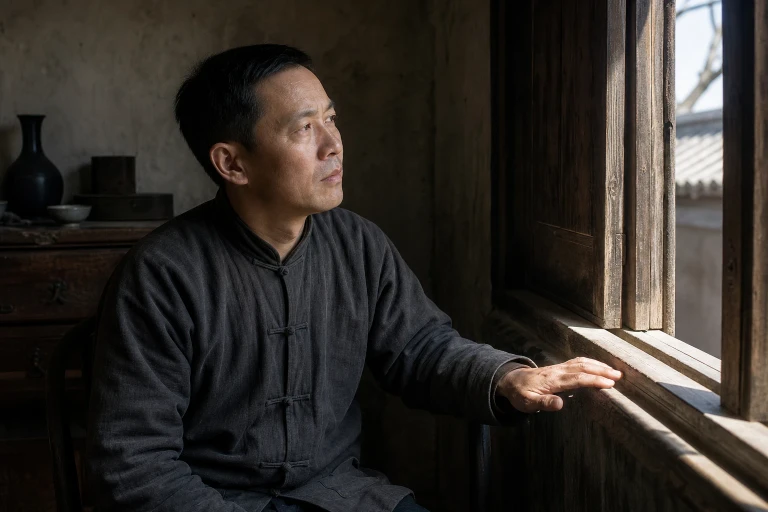
From this extraordinary dream, Youqing came to understand that his illness was not random misfortune, but karmic retribution for transgressions committed in a past life. Yet because he turned toward goodness in this life — treating others kindly, cultivating virtue, and praying with unwavering sincerity — the karmic burden was softened and ultimately resolved. His recovery was not merely physical. It showed that Heaven responds to sincerity, and that karmic debts can be transformed through repentance, upright conduct, and steadfast faith.
By choosing the path of monastic life, Youqing fulfilled the vow he made during his suffering. His healing became both a spiritual awakening and a rebirth, showing that when one aligns body, speech, and mind with uprightness — the true meaning of 直, 矗, and the deeper “Dao” — blessings naturally arise. Perhaps this was the grace bestowed upon him for remaining devoted to the divine even in the darkest moments of illness.
Translated by Audrey Wang and reviewed by Helen London
Follow us on X, Facebook, or Pinterest
