
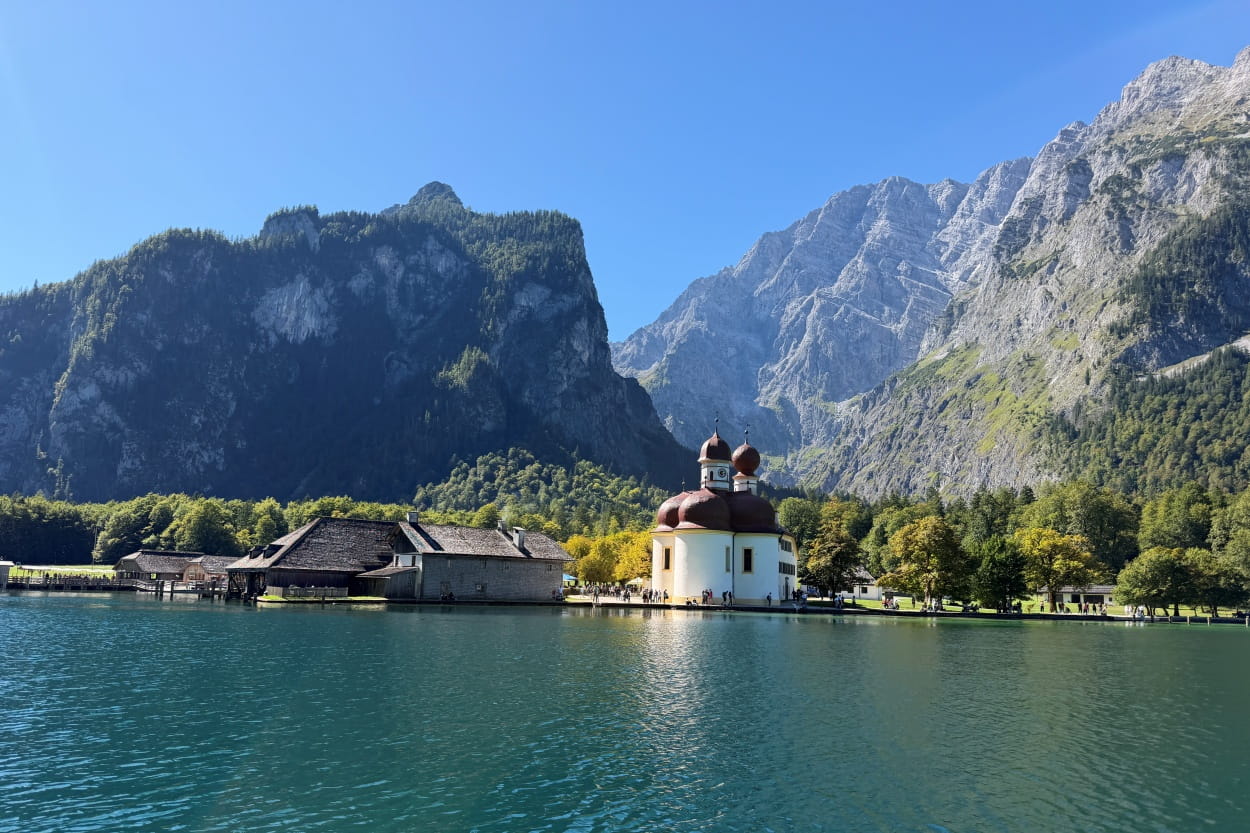
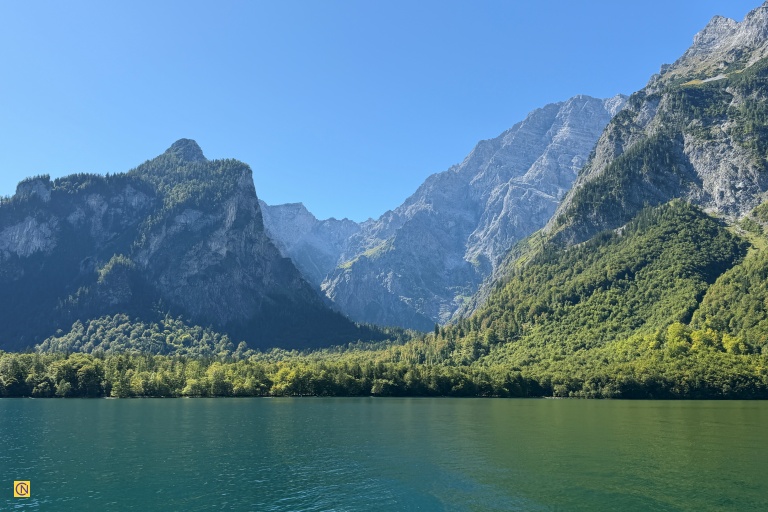
Nestled in southeastern Bavaria near the Austrian border, Königssee is one of Germany’s most spectacular alpine lakes. Within Berchtesgaden National Park, the narrow glacial lake stretches for about 7 kilometers and reaches a maximum depth of 192 meters. Steep cliffs plunge almost vertically into the water, while the imposing Watzmann East Face forms a dramatic backdrop.
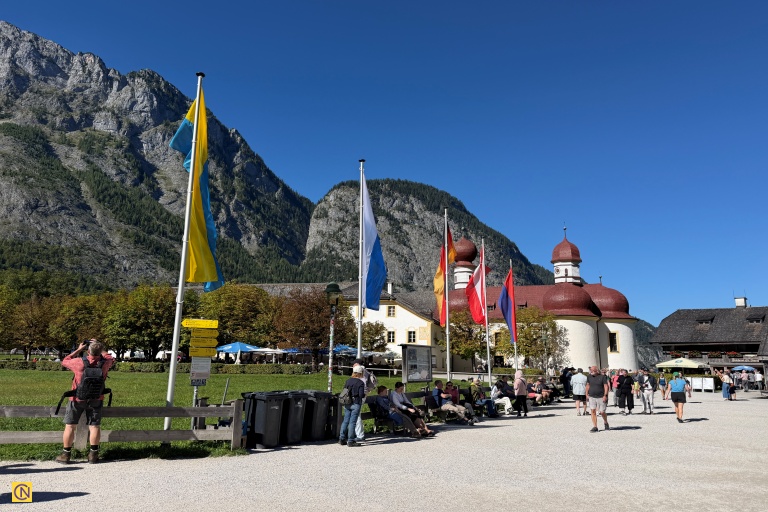
On the way to the lakeshore, visitors pass along Seestraße, a lively pedestrian street lined with shops, restaurants, and historic buildings. Near the lake stands a memorial obelisk dedicated to Prince Regent Luitpold of Bavaria. Erected in 1911 to commemorate his 90th birthday, the stone monument features a bronze portrait medallion of Luitpold and is one of the historic landmarks around Königssee.
Legends behind the name Königssee
Several legends have been passed down about the origin of the name “Königssee.” One local tale says that the surrounding mountains resemble a king, a queen, and their child, while a distant peak looks like a reclining witch. Another legend tells of a cruel ruler and his family who were punished and turned into rocky cliffs overlooking the lake.
These stories, however, are part of local folklore. Historical sources offer different explanations for the name. Early records include names such as “Chunysee” and “Kunysee,” and some researchers suggest that “Kuno” may have played a role in the name’s development. Thus, the true origin of “Königssee” remains open to different interpretations.
Silent electric boats and the famous echo
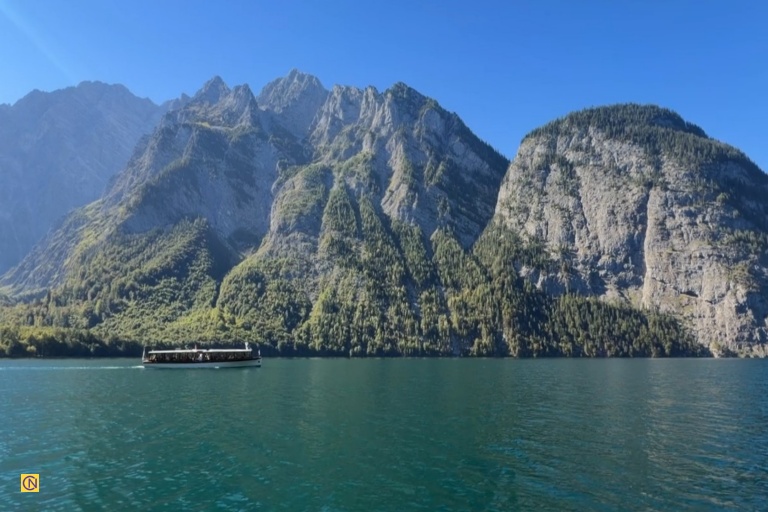
One highlight of visiting Königssee is taking an electric boat into the lake’s heart. Because steep cliffs leave no road or ordinary lakeside trail around the lake, boating is the principal way to experience its dramatic scenery. The boats glide quietly across the emerald-green water, revealing forests, cliffs, and magnificent Alpine peaks along the way.
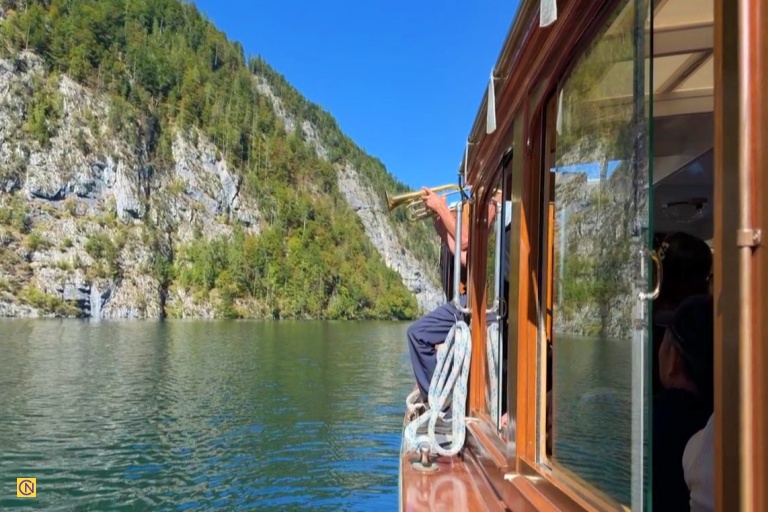
Near the famous Echo Wall, or Echowand, the boat usually pauses while the captain plays a trumpet. The melody bounces off the steep cliffs and returns as a remarkably clear echo, creating one of the lake’s most memorable experiences.
Electric boats have operated on Königssee since 1909, and the passenger fleet remains electrically powered today. The lake has also benefited from a long tradition of environmental protection and has been part of Berchtesgaden National Park since 1978.
St. Bartholomä and its iconic red domes
After about 35 minutes, the boat reaches St. Bartholomä on the Hirschau Peninsula. Dating back to 1134, the famous pilgrimage church is distinguished by its striking red domes and distinctive towers. Together with the former hunting lodge, it forms one of the most recognizable photographic scenes on Königssee, framed by the spectacular Watzmann East Face.
The former hunting lodge beside the church was built around 1700 and later became a traditional restaurant. Prince Regent Luitpold particularly enjoyed spending time at St. Bartholomä hunting with his guests, and the historic dining room “Hoheit” commemorates his connection to the site.
Kessel, Obersee and Germany’s highest waterfall
For hikers, Kessel is a request-only stop and a key gateway to alpine trails leading to destinations such as Gotzenalm and Königsbachalm. Continuing by boat to Salet, visitors can walk for about ten minutes to reach peaceful Lake Obersee.
A trail along the lakeshore continues to Fischunkelalm and offers spectacular mountain views. Beyond Fischunkelalm lies Röthbachfall, Germany’s highest waterfall, with a total drop of 470 meters.
The historic Seeklause
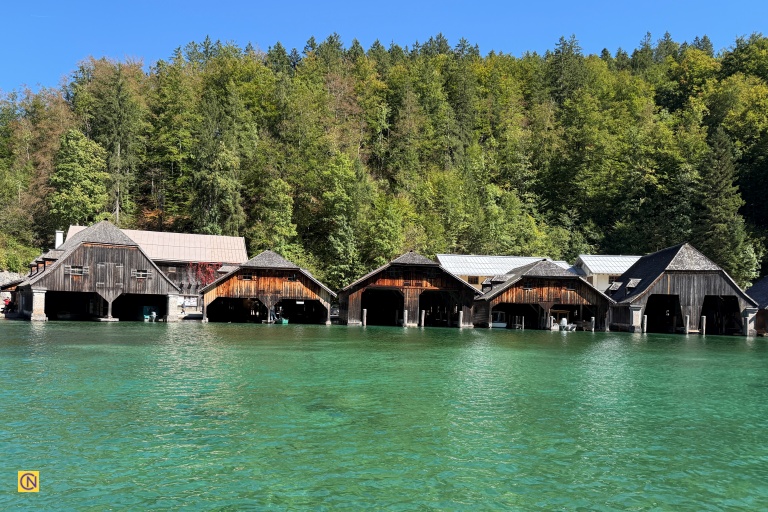
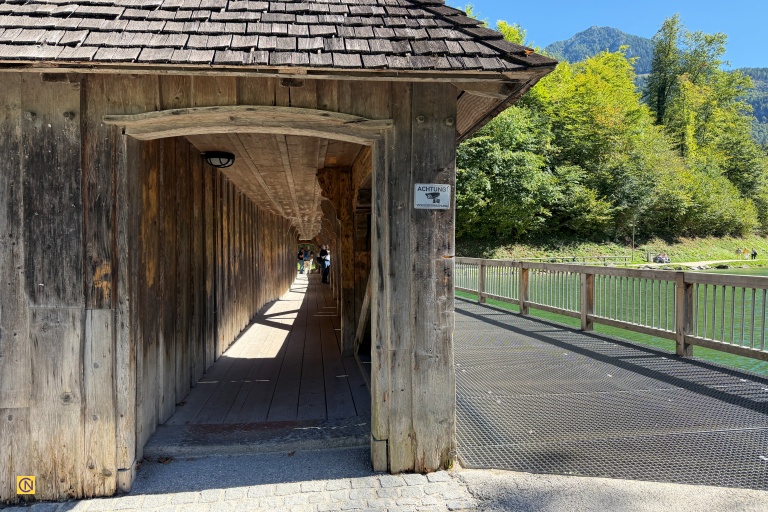
At the northern outlet of Königssee stands the historic Seeklause, a water-control structure between the lake and the Königsseer Ache. It once played an important role in timber transport, but from around 1870 it increasingly helped regulate the lake’s water level. Log driving finally ended in 1970. The structure was extensively rebuilt between 1938 and 1940 and acquired its distinctive covered wooden form and pedestrian bridge.
Today, visitors can walk across the bridge and along the nearby paths, enjoying a peaceful combination of water, forest, and traditional wooden architecture.
The tranquil beauty of the Bavarian Alps
Königssee is more than a scenic mountain lake. It brings together dramatic Alpine landscapes, historic architecture, traditional culture, and long-standing conservation efforts. From silent electric boats and the famous mountain echo to St. Bartholomä, Obersee, and the historic Seeklause, each stop reveals a different aspect of the Bavarian Alps’ enduring beauty.
Follow us on X, Facebook, or Pinterest
