

In 257 B.C., Bai Qi, a renowned general of the ancient Chinese state of Qin, arrived at Duyou, not far from the Qin capital of Xianyang. A messenger sent by King Zhaoxiang of Qin brought him a sword and ordered him to take his own life. Bai Qi looked up at the heavens and sighed: “What crime have I committed against Heaven to deserve this?”
After a long silence, he seemed to realize something. The Records of the Grand Historian, in its biography of Bai Qi and Wang Jian, records his final words: “I indeed deserve to die. At the Battle of Changping, hundreds of thousands of Zhao soldiers surrendered, but I deceived them and had them all buried alive. That alone is enough to warrant my death.” With those words, Bai Qi fell upon his sword and died. His earthly life had ended. Yet according to ancient Chinese accounts of karma and retribution, his death did not settle the blood debt he had incurred through the massacre of some 400,000 surrendered soldiers at Changping.
For more than a thousand years, from the Sui and Tang dynasties through the Southern Song Dynasty and into Ming Dynasty literature, Bai Qi’s name repeatedly appeared in accounts of the underworld, reincarnation, and punishment for past misdeeds. These stories were preserved not to celebrate military strategy, but to convey a traditional Chinese teaching: Good deeds bring blessings, while evil deeds bring retribution.
Eight centuries after his death, his sins remained unpaid
In A.D. 591, during the reign of Emperor Wen of the Sui Dynasty, an unusual incident reportedly occurred.
Zhao Wenchang, an official in the imperial treasury, suddenly collapsed and appeared to die. Although he had stopped breathing, his family noticed that his chest remained slightly warm. They therefore delayed placing his body in a coffin. After some time, to their astonishment, Zhao revived.
Upon awakening, Zhao described his experience in the afterlife. He said he was brought before Yama, the King of the Underworld, who asked what good deeds he had performed during his lifetime. Zhao replied that his family was poor and he had been unable to perform many charitable acts. However, he had consistently devoted himself to reciting the Diamond Sutra, a Buddhist scripture.
Upon hearing this, Yama praised Zhao’s devotion and ordered an attendant to bring him the scripture. Zhao recited it without missing a single word and was granted permission to return to the world of the living.
As a guide escorted him through the southern gate of the underworld, they passed a large pit filled with human waste. Someone was submerged in the filth, with only a patch of hair visible above the surface. Astonished by the sight, Zhao asked who the person was. The guide replied: “That is Bai Qi, the general of Qin. He is imprisoned here because he has not yet repaid the debt of his sins.”
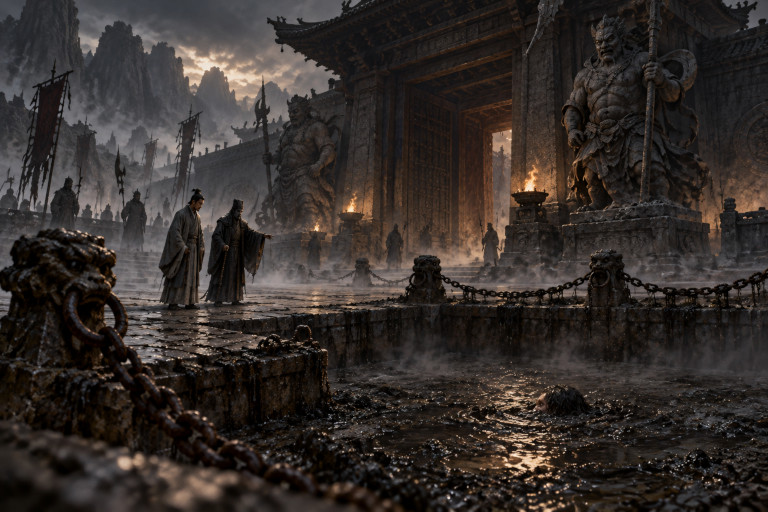
More than 800 years had passed since Bai Qi’s death, yet according to this account, his punishment was still continuing.
Ancient Buddhist literature preserved the story, including Fayuan Zhulin (A Forest of Pearls in the Garden of Dharma) and Taiping Guangji (Extensive Records of the Taiping Era).
Bai Qi appears again during the Tang Dynasty
Several decades later, during the reign of Emperor Gaozong of the Tang Dynasty, a monk named Daoying lived at Fahai Temple in Chang’an. The Northern Song Dynasty monk Zanning recorded an extraordinary encounter involving Daoying in Volume 18 of the Song Biographies of Eminent Monks.
According to the account, Daoying received a message from King Zhuangxiang of Qin, the deceased father of Qin Shi Huang, China’s first emperor. The former king and his more than 300 followers were starving and asked the monk to provide food. Moved by compassion, Daoying agreed to prepare a meal.
When the king and his entourage arrived, Daoying encountered the spirits of figures who had lived centuries earlier. During their conversation, King Zhuangxiang pointed out two men among his companions. “These are Bai Qi and Wang Jian,” he explained. Both were celebrated generals in Chinese military history. Bai Qi had defeated the state of Zhao at the Battle of Changping, while Wang Jian played a major role in conquering Zhao, Yan, and Chu, helping Qin Shi Huang unify the Warring States.
Yet the ancient account did not dwell on their military achievements. Instead, it explained that because they had killed so many people, their karmic punishment had not yet come to an end. The message echoed the earlier account of Bai Qi’s suffering in the underworld. One record described his sins as still unpaid; the other declared that his punishment had not ended.
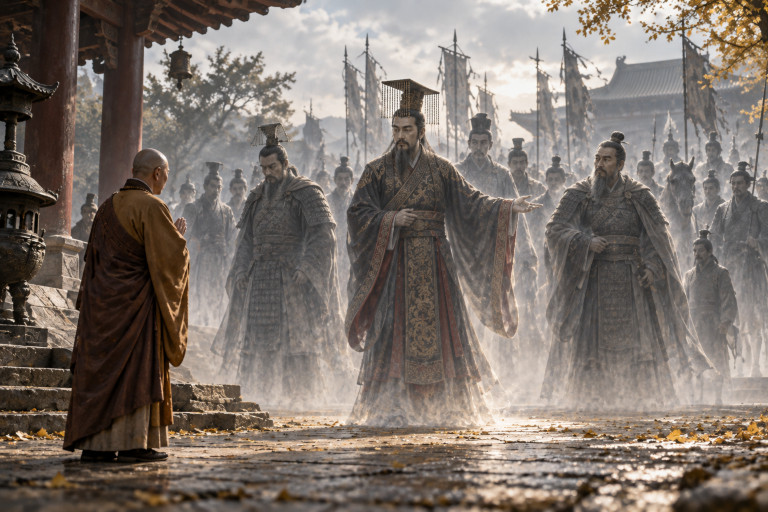
By then, the Qin Dynasty had long since disappeared, and the remains of those who died at Changping had been buried beneath the earth. Yet in these traditional accounts of cause and effect, an individual’s death or a dynasty’s fall did not erase the consequences of past actions.
A young woman claims to be Bai Qi’s reincarnation
Centuries later, in A.D. 1195, during the Southern Song Dynasty, a 17-year-old girl from a family surnamed Chen in Fuzhou became seriously ill. As her condition worsened, her family gathered around her bedside.
Near the end of her life, the young woman, who had never learned to read, suddenly spoke words that astonished everyone present: “I am Bai Qi, the general of ancient times.”
Her family was bewildered. They asked why she claimed to be the ancient Qin general who had died more than 1,400 years earlier.
The girl replied that she was indeed Bai Qi. During her former life, she said, she had killed 700,000 to 800,000 people and had subsequently endured immeasurable suffering in hell. Her punishment, however, had not ended there.
She explained that she had only recently been permitted to regain human form. Even so, she was condemned to be reborn as a woman in every lifetime, with each life ending before the age of 20. After speaking these words, she died.
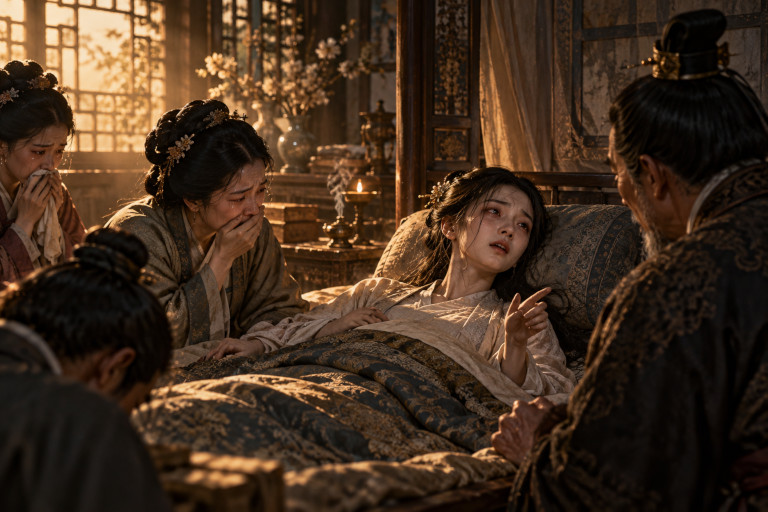
The account appears in Yijian Zhi (Records of the Strange), a collection of extraordinary stories compiled by the Southern Song scholar Hong Mai. The story is titled “The Daughter of the Chen Family Becomes Bai Qi.”
According to this account, more than 1,400 years after Bai Qi’s death, his punishment had still not been fully repaid. Even after enduring the torments of hell, he continued to suffer through repeated reincarnations and shortened lives.
For the young woman, death came at just 17, an age when life had scarcely begun.
The legend of the lightning-struck ox
Another unusual account of Bai Qi’s karmic retribution appears in the Ming Dynasty novel Chronicles of the Eastern Zhou Kingdoms, written by Feng Menglong. In Chapter 99, after recounting Bai Qi’s death, the author describes a strange incident said to have occurred during the late Tang Dynasty.
One day, a violent thunderstorm swept through an area, and a bolt of lightning struck and killed an ox.
When people examined the animal, they were astonished to discover two Chinese characters on its belly: “Bai Qi.”
The incident prompted speculation that the general, having killed so many people during his lifetime, had been reborn in the animal realm as punishment for his deeds. Even centuries after his death, he had not escaped the consequences of his actions, and people interpreted the lightning strike as another act of retribution.
Feng Menglong concluded the account with a warning: “When the karma of killing is so grave, should those who command armies not take heed?”

A karmic debt spanning more than a thousand years
Taken together, these ancient accounts present a striking sequence of stories extending across more than 14 centuries.
At the end of the Warring States period, Bai Qi acknowledged his responsibility for the slaughter of surrendered soldiers at Changping before taking his own life. More than 800 years later, a Sui Dynasty account described him still suffering in the underworld, his sins not yet repaid.
In a Tang Dynasty encounter preserved by a Song Dynasty Buddhist writer, Bai Qi appeared alongside Wang Jian, both said to be undergoing punishment for the many lives they had taken. Centuries later, a dying girl in the Southern Song Dynasty claimed to be Bai Qi’s reincarnation, condemned to repeated lives of suffering and premature death. A later Ming Dynasty novel preserved yet another legend in which he was reborn as an ox and killed by lightning.
These accounts come from different periods and different types of literature. Buddhist accounts of miraculous events, collections of supernatural tales, and historical novels are not equivalent to official historical works such as the Records of the Grand Historian. Nevertheless, they preserve a belief deeply rooted in traditional Chinese culture: The consequences of good and evil do not necessarily end with a person’s death.
During his lifetime, Bai Qi was among the most formidable generals of the Warring States period. Honored with the title Lord Wu’an, he commanded Qin’s armies for more than three decades, captured over seventy cities, and was credited with an undefeated military record. Yet his victories came at an enormous human cost. His reputation for ruthless killing earned him the epithet “Butcher of Men.” With a single military command, he could determine the fate of hundreds of thousands of people.
However, in accounts passed down by later generations, his power and military glory offered him no protection. In Taiping Guangji, the once-feared general was reduced to a patch of hair protruding from a pit of filth. In the Song Biographies of Eminent Monks, he was a spirit whose punishment had not ended. In Yijian Zhi, he appeared as a young woman condemned to die before reaching 20. And in Chronicles of the Eastern Zhou Kingdoms, he was reborn as an ox struck down by lightning.
An ancient Chinese saying from the I Ching, or Book of Changes, teaches: “A family that accumulates good deeds will have blessings to spare; a family that accumulates evil deeds will have calamities to spare.”
The consequences of one’s actions are not always immediately apparent. A person who commits evil may still enjoy wealth and influence, while a general responsible for countless deaths may receive honors and titles. When judged only by the events of a single lifetime, justice may sometimes seem absent. Traditional Chinese teachings about karma, however, look beyond the brief span of an earthly life. They hold that good and evil carry consequences that may unfold across generations and even successive lifetimes.
The stories of Bai Qi, preserved and retold for more than a thousand years, reflect this enduring understanding of moral responsibility. His military victories brought him fame, but the lives lost through his commands left a debt that, according to these ancient accounts, neither his power nor his death could erase.
In the moral teachings preserved by the ancients, death is far from the end of a karmic debt.
References
- Sima Qian, Records of the Grand Historian (Shiji), “Biographies of Bai Qi and Wang Jian.”
- Fayuan Zhulin (A Forest of Pearls in the Garden of Dharma), accounts concerning Bai Qi’s karmic retribution.
- Taiping Guangji (Extensive Records of the Taiping Era), Volume 102, “Zhao Wenchang.”
- Zanning, Song Biographies of Eminent Monks (Song Gaoseng Zhuan), Volume 18, “Biography of Daoying.”
- Hong Mai, Yijian Zhi (Records of the Strange), Wu Collection, Volume 1, “The Daughter of the Chen Family Becomes Bai Qi.”
- Feng Menglong, Chronicles of the Eastern Zhou Kingdoms (Dongzhou Lieguo Zhi), Chapter 99.
Translated by Chua BC
Follow us on X, Facebook, or Pinterest
