

When a person is overwhelmed by pessimistic thoughts, fear, or anxiety, the effects are not confined to the mind. Prolonged psychological stress can affect many systems throughout the body, including the immune system.
The body’s stress response is not inherently harmful. In the short term, it helps us respond to danger, pressure, or other immediate challenges. Trouble arises when that state does not switch off. Chronic stress can disrupt immune regulation, weakening some protective immune responses while promoting excessive or prolonged inflammation.
Feelings of exhaustion, hopelessness, or persistent anxiety can therefore place a genuine burden on both mental and physical health. They don’t simply “shut down” the immune system, but prolonged stress can make it harder for the body to maintain the balance needed for health and recovery.
Inflammation can heal — or harm
Physical health depends in part on a continuous balance between damage and repair, and the immune system plays a central role in that process.
Inflammation itself is not the enemy. When we are injured or infected, inflammation is one of the body’s essential defense and repair mechanisms. Immune cells gather at the affected area, fight invading organisms, remove damaged cells, and kick-start healing. In other words, a healthy inflammatory response protects us.
Problems arise when inflammation does not subside after its work is done, or when the immune system directs its response toward healthy tissue. Instead of protecting and repairing the body, persistent or misdirected inflammation can begin to damage it.
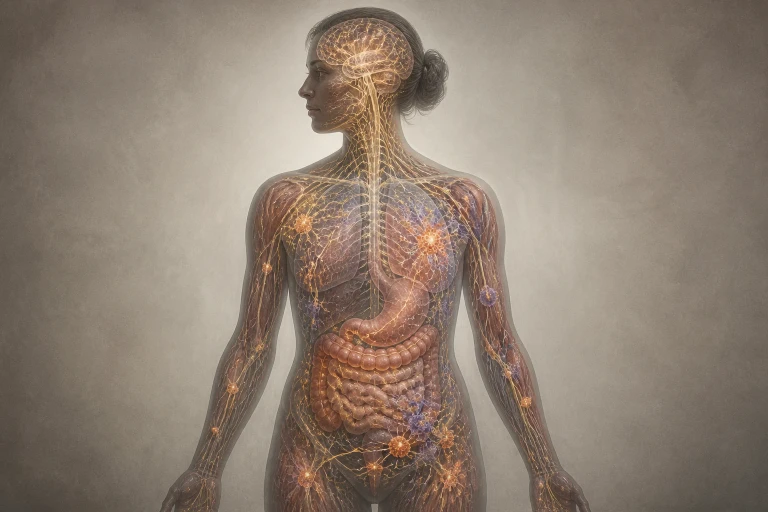
This distinction is important. A healthy immune system is not simply a more active immune system. It must know when to respond, how strongly, and when to stand down. Too little immune activity can leave the body less able to defend itself, while excessive or misdirected activity can contribute to tissue damage, chronic inflammatory conditions, and autoimmune disease. The goal, then, is not to eliminate inflammation, but to maintain the body’s ability to regulate it appropriately.
When stress and physical symptoms reinforce each other
Peptic ulcers offer one example of how physical illness and emotional stress can become intertwined.
Two of the most common causes of peptic ulcers are infection with Helicobacter pylori bacteria and the use of nonsteroidal anti-inflammatory drugs. Treatment may therefore include antibiotics to eliminate H. pylori, acid-suppressing medications, medication adjustments, or other measures that target the underlying physical cause.
But addressing the physical cause does not mean emotional stress is irrelevant. When people become caught in recurring patterns of anxiety, tension, worry, or anger, the body repeatedly activates its stress-response systems. Stress hormones rise, muscles tense, and digestive symptoms such as stomach pain and discomfort may become more pronounced. Those symptoms can then generate still more anxiety. Pain creates worry; worry creates more tension; and the cycle continues.
This is one reason persistent emotional stress deserves attention alongside appropriate medical treatment. Treating an ulcer’s physical cause remains essential, but reducing the stress that aggravates symptoms can also be an important part of recovery.

What keeps the body from relaxing?
The same question can be useful more broadly: What pressures, worries, or concerns repeatedly keep the mind and body in a state of tension?
Sometimes you can’t change the external problem immediately. A difficult relationship, financial pressure, illness, family concerns, or uncertainty about the future may remain. But our internal response to those circumstances is not always fixed.
Recurring thoughts can produce recurring emotional reactions. Worry leads to tension; anger brings another surge of stress; the mind returns to the same problem, and the body responds again. Recognizing that cycle is the first step toward interrupting it.
We can ask ourselves: Can I accept that I am experiencing these emotions? If not, why? What am I afraid of losing, or what am I trying to control? Do I recognize that another emotional response is possible? If so, am I willing to choose one?
These questions are not an invitation to deny difficult emotions or pretend serious problems don’t exist. The purpose is to understand what keeps us trapped in the same emotional pattern.
Breaking the cycle of chronic stress
The better you understand yourself, the better you can regulate your responses. Recognizing what matters deeply to us can help explain why certain people or situations provoke such powerful emotions.
Self-acceptance also matters. Fighting every unwanted thought or feeling can create another layer of tension, while recognizing an emotion without letting it control our response can help prevent the same stress cycle from repeating indefinitely.
We cannot remove every source of pressure from our lives, nor can a change in attitude cure an infection, an ulcer, cancer, or an autoimmune disease. Such conditions require appropriate medical diagnosis and treatment. But that doesn’t make the mind-body connection unimportant.
Chronic emotional stress has physical consequences, and learning to reduce that stress can become a meaningful part of caring for the body. Greater self-awareness gives you the opportunity to recognize when fear, anger, worry, or tension becomes a repeated pattern and respond differently.
When the body needs an immune response, that response is protective. When the danger has passed, the body also needs to return to balance. Supporting that balance — through appropriate medical care, healthy habits, stress reduction, and greater awareness of our own emotional patterns — can help create better conditions for both physical and emotional well-being.
This article is adapted and excerpted from the book Self-Healing Through the Power of Mind: Reversing Chronic Illness by Hsu Jui-yun and Cheng Hsien-an. The views expressed herein are solely those of the authors. Reprinted with permission from Commonwealth Publishing Group. For the complete work, see the original book.
Translated by Patty Zhang
Follow us on X, Facebook, or Pinterest
