
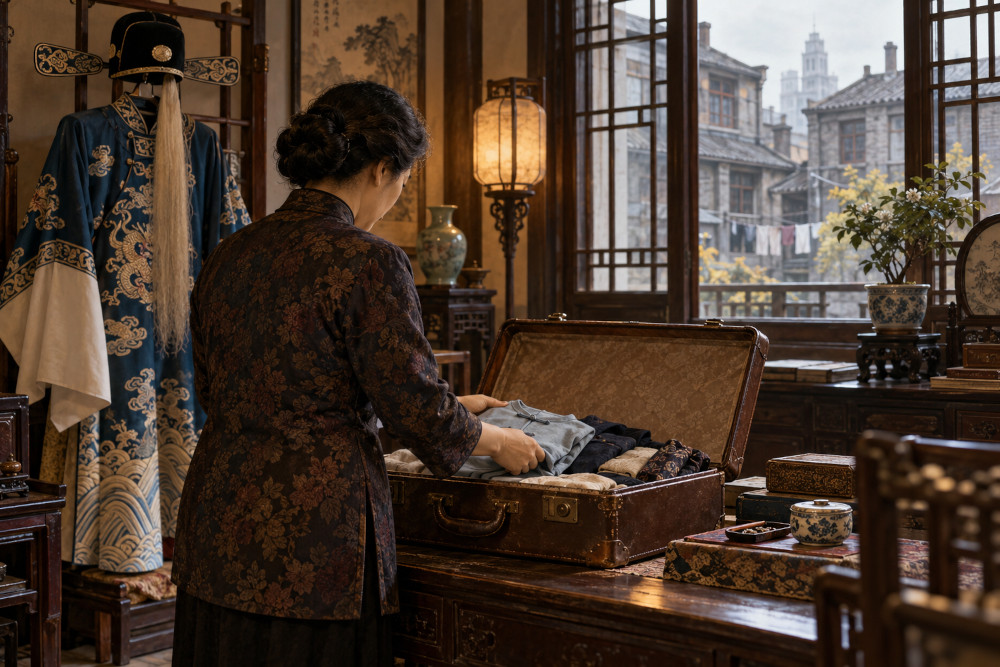
“Of the six children in our family, five escaped the decade of catastrophe,” Zhou Caici recalled during a 2009 interview with Shanghai’s Xinmin Weekly. Known internationally as Vivian Chow and affectionately called “Aunt Ci” (茨姑), she was a prominent figure in Hong Kong and Shanghai entertainment circles who had helped advance the careers of celebrated performers such as Leslie Cheung and Jacky Cheung.
Her father was Zhou Xinfang, one of the greatest Peking Opera masters of the 20th century. Her mother, Qiu Lilin, also known as Lilian Qiu, came from a wealthy Shanghai family and was one of the city’s leading socialites. Having lived through war and political upheaval, Qiu sensed that another disaster was approaching China. One by one, she sent five of her six children abroad, even as she chose to remain beside her husband.
Years later, the children would come to understand the full significance of their mother’s decisions. While they built new lives overseas, their parents and eldest brother endured years of persecution under the Chinese Communist Party.
A mother who foresaw danger
Zhou Xinfang and Qiu Lilin had six children together: four daughters and two sons. Only their elder son, Zhou Shaolin (William Chow), remained in mainland China with his parents throughout the Cultural Revolution.
In 1947, Qiu sent her eldest daughter, Zhou Caizao (Susan Cha), to the United States to study. In the early 1950s, she arranged for her third daughter, Zhou Caiqin, who would become internationally known as the actress Tsai Chin, and her younger son, Zhou Yinghua, later known as restaurateur Michael Chow, to study in Britain. Her second daughter, Zhou Caiyun (Cecilia Chung), and youngest daughter, Zhou Caici, eventually settled in Hong Kong. Zhou Xinfang once compared his wife to an old mother cat carrying her kittens to safety, one by one, in her mouth.
Qiu’s determination reflected her growing unease about China’s political future. When her own family relocated to Hong Kong in 1947, they urged her to accompany them. She declined because she knew her husband, deeply attached to his homeland and his art, would not willingly leave. Despite her misgivings about China’s future, she was determined to remain at his side.
Zhou Caici later recalled that her mother frequently warned of an approaching getou, a Shanghai dialect expression referring to an obstacle so formidable that it could not be overcome. “My mother was remarkable,” she recalled. “She was always so capable. She understood human nature and saw things very clearly. She had a worldly side, but also an extraordinary side.”
At the time, the children were reluctant to leave their comfortable lives in Shanghai. They could not understand why their mother insisted on separating them from their family and homeland. Only after learning of their parents’ suffering did they fully appreciate the painful choices she had made.
A master of Peking Opera
In the spring and summer of 1949, as the Chinese Communist Party prepared to take control of Shanghai, Zhou Xinfang received offers encouraging him to relocate to Hong Kong. He was reportedly promised generous financial rewards and opportunities to perform internationally, but none of these inducements persuaded him to leave China.
Zhou’s decision to remain in Shanghai was celebrated by the incoming Communist authorities. Chen Yi, who became the city’s mayor, hosted a banquet in his honor. That October, Zhou and fellow Peking Opera master Mei Lanfang attended the founding ceremony of the People’s Republic of China at Tiananmen.
Zhou had devoted nearly his entire life to Peking Opera. He first appeared onstage at seven under the name Qilintong, or “Qilin Boy,” and eventually became the founder of the influential Qi school of performance. His remarkable career nearly ended when his voice changed during adolescence. At 14, his formerly clear voice became rough and hoarse — a potentially devastating setback for a Peking Opera performer.
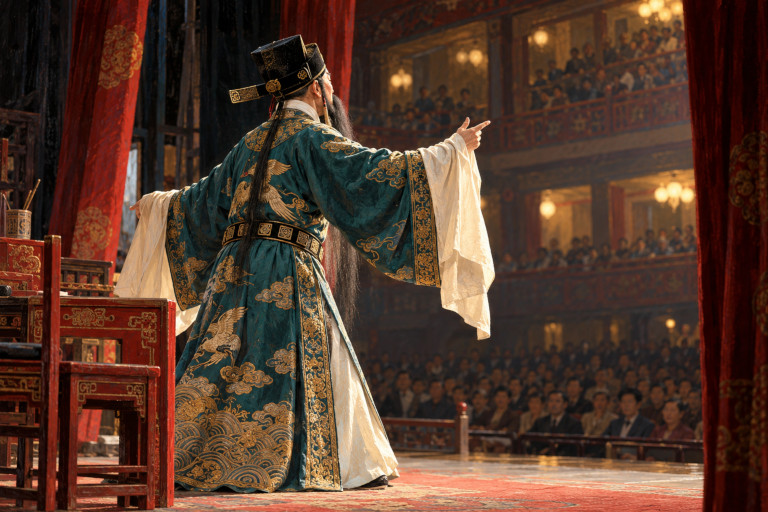
Rather than abandon the stage, Zhou spent years developing a distinctive singing style suited to his altered voice. Its restrained, resonant quality, combined with his commanding speech, expressive movements, and mastery of traditional stage techniques, won him widespread admiration. His repertoire included such classics as The Fisherman’s Revenge, Xu Ce Runs Through the City, and Xiao He Chases Han Xin in the Moonlight. He was celebrated alongside Ma Lianliang, another leading performer of older male roles, in the pairing known as “Southern Qi and Northern Ma.”
After the Communist takeover, Zhou held numerous official cultural positions, including director of the Shanghai Peking Opera Theater. In 1959, he joined the Chinese Communist Party. Despite his prominence and his willingness to work within the new political system, however, he would eventually become a target of the regime.
Conflict with Jiang Qing
Beginning in the early 1960s, Mao Zedong’s wife, Jiang Qing, became increasingly involved in reshaping China’s performing arts according to Communist political ideology. She promoted revolutionary “model operas” and sought to displace much of the traditional repertoire. Zhou Xinfang, who had spent his life preserving and developing traditional Peking Opera, opposed this direction.
In 1965, at a Party meeting within the Shanghai Peking Opera Theater, he criticized the decision to suspend regular performances in favor of concentrating resources on productions such as Taking Tiger Mountain by Strategy. He argued that the policy wasted enormous sums of money and deprived performers of valuable years in which to develop their art.
His criticism brought him into conflict with Jiang Qing and the increasingly radical political forces surrounding her. Soon, accusations began circulating about Zhou’s political background. Shanghai’s Wenhui Bao newspaper published repeated attacks on his historical opera Hai Rui Submits His Memorial, portraying it as an anti-Party and anti-socialist work.
In May 1966, as the Cultural Revolution began, officials and security personnel entered Zhou’s home and took him away for political investigation. Before leaving, Zhou looked at his wife, embraced her, and said: “I’m leaving. Take good care of yourself.” For Qiu Lilin, the catastrophe she had feared for so long had finally arrived.
Violence descends on the family
By August 1966, Zhou Xinfang and his eldest son, Zhou Shaolin, were being detained and interrogated at the opera theater. The violence soon reached their home, where Red Guards subjected members of the family to terrifying abuse.
According to accounts of the family’s ordeal, the Red Guards stormed the residence and attacked the family watchdog with bricks and stones. They whipped Zhou’s daughter-in-law, Huang Minzhen, with military belts until she lost consciousness. They also seized his granddaughter, Meimei, threatening to shave her head in a deliberately humiliating style and parade her publicly as an enemy of the revolution. The girl suffered such severe psychological trauma that she was subsequently admitted to a psychiatric hospital in Shanghai.
Zhou Shaolin tried desperately to protect his father. When the elder Zhou was taken to the Lyceum Theatre, his son followed. “Why did you come?” Zhou Xinfang asked him. “They’re going to beat you!” His son replied: “If they beat me, you’ll have to take a few fewer blows.”
The persecution intensified during Shanghai’s January Storm of 1967. Zhou Xinfang was forced onto an elevated utility repair truck and paraded through the streets as a political enemy. His arms were twisted behind his back, and a humiliating placard hung from his neck. Blood ran from his nose and the corners of his mouth. His hair was pulled back violently, and his face was covered with bruises.
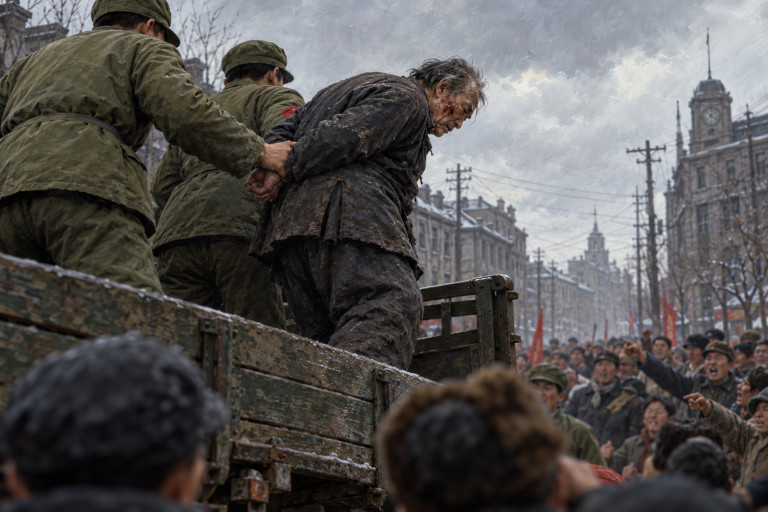
Qiu Lilin was also subjected to repeated public humiliation and savage beatings. The attacks left her covered in wounds and, at times, unable to rise from her bed. When someone urged her to hide, she refused, explaining that the attackers would simply direct their violence toward her husband instead. She told her daughter-in-law: “Let them beat me to death instead. Otherwise, they will beat your father to death.”
Qiu Lilin’s final sacrifice
In March 1968, Zhang Chunqiao, a powerful Communist official who would later become notorious as a member of the Gang of Four, authorized Zhou Xinfang’s arrest. His son was also taken into custody.
Within days, Qiu Lilin was subjected to another brutal assault. Accounts of her mistreatment describe attackers seizing her by the hair and repeatedly hurling her against walls and onto the floor until she lost consciousness. The beatings caused devastating injuries, including damage to her kidneys. She was eventually found collapsed in her husband’s study.
Her eldest daughter-in-law, Huang Minzhen, recognizing that her condition was critical, rushed her to the hospital. But according to the family’s account, medical personnel were forbidden to treat her. She was left on a stretcher in the corridor outside the emergency room, without the care she desperately needed.
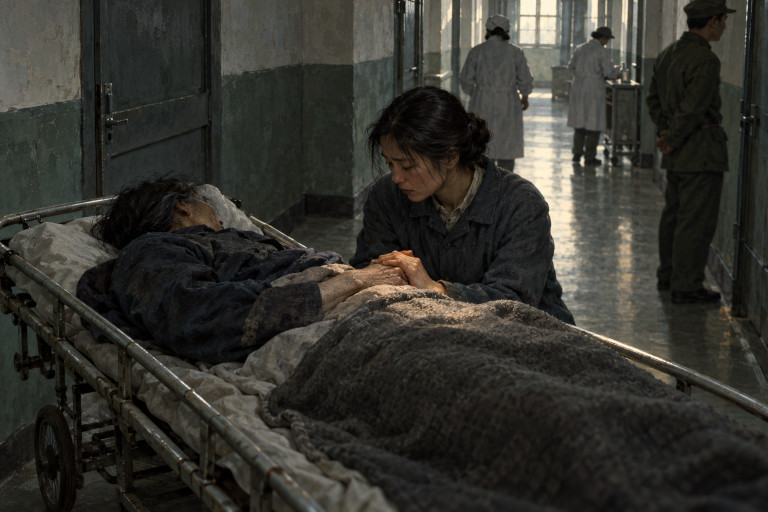
Qiu had spent years protecting her children from the political turmoil she believed was coming. Five had reached safety overseas, but she had been unable to protect her husband or the son who remained with them. She and Zhou Xinfang had shared decades of hardship and devotion. During his earlier performing career, she had even accompanied him on demanding tours through northern China, carrying a small pistol for protection.
As her life drew to a close, her greatest consolation was that five of her children had escaped the catastrophe. Her deepest regret was that she had been powerless to protect her husband, whose safety remained her foremost concern.
Late on March 27, 1968, with Huang Minzhen beside her, Qiu whispered: “Don’t cry. In the future, your father…” She died before she could finish speaking, at the age of 63.
The woman who had recognized the danger ahead and helped five children escape it had herself become a victim of the Cultural Revolution. Her death left her husband and children separated by political persecution, imprisonment, and thousands of miles, with little chance to comfort one another in their grief.
Translated by Chua BC
Follow us on X, Facebook, or Pinterest
