
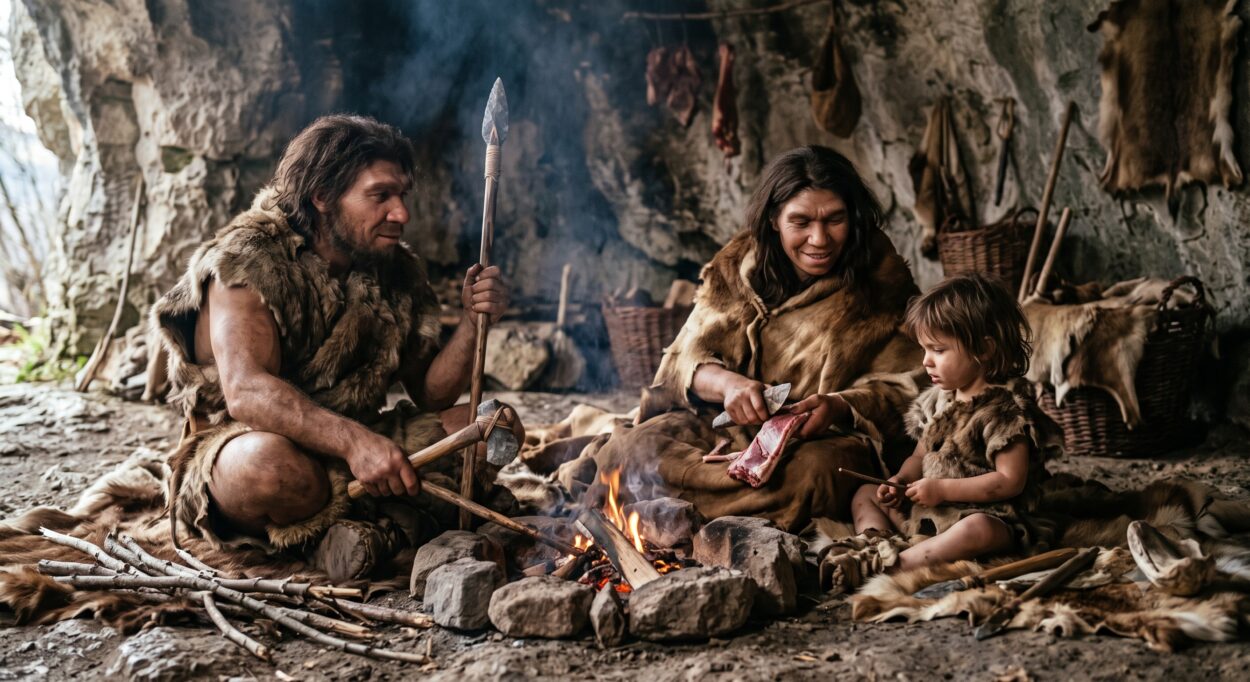
The email arrives with a percentage. You are 2% Neanderthal. Something small and involuntary happens when most people read that sentence. A flinch. A joke about clubs and caves. Ever since a limestone quarry in Germany’s Neander Valley gave up a strange, heavy-browed skeleton in 1856, the word has worked in English as an insult. Slow. Brutish. Unfinished. That flinch is a misunderstanding. The archaeology shows a people who cared for their sick and injured over months and years. The Neanderthal DNA you carry is not a leftover flaw or a mark of something unevolved. It is closer to a survival kit. It came from people who had already spent hundreds of thousands of years learning to live through Eurasian winters. Those winters would have killed a newcomer from Africa.
Much has changed since we first wrote about Neanderthal DNA in 2017. Researchers can now say when the two peoples met and for how long. They can name the traits that meeting left behind, and correct a few stories that turned out to be wrong. And they have discovered that the most extraordinary chapter of the whole story was written not in Europe, but in China.
How much Neanderthal DNA do you carry?
Most people living outside Africa carry roughly 1% to 2% Neanderthal DNA, and some carry as much as 4%. People of African descent carry it too, at about a third of the level found in Eurasians. East Asians carry the most of anyone, slightly more than Europeans do. That second sentence quietly overturns something most of us were taught. For years the textbook line was simple: Neanderthals met modern humans only after our species left Africa, so Africans inherited nothing from them. In 2020, a Princeton team led by Joshua Akey built a new computational tool called IBDmix and went looking anyway. They found Neanderthal DNA in African genomes. Some of it was carried back into the continent by Eurasians who migrated home again. Some came from an even older gene flow running the other way.
It is a correction worth sitting with, because the older version of the story has been misused. No human population is without a share of Neanderthal DNA. We covered that finding when it was first reported, and it holds up: Africans carry Neanderthal ancestry, too.
Why East Asians carry more than Europeans
Here is a puzzle that almost no one bothers to explain. Neanderthals lived in Europe and western Asia. Their bones come out of European caves. So why do people in China, Japan, and Korea carry between 8% and 24% more Neanderthal DNA than Europeans do? The most likely explanation has less to do with romance than with farming. Around 10,000 years ago, farmers spread out of Anatolia into Europe in great numbers. They carried comparatively little Neanderthal ancestry, and as they mixed with the hunter-gatherers already living there, they diluted the European share. A modeling study published in Science Advances in 2023 found that this expansion of farming was decisive.
East Asia saw no such influx. Farming there developed locally from the people already present, and the Neanderthal signal was never diluted. It is one more reminder of how thoroughly migration has redrawn the genetic map of Europe, a story we have followed in our coverage of what ancient DNA reveals about migration.
A 7,000-year encounter: When we met the Neanderthals
For a long time, the meeting between the two peoples was imagined as a scatter of brief encounters across tens of thousands of years. Two studies published in December 2024, one in Science and one in Nature, replaced that picture with something far more intimate. Researchers read segments of Neanderthal DNA from ancient and modern genomes, then measured how far apart they were due to recombination. That let them date the main period of interbreeding with real precision. It began about 50,500 years ago. It lasted roughly 7,000 years. Its center of gravity sits around 47,000 years ago, and then Neanderthals began to vanish from the record entirely.
Seven thousand years is not a fling. It is longer than the span separating us from the building of Stonehenge, twice over. For that entire stretch, two kinds of human lived alongside each other, and often enough with each other, across the same cold landscape. Every person alive today whose ancestors left Africa descends from that single long encounter and carries Neanderthal DNA as a result. The variation you carry, and the variation your neighbor carries, traces back to the same few thousand years. If you are curious about the deeper past of this lineage, we have written about where the Neanderthal lineage began.
Skin, sun, and the trait that started it all
The finding that first drew attention to this question, and the one our original article was built around, concerned something ordinary: whether you tan or burn. In 2017, Michael Dannemann and Janet Kelso at the Max Planck Institute for Evolutionary Anthropology sifted through data from 112,338 participants in the UK Biobank. They were looking for stretches of Neanderthal DNA that tracked with everyday traits, and they found them. “We can now show that it is skin tone, and the ease with which one tans, as well as hair color, that are affected,” Kelso said of the team’s findings.
The interesting detail is that the effect runs in both directions. Some Neanderthal variants are associated with lighter skin; others with darker skin. There is no single Neanderthal complexion hiding in the modern genome. What there is, instead, is variation, and a great deal of it. One archaic variant associated with poor tanning and a higher risk of childhood sunburn is carried by more than 66% of Europeans.
The likely reason is light. Neanderthals had lived under the weaker ultraviolet radiation of Eurasia for hundreds of thousands of years before Homo sapiens arrived from a far sunnier continent. Their pigmentation genes had been shaped by that dimmer sky, and when the two populations met, some of those adaptations passed across. One honest caveat belongs here, and it applies to much of what follows. The UK Biobank participants in this study were of British ancestry. A finding drawn from one population is a finding about that population until someone checks the others.
Sleep, pain, and mood: The Neanderthal genes you live with
Skin was only the beginning. As biobanks have grown, so has the catalog of Neanderthal DNA traits, running from sleep to pain to immunity.
Are you a morning person?
This is where the story has genuinely changed, including for us. Dannemann and Kelso’s 2017 work identified variants near a gene called ASB1 that were associated with a preference for being an evening person, a night owl. Our original article reported exactly that. It was a reasonable reading of a single locus, one spot on the genome.
But a single locus is not a genome. In December 2023, Keila Velazquez-Arcelay, John Capra, and colleagues examined the entire set of archaic variants affecting circadian genes and found that, taken together, they push in opposite directions. Their conclusion, published in Genome Biology and Evolution, was that introgressed variants most strongly associated with chronotype “increase the propensity for morningness.” The explanation is elegant. Near the equator, day length barely shifts across the year. At high latitudes it swings wildly, and a body clock that runs slightly fast is better at catching up with the lengthening light of spring. Neanderthals had been solving that problem for far longer before we showed up.
So if you wake before your alarm, you may have inherited a body clock tuned for northern summers. Whether that morning energy is best spent exercising is a separate question, and one worth reading about: whether you train better in the morning or the evening.
Why some people feel pain more sharply
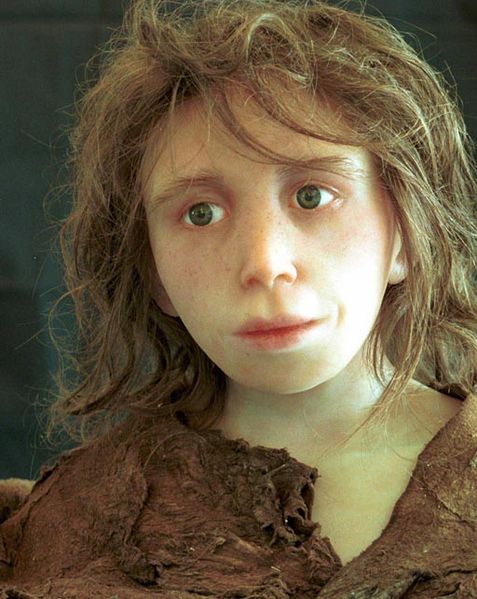
In October 2023, an international team led by Fudan University in Shanghai and University College London reported something stranger still. Three Neanderthal variants in a gene called SCN9A, which helps govern how pain signals travel, are associated with heightened sensitivity to pain. The researchers measured pain thresholds in 1,623 volunteers in Colombia. Those carrying all three variants proved more sensitive to a pinprick applied after the skin had been treated with mustard oil. Notably, the effect appeared only for that kind of mechanical pain. Sensitivity to heat and to pressure was unchanged. Carrying these variants does not mean living in pain. It means the volume knob on one specific channel sits, on average, a little higher.
Immunity, metabolism, and mood
The broadest accounting came in 2023. A team including researchers at Cornell, Harvard, and UCLA analyzed more than 235,000 likely Neanderthal-derived variants. Their data came from roughly 300,000 white British participants in the UK Biobank. They found that 4,303 of those variants play a substantial role in modern human biology, influencing 47 distinct traits. The genes involved cluster in three areas above all: the immune system, development, and metabolism, including how quickly a body burns calories. That is the honest shape of what Neanderthal DNA does. Not one gene for one dramatic trait, but thousands of small nudges, most of them acting on the immune system and the machinery of everyday metabolism.
Here is the strongest evidence at a glance:
| Trait | What the research found | Source |
|---|---|---|
| Tanning and sunburn | A variant tied to poor tanning and childhood sunburn is carried by more than 66% of Europeans | Dannemann & Kelso, 2017 |
| Body clock | Archaic variants push, on balance, toward being a morning person | Velázquez-Arcelay et al., 2023 |
| Pain sensitivity | Three SCN9A variants heighten sensitivity to mechanical pain, but not to heat or pressure | Faux et al., 2023 |
| Immunity and metabolism | 4,303 variants show detectable effects across 47 traits | Wei et al., 2023 |
The COVID twist: A Neanderthal gene that cuts both ways
In September 2020, Hugo Zeberg and Svante Pääbo reported that a 50-kilobase stretch of Neanderthal DNA on chromosome 3 was associated with up to a 3-fold increase in the risk of severe COVID-19. About one in six Europeans carries it. The story traveled fast, and it traveled in one direction: our ancient cousins had left us a liability. Five months later, the same two researchers published the other half. A second stretch of Neanderthal DNA, this one on chromosome 12, carries three genes, OAS1, OAS2, and OAS3, that help cells destroy the genetic material of RNA viruses. That haplotype is associated with a roughly 22% reduction in the relative risk of severe illness, and it is common across all regions of the world outside Africa.
The same encounter, then, handed us a vulnerability and a defense. Which is what inheritance from a real population of real people looks like: mixed, contingent, and indifferent to the stories we would prefer to tell about it. Pääbo’s work in reconstructing these genomes earned him the Nobel Prize in Physiology or Medicine in 2022. One caution matters here. These are associations measured across large populations, not predictions about individuals. Carrying a risk variant is not a diagnosis, and carrying a protective one is not armor. If you have real questions about your own health, they belong with your doctor and not with a genetics article.
The Chinese connection
Neanderthals were not our only relatives, and Neanderthal DNA is not the only archaic inheritance we carry. Somewhere in Asia lived a sister population, so little known that for years they existed as little more than a genetic signature teased from a finger bone in a Siberian cave. We call them Denisovans. Melanesians and Papuans carry 4% to 6% Denisovan DNA. East and South Asians carry less, generally under 0.5%. And almost everything we have learned about who these people were has come out of the ground in China.
A monk’s discovery in a Gansu cave
In 1980, a Tibetan Buddhist monk was meditating in Baishiya Karst Cave (白石崖溶洞), a sanctuary set into a cliff in Xiahe County, Gansu, more than 3,200 meters above sea level. In the dim light of the cave, he found a piece of a human jaw. He did not take it to a university. He gave it to the sixth Gungthang tulku, a senior lama, who eventually passed it to Lanzhou University. There it sat, unremarkable, for the better part of 40 years. In 2019, researchers analyzing ancient proteins in its tooth enamel published their results in Nature: the Xiahe mandible was Denisovan and roughly 160,000 years old. It was the first Denisovan fossil ever identified outside Denisova Cave in Siberia. It proved these people had lived on the roof of the world, in thin air and brutal cold. They did so long before our own species managed it. The cave remains a place of worship. Pilgrims still climb to it. Whatever else it is to science, it was a sanctuary first.
Dragon Man gets a face
The second story begins in 1933, on the bank of the Songhua River in Harbin, in the puppet state of Manchukuo under Japanese occupation. A laborer working on the Dongjiang Bridge unearthed a nearly complete human skull. He understood what he was holding and who would take it from him. He hid it in an abandoned well. There it stayed for 85 years, through a war, an occupation, and a revolution, its location passed down in his family. In 2018, his grandson retrieved it and donated it to Hebei GEO University.
In 2021, researchers described it as a new species and named it Homo longi, “Dragon Man” (龙人), for the province of Heilongjiang. The classification was contested from the start. Then, in June 2025, two papers in Cell and Science settled it: ancient proteins and mitochondrial DNA recovered from the skull place it firmly among early Denisovans. The Harbin cranium, hidden in a well by a man who never learned what he had found, is the only Denisovan skull known to science. After decades of studying these people through fragments and statistics, we finally know what one of their faces looked like.
Why Tibetans thrive where others gasp
There is a practical legacy to all of this, and it is written on the Tibetan Plateau. A lowlander who moves to high altitude responds by producing more red blood cells. Push that response far enough, and the blood thickens, which over years brings headaches, exhaustion, and serious cardiovascular strain. Tibetans, who have lived above 4,000 meters for millennia, do not do this. They carry a variant of a gene called EPAS1 that regulates the body’s response to low oxygen. It lets them live, work, and bear children in air that leaves visitors gasping.
That variant, as researchers reported in Nature in 2014, came from the Denisovans. It is difficult to think of a cleaner illustration of what archaic ancestry is. Not a defect. Not a curiosity. An adaptation, worked out over an unimaginable span of time by people who lived on that plateau before us, and handed forward to the people who live on it now. For more remarkable finds like these, explore Nspirement’s discoveries from beneath the soil.
What your Neanderthal DNA percentage doesn’t mean
So you have your number. Before you read too much into it, three things are worth knowing.
First, most archaic DNA does not build proteins. It regulates when other genes switch on and off. Think of it less as a new instrument added to the orchestra and more as a hand resting lightly on the conductor’s tempo.
Second, if your result came from a consumer testing service, your percentile is calculated against that company’s other customers, not against humanity. Being in the 98th percentile means you carry more than most people who bought the same kit.
Third, and most importantly, the number carries none of the freight the word “Neanderthal” does. As the U.S. National Library of Medicine puts it plainly, having more or less archaic DNA says nothing about how “evolved” a person is, and gives no indication of strength or intelligence. There is no scale here, and no ranking. There is only variation, which is what a species looks like up close. It is a fair summary of what ancient genes reveal about who we are.
The inheritance you carry
Strip away 150 years of insult and what remains is a quieter, better story. Your Neanderthal DNA came from people who endured ice ages. It arrived during a 7,000-year encounter that faded as the Neanderthals themselves vanished, around 40,000 years ago. It still shapes how you tan, when you wake, how sharply you register a pinprick, and how your immune system meets a virus it has never seen. It handed us a dangerous variant during a pandemic and a protective one in the same breath. Meanwhile, on a Tibetan plateau, a gift from a related people lets a farmer draw an easy breath at an altitude that would flatten most of us.
The human story is not a ladder with us standing at the top. It is a braid. A monk meditating in a Gansu cave, a laborer hiding a skull from an occupying army, a jawbone resting in a university drawer for 40 years: three people who never met, each holding a piece of the same inheritance without knowing it. That 2% is not what you overcame. It is part of what you are made of, and part of the reason your ancestors survived long enough to make you.
Follow us on X, Facebook, or Pinterest
