

On the morning of April 4, 1983, a 15-minute drama quietly appeared on television screens across Japan. Few people could have imagined that this modest morning series would become one of the most beloved dramas in Japanese television history.
Oshin was produced by NHK, Japan’s national public broadcaster, to mark the 30th anniversary of its television broadcasts. Airing from April 1983 to March 1984, the series ran for 297 episodes, each only 15 minutes long. During its original broadcast in Japan, it achieved an average audience share of 52.6%, a figure that remains almost unimaginable today.
Yet the true legend of Oshin was not limited to Japan. The series later reached audiences across Asia, the Middle East, and beyond, airing in dozens of countries and regions. It was shown in places as different as Taiwan, China, Hong Kong, Singapore, Vietnam, Indonesia, Sri Lanka, Afghanistan, Iran, and Egypt. In Iran, reports say viewership reached extraordinary levels, and for a time, “Oshin” became one of the words most closely associated with Japan.
In the Chinese-speaking world, its influence was especially deep. Hong Kong and China introduced the drama in the mid-1980s, and it was rebroadcast several times. When Oshin first aired in China in 1985, it reportedly became a nationwide sensation. In Taiwan, where the series aired in 1994, the Mandarin theme song Forever Believe, sung by Judy Ongg, also became part of the memory of a generation. Its lyrics about persistence, dreams, and hope for the future resonated with many viewers who were striving to build better lives.
When viewers could not separate drama from life
The reaction to Oshin in Japan still feels astonishing today.
When the story reached the scenes in which Oshin was mistreated by her harsh mother-in-law, many viewers angrily called NHK to protest. Some felt so sorry for Oshin’s impoverished mother that they sent rice to the actress who played her. Others mailed money to NHK, asking that it be used to help the family in the story.
Oshin was no longer merely a character on a screen. To many viewers, she had become someone real, a member of the family, someone who deserved protection. A fictional drama had moved people so deeply that they wanted to send rice and money into the world of the story. Its emotional force had gone beyond entertainment and touched something much deeper.
The life of Oshin
What kind of story could create such a response?
It begins with a seven-year-old girl. In 1901, Oshin was born into a desperately poor tenant farming family in Yamagata Prefecture. Her family did not have enough food, so her father, with tears in his eyes, sent her away to work as a servant in a wealthy household. In exchange, the family received a few bags of rice to help feed the other children.
So at the age of seven, Oshin left home. She cried as she said goodbye to her father on a wooden raft, then walked alone into the snow and cold of Yamagata toward a future she could not understand.

She did not know that this was only the beginning of her suffering.
In the house where she served, Oshin rose before dawn. She cleaned, boiled water, served the family, and endured scolding for the smallest mistake. She had no time to play and no chance to attend school. Her childhood consisted of endless work and, at times, little more than a bowl of spoiled cold rice.
After surviving those years as a servant, she later learned hairdressing and slowly found a place for herself in society through her own hands. Those days were still hard, but compared with what came before and what would come later, they were a rare period of breathing room in her life.
Fate, however, did not release her so easily. Oshin married the man she loved, believing she might finally have a stable home. Instead, she was subjected to relentless mistreatment from her mother-in-law. In that era, a daughter-in-law was often treated not as an individual with her own dignity, but as an extra pair of hands in the household, someone who could be blamed, scolded, and used.
Oshin endured. She cried. She gritted her teeth and went on, because she knew there was no easy way out.
Then history itself seemed to turn against her. In 1923, the Great Kanto Earthquake destroyed in an instant what she had worked so hard to build. She climbed out from the ruins and began again. After that came financial panic, wartime controls, and food shortages. Each wave of history struck when she was most vulnerable.
The cruelty of war was not only in the bombs and fires, but in the people it took away. Oshin lost those she could least bear to lose. After the Tokyo air raids, she stood in a burned wasteland. She was in her fifties, and once again, she had almost nothing.
But Oshin did not collapse. She folded her grief deep into her heart and started over. She went into business, opened one store, then another, and against the background of postwar ruins, built a chain of supermarkets through sheer persistence.
At the end of the drama, the camera returns to the elderly Oshin, her hair white, sitting at the entrance to her old home, looking back on her life. Viewers understood what they were seeing: a woman who had suffered almost everything and lost almost everything, yet had never truly been defeated.
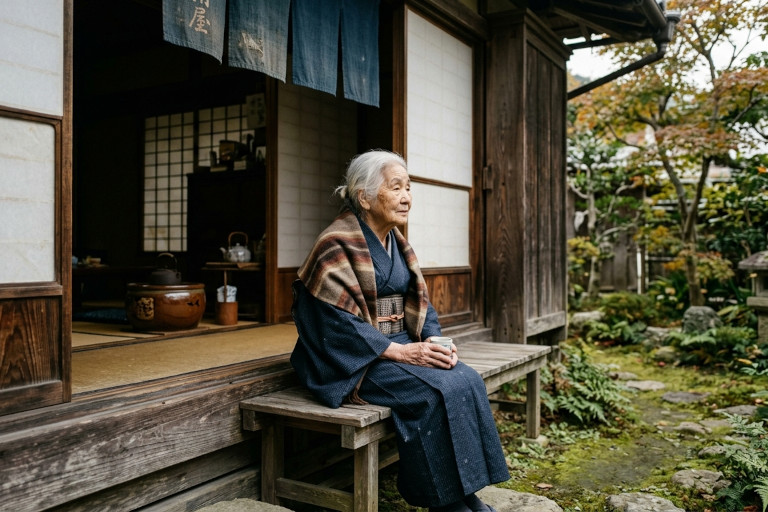
This was the story that made so many Japanese households tune in at the same time, and that later moved countless viewers in China to tears for the life of a Japanese woman.
The woman behind Oshin
Many viewers have asked: Was Oshin based on a real person?
The answer is yes, at least in part. The character is closely associated with Katsu Wada, a woman whose life also bore the marks of poverty, labor, endurance, and business success. Screenwriter Sugako Hashida, who created Oshin, had known of women like her and drew from the hardships of that older generation.
Katsu Wada began working as a child laborer at the age of 10. Later, she and her husband, Ryohei Wada, opened a small fruit and vegetable shop in Atami, Shizuoka Prefecture. That modest shop became the beginning of Yaohan, the retail company later expanded by their son, Kazuo Wada.
Kazuo inherited his mother’s unyielding spirit. From that small shop, he built Yaohan into an international retail group with supermarkets and department stores across many countries and regions. At its height, the company employed tens of thousands of people and recorded annual sales of hundreds of billions of yen. Kazuo Wada became known as “the Wada of the world.”
In 1995, Yaohan reached one of its brightest moments when it opened a major department store in Shanghai. Known as Nextage Shanghai and associated with Shanghai No. 1 Yaohan, the store drew an estimated 1.07 million visitors on its opening day, setting a Guinness World Record for the most visitors to a department store in a single day.
For many people in China at that time, the store represented a first encounter with the scale and spectacle of modern retail. There was no online shopping, and large shopping centers were still uncommon. People arrived by bus from many directions, some from other cities, simply to see the shining screens, the bright displays, and the escalators.

But the rise of Yaohan did not last. In 1997, as the Asian financial crisis swept through the region, the company collapsed under enormous debt. What had grown from a small vegetable shop into an international retail empire fell into bankruptcy. The rise and fall of the Wada family over two generations carried a dramatic force that even fiction might hesitate to invent.
Why Oshin still moves people
The reason Oshin moved audiences across so many cultures is not complicated. She was ordinary.
She was not a hero. She was not a genius. She could be weak. She made mistakes. She could become worldly when life pressed her too hard. She could break down and cry in the darkness when no one else could see.
There was no heroic halo around her. What she had was the instinct of an ordinary person facing an unforgiving fate: to endure, live, and stand up again.
That is why people recognized her. Behind the snow, poverty, war, and loss, they saw something familiar. They saw a person who had been beaten down by life but refused to disappear.
Perhaps that is why Oshin’s story remains so unforgettable decades later. It shows that hardship may bend a person, but it need not have the final word. As long as one can rise again and take the next step, the spirit remains unbroken.
Translated by Joseph Wu
Follow us on X, Facebook, or Pinterest
