
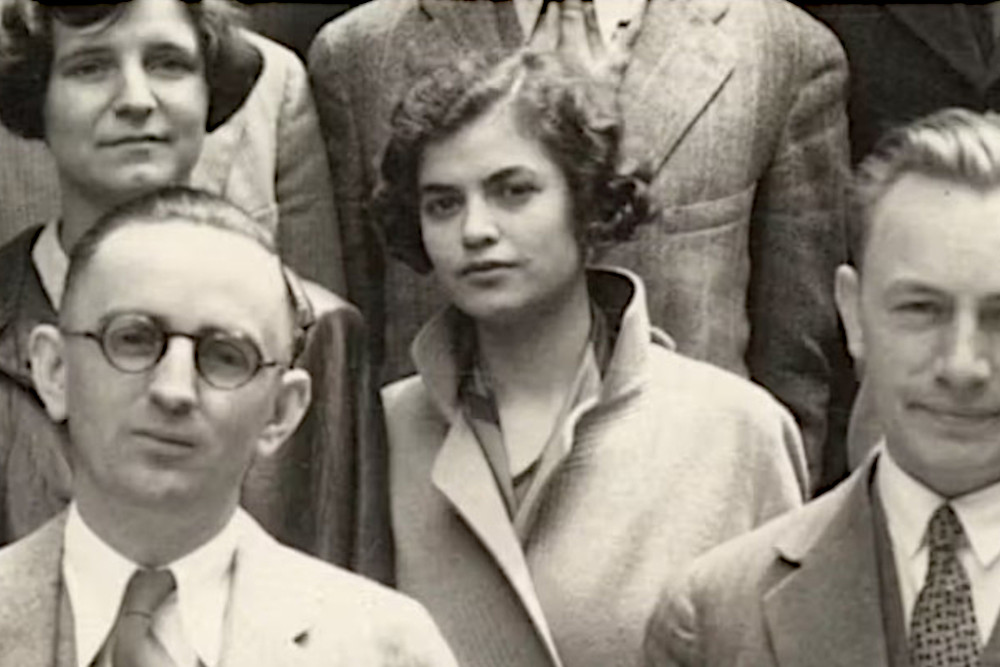
In 1977, an American physicist named John H. Van Vleck won the Nobel Prize for his work on magnetism. In his Nobel lecture, amid a discussion of rare earth elements, one sentence leaps out:
Miss Frank and I made the relevant calculations.
Who was Miss Frank? Van Vleck credits her with key work on the quantum mechanics of magnetism, but she is almost absent from the history books.
Amelia Frank published a handful of scholarly papers that are well-cited for the time. Yet histories of physics mostly mention her only as the wife of Eugene Wigner, who was himself awarded the Nobel Prize in physics in 1963.
Why don’t we know more about Amelia Frank, and why aren’t her contributions recognized? When we searched through the archives, we found a remarkable scientific life unfolding at the dawn of quantum mechanics.
A bright beginning
Born in 1906, Amelia Z. Frank grew up a junkyard owner’s daughter in Adrian, Michigan. Local newspaper reports paint her as a bright, accomplished teen and an independent thinker.
As an undergraduate at a leading women’s university, Goucher College, she joined the physics club. Her senior yearbook relates that her presentation on the Compton effect — a description of how light interacts with electrically charged particles, named after Arthur Compton — was both highly technical and engaging.
Nine months later, Compton gained wide public recognition with the award of the 1927 Nobel prize for demonstrating that X-rays could behave like particles. Amelia Frank clearly had her finger on the pulse of the quantum mechanical revolution then occurring in physics.
Where many scholars intrigued by the quantum frontier pursued their studies in Europe, Amelia Frank went to the University of Wisconsin. There, she met the recently recruited Van Vleck.

Quantum innovation
Arriving in Madison in 1928, Frank had placed herself at the American center of quantum innovation.
At that time, quantum mechanics could describe isolated particles or atoms, but puzzling out the behavior of solid materials was proving difficult.
Magnetism was the perfect testbed, as it can only be explained by quantum mechanics — not classical physics. Amelia Frank, supervised by Van Vleck, turned to rare earth elements, where magnetism is strong and existing theories were insufficient. Could quantum physics resolve this conundrum?
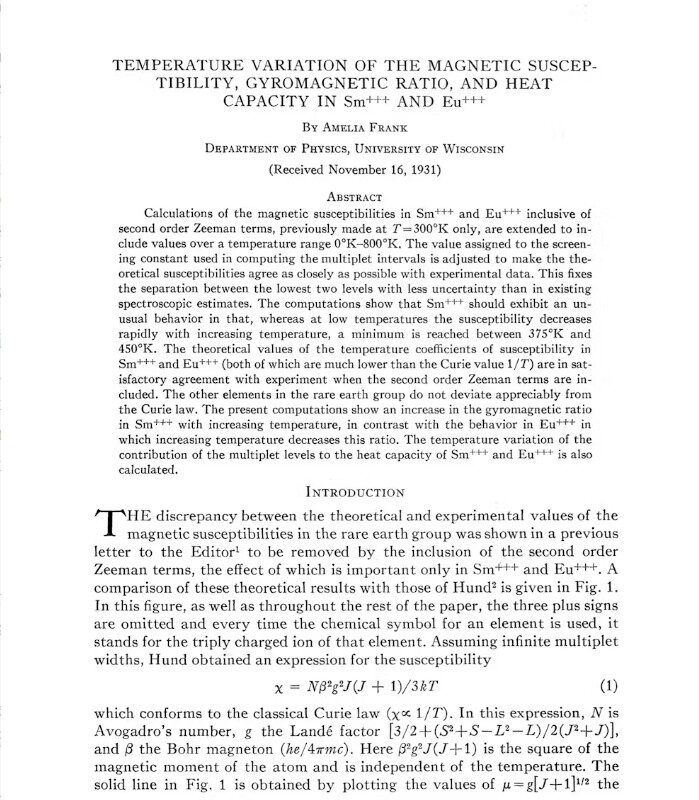
Amelia Frank’s thesis, partially published in Physical Review in 1932, focused on the element samarium. It showed quantum mechanical corrections were needed to explain the experimental data and contains a plot that appears in Van Vleck’s Nobel lecture, labelled “V.V. & F”.
Hard times
After her Ph.D., Amelia Frank worked as a tutor at the University of Wisconsin and continued her research. Her 1935 article on crystal field theory showed how samarium’s energy levels shift due to neighboring atoms.
Colleagues described her as a promising scholar, and her publication record was good. But she faced barriers that slowed her work.
Money was one issue. Amelia Frank was supporting her younger sister, an undergraduate chemistry student, and it was the middle of the Great Depression.
In an unpublished 1935 letter we found in Box 12, Folder 214 of the J. H. Van Vleck papers held by the American Institute of Physics in the Niels Bohr Library and Archive, Amelia Frank told Van Vleck she’d had to take another job to survive:
Our finances were in such bad shape that I suggested to various people that I’d be interested in typing […] and so I have taught classes, tutored, typed, and cooked, but I have not finished my paper.
Van Vleck was seeking positions for Amelia Frank, but jobs were scarce — and as a Jewish woman in that era, she would have faced multiple forms of discrimination.
Marriage and death
Ultimately, Amelia Frank left physics, resigning from the University of Wisconsin around October 1936. When Van Vleck asked why, Amelia Frank let him in on a then-closely guarded secret: She had started a relationship with new colleague Eugene Wigner.
The pair married shortly before Christmas. Wigner described himself as astonished by his love for her.
But their happiness didn’t last. Just weeks after the wedding, Amelia Frank fell ill.
Wigner said it was her heart; others said it was cancer. Either way, Amelia Frank’s condition was grave.
After months in the hospital, she returned to Michigan. She passed away in her parents’ home on August 16, 1937. She was 31.
An enduring contribution
Amelia Frank’s untimely death is one reason why she is under-recognized today. However, it is not a sufficient one.
Frank kept company with other trailblazing women across the country. Her flatmate in Wisconsin was Mary Bunting, who was later president of the women-only Radcliffe College and oversaw its integration with Harvard.
Amelia Frank’s ambition, intellect, and drive took her to the frontiers of knowledge. There, Van Vleck’s support kept her in physics long enough to make lasting, if overlooked, contributions.
Ninety years have passed, but Amelia Frank’s life exemplifies women’s ongoing experiences in physics, good and bad.
Women remain drastically under-represented in quantum physics. To take one example, a 2023 survey found 87.5 percent of full-time Australian quantum researchers were men.
Women remain more likely than men to have caring responsibilities that increase financial stress and reduce research time. And mentorship and purposeful community-building remain vital for bringing women into the field — and keeping them there.
In the end, this may be Amelia Frank’s most enduring contribution to quantum physics. Recovering her story is important because it allows her scientific contributions to be appropriately recognized. Perhaps more importantly, her story reminds us that women have belonged in quantum physics from the beginning.
Peter Jacobson, Senior Lecturer in Condensed Matter Physics, The University of Queensland, and Beck Wise, Lecturer in Professional Writing, The University of Queensland
This article is republished from The Conversation under a Creative Commons license. Read the original article.
Follow us on X, Facebook, or Pinterest
