

The quiet peak of history is not marked by triumph or collapse, but by a collective pause in which humanity senses that what it has built now demands something in return.
There are moments in human history that feel less like chapters and more like summits. Not endings, not beginnings — peaks. Places where one can pause, look backward across the terrain already crossed, and forward into a landscape still obscured by fog. The year 2025 felt like such a place. Technologically elevated, morally strained, emotionally saturated. A year heavy with signals, contradictions, and quiet reckonings.
The quiet peak of history: A stage and symphony
Some traditions hold that history does not unfold randomly, but within an intricate cosmical climate — an unseen weather system of causes, responses, corrections, and allowances. From this altitude, events do not appear isolated. Innovations, conflicts, cultural shifts, and even catastrophes seem arranged less like accidents and more like movements in a vast composition.
Not deterministic in the narrow sense, but purposeful. Willful. As though history itself were asking something of us, one lesson at a time.
From such a vantage point, every actor has a role. The visionary and the opportunist. The reformer and the disruptor. The saint, the sinner, and the reluctant participant are simply trying to get through the day. No one is extraneous. Each becomes, willingly or not, a mouthpiece for a lesson meant to be surfaced, tested, and learned by humanity as a whole.
The year the systems spoke back
In 2025, the systems we built began to speak back to us.

Artificial intelligence crossed a threshold — not in raw capability alone, but in presence. It no longer felt like a distant instrument. It appeared in writing, medicine, education, logistics, and companionship. For some, this felt like a gain: acceleration, leverage, expansion. For others, it felt like a loss: of certainty, of authorship, of place. The same technology that amplified creativity also magnified anxiety. The same models that solved problems exposed how little structure we had placed around power.
This was not a failure of intelligence. It was a failure of containment.
Cloud infrastructures faltered. Centralized systems revealed their brittleness. When a single outage could ripple across continents, the illusion of seamlessness dissolved. Efficiency had been mistaken for resilience. Redundancy had been optimized away. The lesson was quiet but unmistakable: systems designed for speed alone cannot carry the weight of civilization.
Data — once treated as exhaust, then as oil — began to demand a new classification altogether. Legal disputes and public debates surfaced a long-avoided question: who owns the traces of human thought? The words, images, patterns, and preferences generated by billions of lives? In 2025, data ceased to be abstract. It became personal, cultural, and ethical.
And beneath it all, the economic unease. Not collapse, but a low-grade hum of instability. Jobs were not disappearing overnight, but roles were eroding at the edges. People sensed that something fundamental was shifting, even if they could not yet name it. The fear was not of work vanishing, but of relevance thinning out.
Losses that were not losses
To call these moments losses would be too simple. Many of them were transitions — painful because they required us to relinquish assumptions we had grown attached to.
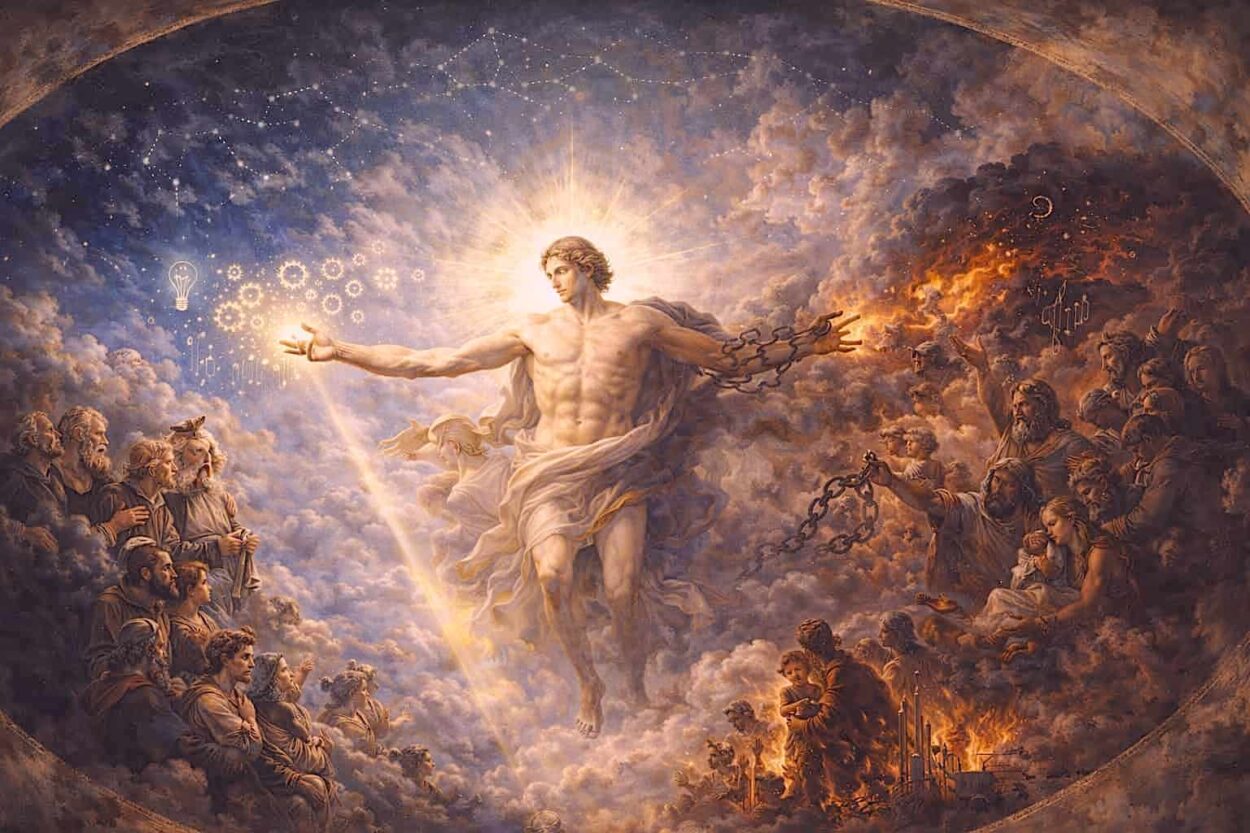
Socially, the year carried the tension of voices long unheard pressing against institutions slow to adapt. Youth movements, climate anxieties, and cultural fatigue signaled a deeper truth: legitimacy can no longer be inherited. It must be continuously renewed. Authority without participation decays quietly, until it does not.
Environmentally, the extremes continued. Fires, floods, heat, blackouts. Less shocking now, more sobering. Sustainability ceased to be a moral preference and revealed itself as an operational requirement. Nature, indifferent to rhetoric, responded only to structure.
Each of these moments — technological, social, and environmental — functioned as a mirror. Not asking what we believe, but how we design. Not what we intend, but what we allow.
The paradox of choice
There is a quiet irony embedded in modern freedom: All that choice ultimately yields is consequences.

We choose architectures, incentives, narratives, shortcuts. We choose what to scale and what to ignore. And then, inevitably, we live inside the results of those choices — sometimes years later, sometimes immediately. The script of history is never fixed in outcome, but it is constrained in logic. Certain actions narrow the range of possible futures. Others widen it.
Li Hongzhi once observed, in essence, that what is created in the present must be endured in the future. It is a simple statement, almost obvious, and yet endlessly overlooked. It applies to technologies and institutions as much as to personal conduct. To virtues cultivated and compromises made. To care extended and care deferred.
2025 was a year of creation — intense, uneven, and often uncoordinated. We built faster than we reflected. We connected more than we understood. We optimized before we stabilized. None of this was malicious. It was human. But it carried weight.
2026: the year of consequences — and integration
If 2025 was a year of signals, 2026 stands as a year of consequences. Not in a punitive sense, but in a clarifying one.
Consequences reveal structure. They teach without ideology. They show us which systems were sound and which were brittle. Which values were performative and which were embedded deeply enough to endure stress?
The quiet promise of 2026 lies not in sudden breakthroughs, but in integration.
Artificial intelligence, having startled us, will be asked to settle into form. Bounded roles. Clear scopes. Human oversight, not as an afterthought, but as a design principle. Intelligence contextualized becomes an augmentation rather than a threat.
Infrastructure will rediscover humility. Redundancy will be revalued. Local resilience will matter again. Systems will be designed less like machines and more like ecosystems — capable of absorbing shocks without collapsing.
Economically, the focus will drift from titles to capabilities. From static roles to adaptive value. Sense-making, judgment, synthesis — these human faculties will regain prominence, not in opposition to machines, but alongside them.
Socially, participation will emerge as the new legitimacy. Not a perfect consensus, but a visible inclusion. Institutions that listen will outlast those that merely announce.
And environmentally, adaptation will finally be understood as innovation. Stability will be recognized as a competitive advantage.
A closing blessing, not a conclusion
Seen from above, 2025 does not appear to be a mistake. It looks like a lesson-heavy passage. A steep incline before a plateau. A necessary compression before rebalancing.

If history does unfold within a larger order — whether one names it cosmical, moral, or simply systemic — then the task before us is not to control outcomes, but to refine inputs. To create with greater care. To design with foresight. To act with an awareness that nothing we build is neutral.
In that spirit, may 2026 meet us not as a reckoning, but as a refinement.
May we prosper through the virtue we cultivate.
May we endure, with compassion and forbearance, the consequences of what we rushed or neglected.
May learning continue where certainty failed.
And may the next peak, when we reach it, find us wiser than the last.
Happy holidays, and a blessed New Year, from all of us here at Nspirement.
P.S. Thank you for being the thoughtful, curious, and inspired readers that you are. Knowing you are here — even briefly — makes the work worthwhile.
Follow us on X, Facebook, or Pinterest
