

Plastic-to-fuel technology has long been explored in laboratories and industrial plants, but a young inventor’s viral backyard demonstration has thrust the concept into the public imagination.
In a backyard in Georgia, a 22-year-old inventor, Julian Brown, claims to have done something that sounds like science fiction made practical. He says he has built a machine that turns discarded plastic into high-octane fuel — fuel potent enough to power a modern American muscle car. In a video that has since ricocheted across social media, he pours a clear amber liquid — his own creation — into the tank of a 2023 Dodge Scat Pack. The engine turns. It catches. The car starts.
If what he says is true — if plastic trash can be reliably converted into usable gasoline, diesel, and even jet fuel in a small-scale, decentralized reactor — the implications stretch far beyond a single driveway demonstration. It would suggest a future in which landfills become fuel depots, in which neighborhoods reclaim energy from their own waste streams, and in which the circular economy is not a slogan but a machine humming in someone’s backyard. But before any of that can happen, the story must withstand the oldest fuel of the internet: belief.
A story that refuses to stay put
The tale has circulated online under different names and in different forms. In some versions, the inventor is a lone teenage prodigy. In others, he is already being “watched” by powerful interests. The machine is sometimes solar-powered, sometimes microwave-driven, sometimes both. The fuel is alternately called “plastine,” “plastoline,” or simply “liquid gold.” Skeptics note that plastic-to-fuel technology is not new. Advocates counter that scale and accessibility are what matter — that the difference between a corporate pilot plant and a backyard system is cultural as much as technical.
The internet has split into two camps. On one side are the believers: viewers who see in the viral footage proof that ingenuity can outrun institutional inertia. On the other hand are the cautious: engineers, chemists, and environmental professionals who ask what standards were met, what emissions were measured, and what certifications exist. Somewhere between inspiration and interrogation stands the young man at the center of it all.
The making of an inventor
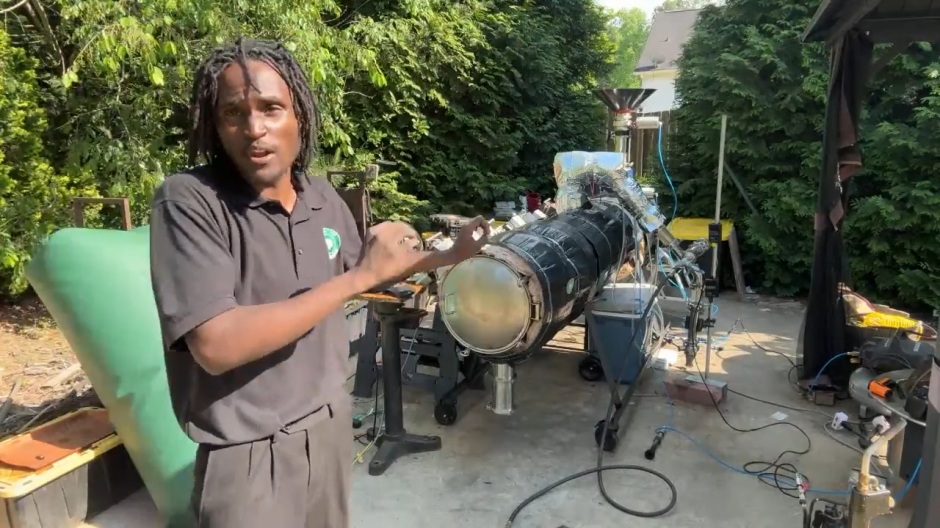
Julian Brown began experimenting with plastic conversion as a teenager. By his own account, he started developing the concept at 17, troubled by the sheer volume of plastic waste accumulating in his community. The images that move many young engineers — turtles tangled in bags, beaches layered with bottles — moved him too. But instead of joining a cleanup campaign, he began sketching a machine.
His platform, known online as NatureJab, documents the evolution of that idea. Over time, a concept coalesced into what he describes as a solar-powered continuous microwave pyrolysis reactor. The phrase alone sounds like a graduate thesis: solar panels feeding electrical power into a microwave-based chamber that thermally breaks down plastic polymers in the absence of oxygen. Plastic, after all, is derived from petroleum. In theory, heat it correctly — without burning it — and you can decompose it back into shorter hydrocarbon chains. Condense the vapors, separate the fractions, and you are left with liquid fuel.
Brown’s claim is that his system can produce 110-octane gasoline, along with diesel and even jet-fuel-range hydrocarbons. He calls the product Plastoline. In October 2025, he staged the moment that would define his public narrative. At a Nissan dealership in the Atlanta area, he demonstrated his fuel in action, pouring it into a 2023 Dodge Scat Pack. The cameras rolled. The car started. The clip spread. For supporters, it was proof of concept. For critics, it was proof of ignition — and nothing more.
The science behind the spectacle
The underlying process Brown invokes is real. Pyrolysis — the thermal decomposition of organic material in the absence of oxygen — has been studied for decades. Researchers and companies alike have explored ways to convert plastic waste into usable hydrocarbon liquids. Microwave-assisted pyrolysis, in particular, has been investigated for its ability to heat materials more uniformly than conventional furnaces.
Under carefully controlled conditions, shredded plastic heated to roughly 350-500°C can break into vaporized hydrocarbons. These vapors, once condensed, resemble crude oil or diesel-like liquids. Further refinement — fractional distillation, catalytic cracking, stabilization — can adjust the composition toward gasoline or other fuels. But theory and practice diverge quickly outside the lab.
Mixed plastic waste contains more than polyethylene and polypropylene. It may include PVC, which releases chlorine compounds when heated. Additives, dyes, flame retardants, and contaminants complicate the chemistry. Without filtration and scrubbing systems, emissions can become hazardous. Without proper condensation and separation, the resulting fuel can vary wildly in composition.
To meet automotive standards, fuel must pass rigorous testing protocols — octane ratings measured under ASTM procedures, sulfur limits, volatility curves, and storage stability benchmarks. Producing a liquid that burns is not the same as producing a certified fuel. And yet, the spectacle matters. Seeing a modern engine run on reclaimed plastic triggers something more than chemical curiosity. It suggests autonomy. It suggests agency.

The promise and scrutiny surrounding plastic-to-fuel technology
Even if Brown’s reactor functions as described, scale remains the crucible. A muscle car idling in a parking lot consumes only a modest amount of fuel. A city consumes millions of gallons a day. To meaningfully dent plastic waste streams or fossil fuel demand, any such system would need to operate continuously, safely, and economically.
A solar-powered setup introduces additional variables. Solar panels generate intermittent energy, whereas continuous high-temperature reactors require steady power. Battery storage, inverters, and thermal management systems must be robust. Each adds cost and complexity.
Then there is regulation. In the United States, fuel production and distribution intersect with environmental protection laws, fire codes, emissions standards, and transportation regulations. A backyard experiment that becomes a neighborhood utility quickly crosses into legal territory. Supporters argue that these hurdles are precisely why decentralized innovation is needed — to push established systems toward adaptation. Critics respond that standards exist to protect public health. Both are correct.
The psychology of disruption
Brown has spoken of facing cyberattacks and harassment as his profile grew. Such experiences are increasingly common for young innovators who find themselves thrust into viral attention. Online notoriety brings not only praise but scrutiny and hostility. Some followers frame his challenges as evidence of a threat that established energy interests feel uneasy. Historically, there has been a cultural appetite for narratives about the suppressed inventor.
Yet the modern energy landscape is more complex than a simple duel between lone genius and monolithic industry. Major energy companies invest in chemical recycling and advanced waste conversion. Governments fund research into circular-economy technologies. Venture capital flows toward climate-adjacent startups. If Brown’s reactor proves scalable and efficient, it would likely attract investment rather than silence. But public trust does not move at the speed of chemical kinetics. It moves at the speed of story.
Between possibility and proof
The deeper tension in the Plastoline saga lies between possibility and proof. It is possible to convert plastic into usable hydrocarbons. It is possible to power an engine with such fuel. It is possible for a determined teenager to build an apparatus that achieves both in some form. It is also possible for optimism to outrun validation.
Responsible scaling would require transparent third-party testing — independent labs measuring emissions, volatility, octane, and contaminants. It would require engineering audits of reactor safety, fail-safes, and environmental controls. It would require regulatory engagement. For many supporters, these steps feel like bureaucracy. Engineers are the bridge between experimentation and infrastructure.
A future worth examining
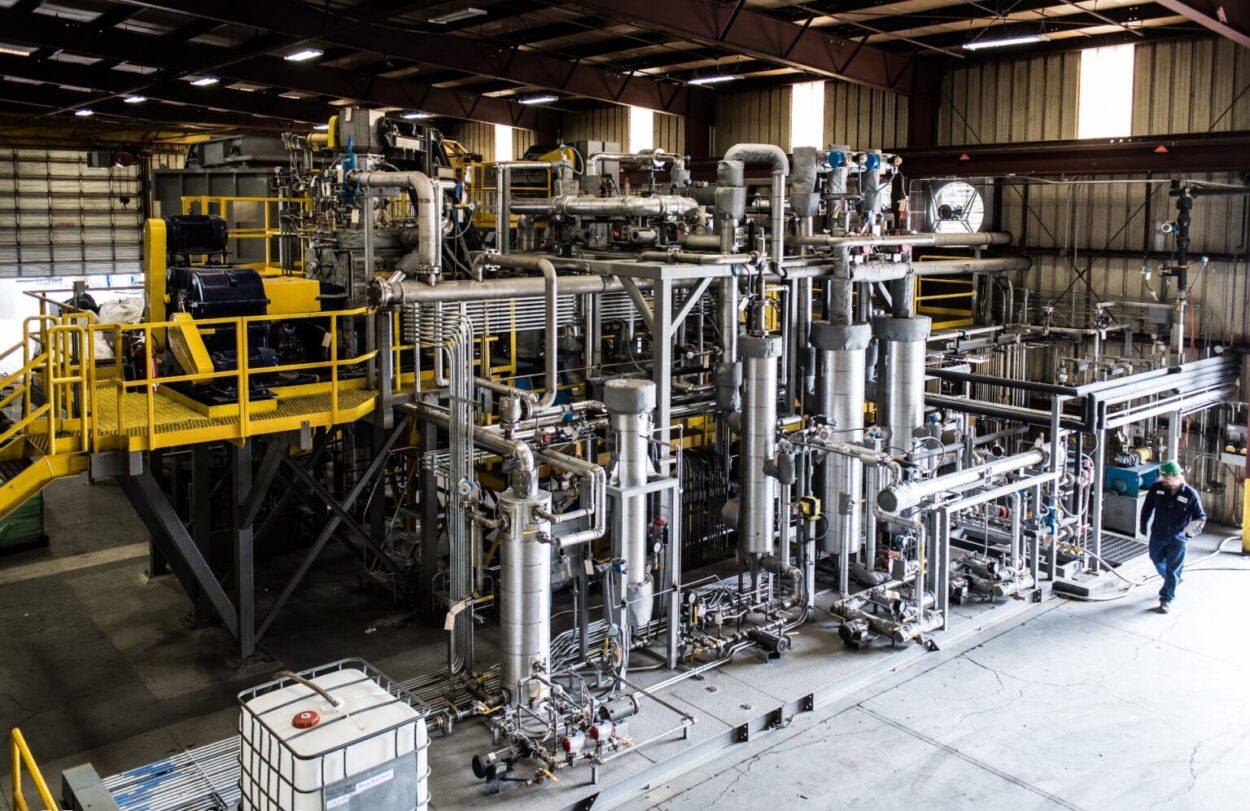
And yet, the core idea is not fantastical. The notion that waste plastic can be chemically recycled into valuable products aligns with broader scientific and industrial trends. Chemical recycling, though controversial, is increasingly discussed as a complement to mechanical recycling.
If a small-scale, efficient, and clean reactor could be replicated affordably, communities might reclaim a portion of their waste stream as energy. Remote areas could reduce dependence on imported fuels. Disaster zones might convert debris into temporary power sources. Such a future would not eliminate fossil fuels overnight. It would not erase the carbon footprint of hydrocarbons. But it could close a loop — transforming a persistent environmental burden into a transitional resource.
The young inventor in Georgia, whether prophet of a decentralized energy renaissance or emblem of internet-age exuberance, has done one thing undeniably well: he has made people look twice at a trash bag. He has asked a question that lingers after the engine noise fades: What if what we throw away is not waste but potential? The answer will not be determined by viral clips alone. It will be determined in laboratories, in regulatory offices, in boardrooms, and perhaps still in backyards.
If the promise of Plastoline — or any successor — moves from spectacle to standard, it will not do so by defying scrutiny but by surviving it. And if it does survive, the transformation will not merely be chemical. It will be cultural. For now, the image remains vivid: a clear liquid poured from a simple container, the turn of a key, the rumble of combustion. In that moment, plastic trash becomes a form of propulsion.
Whether that moment marks the beginning of a new chapter in energy — or simply another footnote in the long history of hopeful innovation — depends on what happens next. But the curiosity it has ignited is real. And curiosity, like combustion, has a way of spreading.
Follow us on X, Facebook, or Pinterest
