

Many people believe that long before recorded history, there were highly advanced prehistoric civilizations — societies that rose and vanished without leaving any surviving written records. It is believed that such cultures possessed technologies far beyond what we currently understand, enabling them to construct monumental structures that still defy explanation today.
The statues of Easter Island
Easter Island is located in the Pacific Ocean, approximately 3,700 kilometers (2,299 miles) off the coast of Chile, with a land area of about 120 square kilometers (46.3 square miles). The island is home to nearly 1,000 megalithic statues known as moai, large stone figures created by the island’s early Polynesian inhabitants.
These statues are characterized by disproportionately large heads, elongated ears that hang low from the sides of the head, and long, straight arms pressed tightly against their bodies. Their mouths are often carved as simple, straight lines, and their faces are typically oriented outward toward the horizon or distant ocean.
Most of the stone statues weigh approximately 20 tons (44,000 lbs), with heights ranging from 3.5 to 4.5 meters (11.5 to 14.8 feet). The largest known specimen stands about 10 meters (33 feet) tall and weighs an estimated 90 tons. Some of these statues even wear “hats” (pukao) carved from red volcanic rock — a feat of placement that may have been even more technically challenging than the carving of the statues themselves. Additionally, many statues were originally fitted with eyes made from white coral stone, which would have given them a striking and lifelike appearance when installed.
Archaeological investigations indicate that all of these megalithic statues were carved from stone sourced at a quarry located elsewhere on the island, requiring careful transport across varied terrain before being positioned on their ceremonial platforms. Taken together, the scale, uniformity, and logistical complexity of the moai statues reflect a highly organized, purpose-driven society capable of executing large-scale construction across challenging terrain, demonstrating a remarkable level of coordination, craftsmanship, and cultural intent.

Architectural structures submerged beneath the sea
Off the coast of Peru, at a depth of 200 meters (656 feet) beneath the ocean, researchers have discovered carved stone pillars and massive architectural structures. Since 1968, underwater discoveries in the vicinity of the Bimini Islands have revealed extensive linear stone arrangements, including formations described as streets, dock-like structures, collapsed wall systems, and gateway-like shapes. These formations appear in large, organized patterns that suggest deliberate placement rather than random scattering.
In several cases, these submerged features have been noted for their resemblance in scale and construction style to known megalithic sites such as Stonehenge and the stone architecture of Tiwanaku, particularly in their use of large fitted stone blocks and linear alignment.
Scientists from France and the United States have also reported the discovery of a massive pyramid-like structure west of the Bermuda Triangle. This formation measures approximately 300 meters at its base and 200 meters in height, with its apex positioned around 100 meters below the ocean surface. According to these reports, the structure may predate the pyramids of ancient Egypt, placing it among the most ancient large-scale formations reported beneath the sea.
These underwater discoveries have fueled ongoing speculation that additional remnants of ancient civilizations may still lie hidden beneath the world’s oceans, preserved for millennia beneath the sea.
The giant stone spheres of Costa Rica
In the late 1930s, the American George Chaytor discovered approximately 200 stone spheres — believed to have been artificially carved — scattered throughout the remote tropical jungles, valleys, and hillsides of a river delta in the southern region of the Central American country of Costa Rica. These spheres varied greatly in size. Some measured only a few meters across, while the largest reached several meters in diameter and weighed many tons.
Crafted with remarkable precision, the spheres displayed an extraordinary level of craftsmanship. Scientific examinations determined that many were fashioned from solid granite and other hard volcanic stone. Researchers also noted the remarkable uniformity of their curvature, with only minimal deviations across the surface, giving them the appearance of nearly perfect geometric spheres.
Archaeologists have argued that the creators of these stone spheres must have possessed considerable knowledge of geometry, advanced carving and shaping techniques, and access to highly durable tools along with precise measuring methods. Without such capabilities, producing stone spheres of such size, symmetry, and refinement would have been extraordinarily difficult. These stone spheres remain among the most intriguing examples of ancient stone craftsmanship in the Americas.
Baigong Mountain, Delingha, Qinghai, China
In an uninhabited region of the Qaidam Basin in Qinghai, China, traces of industrial activity have reportedly been discovered. On the summit of a mountain known as Baigong Mountain, researchers found hundreds of heavily rusted iron pipes dating back to antiquity. To this day, scientists remain baffled as to the origin of these pipes.
Some of the pipes are embedded deep within the mountain itself, while others lie submerged in a nearby salt lake. Additional iron pipes have also been observed along the lake’s shoreline, many of them aligned in an east-west direction. Several of the larger pipes, measuring approximately 40 centimeters (15.7 inches) in diameter, appear strikingly uniform in size and seem to have been arranged in deliberate patterns.
According to reports surrounding the discovery, the apparent sophistication of these structures has raised questions about how such iron formations could have been produced in an era when ancient peoples were believed to possess only limited metallurgical capabilities. As a result, Baigong Mountain has become one of the more mysterious sites frequently cited in discussions of unexplained ancient phenomena.
The thousand-year rust-proof iron pillar of India
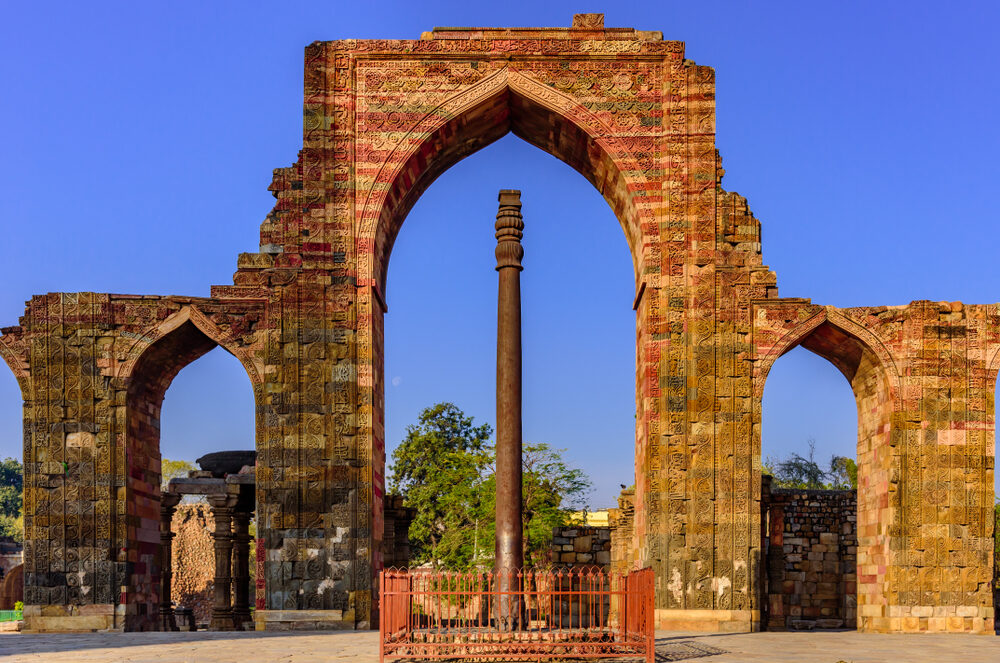
India is home to an ancient iron pillar known as the “Iron Pillar of Delhi,” a remarkable artifact that has remained largely rust-free for more than a thousand years. This pillar stands within the courtyard of the Quwwat-ul-Islam Mosque in Delhi, India.
The massive iron pillar rises approximately 7.2 meters (23.6 feet) above the ground and weighs an estimated 10 tons. Despite enduring centuries of exposure to rain, humidity, and seasonal climate changes, it has shown remarkably little corrosion or structural deterioration.
Scientific analyses have indicated that the pillar possesses an exceptionally high iron content — approximately 99.7 percent — and contains a unique and highly sophisticated metallurgical composition that contributes to its resistance to rust. Researchers have noted that a thin protective film formed naturally on the surface of the metal, helping preserve the pillar over the centuries.
Inscribed upon the “Iron Pillar of Delhi” is an ancient Sanskrit text: “He seemed to grow weary of this world and thus departed from it; his physical body, in its material form, ascended to another realm — borne aloft by the weight of his achievements and virtues. Although he has departed from this mundane world, his deeds and his illustrious name shall forever be recounted and celebrated across the face of the earth.”
Inscribed upon the “Iron Pillar of Delhi” is an ancient Sanskrit text describing a revered figure in commemorative terms: “He seemed to grow weary of this world and thus departed from it; his physical body, in its material form, ascended to another realm — borne aloft by the weight of his achievements and virtues. Although he has departed from this mundane world, his deeds and his illustrious name shall forever be recounted and celebrated across the face of the earth.”
Judging by the pillar’s stylistic design and its cultural-historical context, it has often been associated with the commemoration of an ancient ruler or honored individual. The inscription reflects a tradition of royal praise and memorialization in classical Indian culture, in which great leaders were often described in elevated, symbolic language that emphasized virtue, legacy, and spiritual significance.
This narrative clearly resonates with the ancient spiritual cultivation and religious traditions of India. In recent years, a new generation of Indian researchers has undertaken a fresh interpretation of the Sanskrit inscription located on the middle section of this ancient pillar, positing that it is, in fact, a relic of a prehistoric civilization.
A two-billion-year-old nuclear reactor in Africa
A factory in France, utilizing uranium ore imported from the Republic of Gabon in Africa, made a startling discovery: the imported ore had already been processed and utilized by someone else. While uranium ore typically contains a uranium concentration of 0.72%, the ore from Oklo — the site in question — was found to contain less than 0.3%. This anomalous phenomenon immediately captured the attention of the scientific community. Further in-depth investigations revealed that the Oklo uranium deposit formed approximately two billion years ago, and that this nuclear reactor came into existence shortly after the ore body itself was formed.
What is truly astonishing is the remarkably rational and sophisticated design of this ancient nuclear reactor. For instance, current research findings indicate that this nuclear reactor spans several kilometers. Yet, despite its colossal size, the thermal disturbance it caused to the surrounding environment was confined to an area within 40 meters of the reaction zone. Even more astonishing is the fact that the waste generated by the reactor did not disperse but, remained confined to the immediate vicinity of the mining site. Compared to this massive nuclear reactor, even the largest nuclear reactors humanity can construct today pale in comparison.
Conclusion
Taken together, these discoveries form a striking and interconnected record of large-scale construction, material precision, and astounding engineering capability, supporting ongoing inquiry into the unexpected technical skills and abilities of prehistoric civilizations. As research continues, these sites remain central to the exploration and understanding of ancient societies, reinforcing the idea that Earth’s ancient past still holds many mysteries yet to be fully understood.
Translated by Patty Zhang and edited by Tatiana Denning
Follow us on X, Facebook, or Pinterest
