
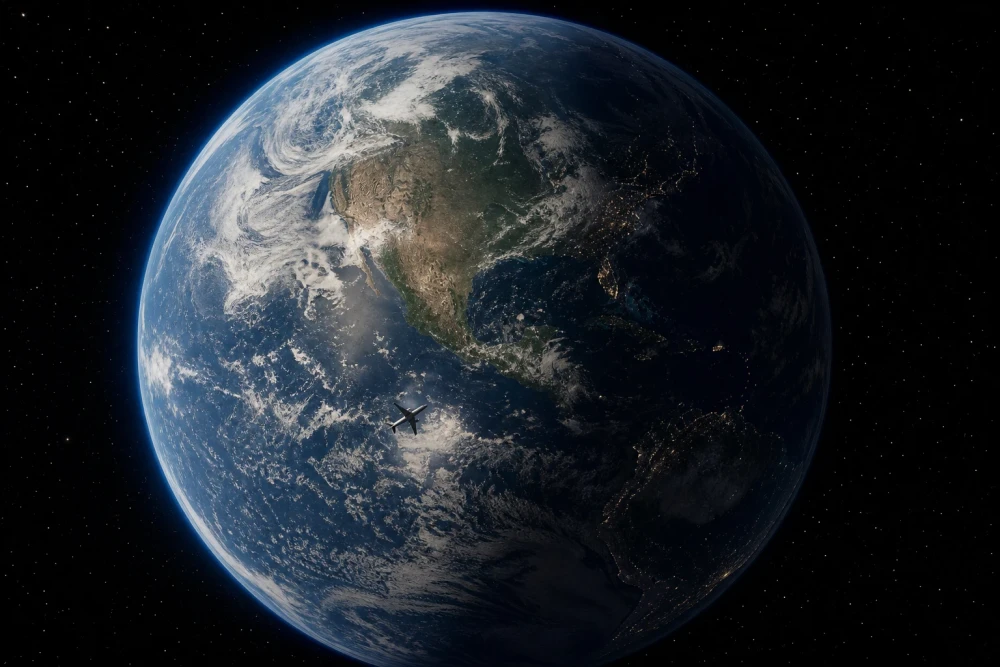
You have probably seen flat-Earth videos while scrolling. They arrive between a recipe clip and a news item, uninvited — usually a passenger on a plane leaning toward the cockpit, asking a pilot directly: Is the Earth flat? The answers vary. Some pilots deflect. Some give short, polished dismissals. And some, in the way they pause before answering, manage to unsettle you in a way you don’t quite expect from a question whose scientific answer has been settled for more than two thousand years.
Late at night, tired, guard down, the algorithm takes you further. One flat Earth video leads to another. The arguments start to feel — if not convincing, then at least harder to dismiss on the spot than they should be. A horizon that looks suspiciously level. A pilot who seems oddly hesitant. A graphic that makes the geometry of a flight path look strange.
So, during a recent stay in Vienna, I did what I had been wanting to do for a while. I met an airline pilot in the hotel lobby and asked him directly. This is not a scientific study. It is not a survey. But for me, personally, it felt representative. He paused. He smiled politely. And then he said: “It’s round. Round, ya.” That answer — plain, calm, almost amused — sent me back to how this question got here in the first place.

Where the flat Earth idea actually came from
The popular story says that ancient people believed the Earth was flat and that we had to wait for explorers and astronomers to correct them. That story is largely wrong. Greek mathematicians were making the case for a spherical Earth around 500 BCE. Pythagoras identified the mathematical arguments early. Aristotle developed them further, noting that ships disappear hull-first over the horizon — something that only makes sense if the surface curves. He also observed that during lunar eclipses, Earth’s shadow on the moon is always circular, regardless of the angle. Only a sphere casts a circular shadow in every direction.
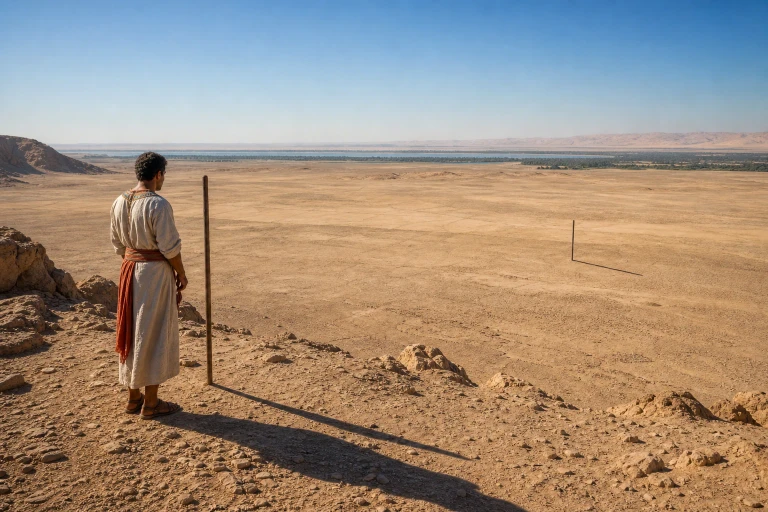
Eratosthenes, working in Alexandria around 240 BCE, went further. He calculated Earth’s circumference using the difference in shadow angles between two Egyptian cities — Alexandria and Syene — on the same day at noon. His result was remarkably close to what we know today. By the Middle Ages, educated people no longer considered a spherical Earth a fringe theory. It was the established view.
The widespread belief that medieval Europeans thought the Earth was flat is itself a myth — and a surprisingly recent one. Historians of science largely trace it to 19th-century writers who painted the medieval period as an age of superstition. For instance, Washington Irving’s fictionalized biography of Columbus invented the idea that Columbus was trying to prove the Earth was round against church objections. He wasn’t. Educated Europeans already knew it was round. So the flat Earth as a popular belief is more a 19th-century invention than a pre-scientific inheritance.
How the modern flat Earth movement was born
Samuel Rowbotham, a British writer, systematized the modern version of flat Earth theory by publishing Zetetic Astronomy in 1849. Rowbotham described the Earth as a flat, stationary disc, with the North Pole at its center and a wall of ice at its edges. He conducted his own observations, famously along a canal in Norfolk, and concluded that the canal’s surface did not curve the way it should if the Earth were spherical. His work attracted followers. In 1956, Samuel Shenton founded the International Flat Earth Research Society. In the 1970s, Charles Johnson took over and reframed the argument in explicitly conspiratorial terms: the round Earth model was a government lie, sustained to hide the truth about our place in the universe. The society was small, eccentric, and largely ignored by mainstream culture. Then the internet arrived.
Why the algorithm revived it
The flat Earth community found YouTube around 2014 and 2015, and the results were dramatic. Flat Earth content performed exceptionally well on video platforms because it does what the best conspiratorial content always does: It makes the viewer feel like they are seeing something others have missed. It rewards a certain kind of lateral thinking, flatters curiosity, and packages everything in a direct, confrontational style that triggers engagement.
The more people watch and comment, the more the algorithm surfaces the content. By 2017 and 2018, major flat Earth conferences were drawing hundreds of attendees. Polls showed that belief in flat Earth had risen measurably, particularly among younger people who had grown up on social media.
This is the context for those pilot videos. They are filmed precisely because they feel transgressive — a trusted authority figure is asked to confirm what the algorithm has been hinting at. When a pilot hesitates, or gives a diplomatically vague answer, the clip circulates as evidence. People read the hesitation as suppressed knowledge rather than, more likely, a professional habit of patience with passengers.
What the arguments for flat Earth actually claim
Flat Earth arguments tend to cluster around a few recurring themes. The horizon looks flat, particularly over large bodies of water. The Earth’s surface appears not to curve when you look at it from the ground. Long-distance photographs sometimes show features that, on a spherical Earth, should be hidden below the curve.
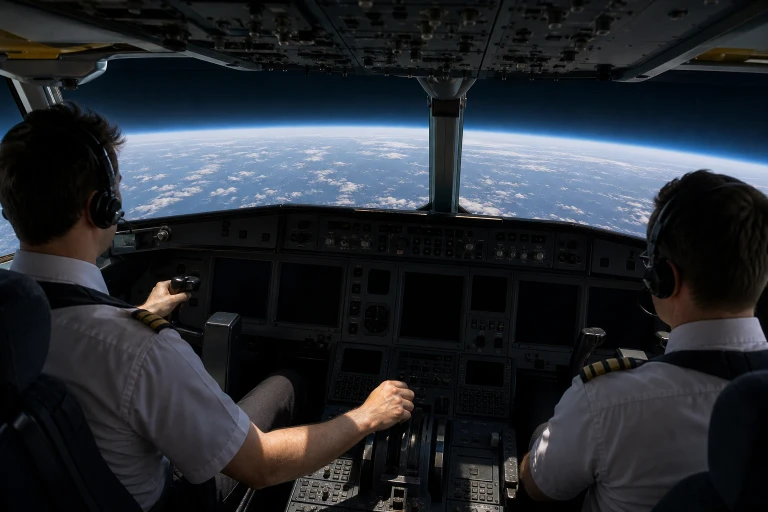
These are not entirely made-up observations. The horizon does look flat to the human eye. The Earth’s curve is subtle enough to be invisible from the ground and only becomes perceptible at altitudes above about 35,000 feet, and even then only in wide-angle views. This is not a conspiracy — it is a consequence of the Earth being very large.
The more specific photographic claims tend to break down under scrutiny. Atmospheric refraction — the bending of light through layers of air at different temperatures — can make distant objects appear higher than they geometrically should be. This is the same phenomenon that causes mirages over hot roads. Flat-Earth communities often treat refraction as evidence for their model, while the physics of refraction itself points to a curved surface.
Other arguments involve flight paths. Some routes between cities in the Southern Hemisphere seem to take unusual paths on a standard map. The flat Earth explanation is that pilots are hiding the true flat geometry. The real explanation is that standard map projections distort distance at high latitudes, and the shortest path on a sphere doesn’t look straight on a flat projection. This is cartography, not conspiracy.

What makes a round Earth essentially impossible to fake
The difficulty with the flat-Earth model isn’t simply that the science disagrees with it. The evidence for a spherical Earth comes from entirely independent sources that would each have to be falsified separately. Gravity explains why the Earth is a sphere. Sufficiently large masses of rock pull themselves into a ball under their own gravity — which is why all the planets, moons, and stars we can observe are spherical. A flat disc of Earth-sized mass would be physically unstable and would collapse into a sphere over geological time.
The stars are different depending on which hemisphere you are in. Constellations visible in the southern hemisphere are not visible in the north, and vice versa. On a flat disc model, all stars would theoretically be visible from all locations. They are not. Eclipses occur exactly when orbital mechanics predict they should. This has been true for centuries. The Babylonians could predict lunar eclipses using mathematics derived from a spherical model. If the geometry were wrong, the predictions would fail. They haven’t.
Time zones are perhaps the most immediately testable evidence. As you move east, the sun rises earlier. This only makes sense if the Earth is rotating and spherical. You can test this yourself with a phone call to someone on the other side of the world — ask them what the sky looks like.
Aircraft navigation may be the most operationally decisive evidence of all. Pilots fly by instruments calibrated to a spherical Earth with a radius of approximately 6,371 kilometers. Airlines use routes computed on that geometry. If the Earth were flat and the geometry were different, those routes would be wrong, flights would arrive at the wrong locations, and the whole system of international aviation — which lands millions of flights each year within seconds of their scheduled arrival times — would collapse. It doesn’t.
Why the videos still land even when you know better
This is worth taking seriously. Flat Earth belief, like most conspiratorial thinking, is less about the specific claims than about trust. If you have good reasons not to trust institutions — governments, media, scientific establishments — then a model that frames all contrary evidence as fabricated is, in a strange way, internally consistent. It is a complete worldview with its own logic.
The pilot videos work on a different level. They make the question feel personal and immediate. You are not reading a textbook. You are watching a real person in a real situation give an answer that doesn’t feel quite as settled as you expected. I know something about that. I asked the question myself, in a hotel lobby in Vienna, of a pilot I had just met. He paused. Smiled politely. And said the Earth is round.
The pause was almost certainly just the beat before answering a question you didn’t expect at check-in. But I understand why that same pause in those videos reads differently to people already inclined to doubt. That is how trust works, and how the absence of trust works too. The evidence for a round Earth is not hidden or rare. It is simply very large, very old, and in many places requires trusting the same systems that conspiratorial thinking teaches you to question. That is the actual loop the algorithm drops you into — not a question about physics, but a question about who you believe.
The answer, for what it’s worth, is the same one the pilot gave me — “It’s round. Round, ya.”
Follow us on X, Facebook, or Pinterest
