
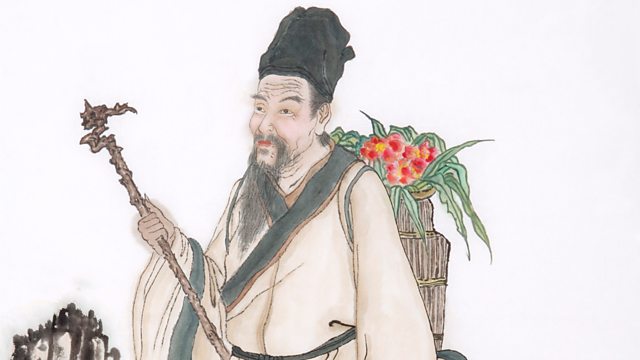
Modern life is moving at an increasingly fast pace, and with it come rising stress levels. As a result, psychological counseling has become increasingly popular. Interestingly, even in ancient times, some doctors treated illnesses by taking into account the patient’s psychological state. One such figure was Li Shizhen, a distinguished medical scholar of China’s Ming Dynasty.
Li Shizhen came from a long line of doctors. His grandfather was a “bell doctor” — a doctor who travelled the countryside, and his father, Li Mingwen, was also a renowned physician. By the time it came to Li Shizhen himself, his medical skills had reached new heights. Many people visited the Li household seeking treatment, whether for minor ailments or more severe conditions.
On one occasion, a patient suffering from diarrhea staggered to Li Shizhen’s door, begging for help. After taking the man’s pulse, Li Shizhen found nothing alarming. He believed the patient needed a couple of days of rest to regain his strength and would soon recover. He advised the man to go home and recuperate.
However, the man didn’t believe he was well. He insisted that other doctors had failed to help him and refused to leave without a prescription from Li Shizhen. After a moment’s thought, Li Shizhen plucked a few roadside weeds, handed them to the man, and instructed him to wash and boil them in water before drinking.

A few days later, the man’s strength had returned, and he came back in high spirits to thank Li Shizhen — only to discover that what he had taken wasn’t medicine at all, but ordinary wild grass with no medicinal properties. Still, he couldn’t help but admire Li Shizhen’s wisdom. Truly, sometimes no medicine is the best medicine.
On another occasion, Li Shizhen employed a similar “psychological remedy” to help a wealthy man in a small town in his recovery.
At the time, a local rich man had heard of Li Shizhen’s great reputation. He brought along a prescription given to him a few days earlier by a local traditional doctor, complaining that the medicine had had no effect. He asked Li Shizhen to write a new prescription. Upon inspection, Li saw it was a formula called the “Four Gentlemen medicine,” which included four ingredients. After checking the man’s pulse and examining his tongue, Li determined the diagnosis was correct: the man was suffering from qi deficiency, and the prescribed medicine should have been effective.
However, judging by the skeptical look on the man’s face, Li knew the patient wouldn’t trust the same prescription again. After a pause, he handed the man a new set of herbal ingredients — still four herbs in total, but a different name for each herb belonging to the same family — and instructed him to take them for half a month.

The man glanced at the unusual names on the prescription and assumed they were some exotic cure-all. Delighted, he ordered his servant to boil the herbs to drink. Sure enough, after 15 days, his symptoms vanished. Deeply impressed by Li Shizhen’s skills, he returned to express his gratitude and praised the miraculous effectiveness of the treatment.
Li Shizhen smiled and revealed: “Actually, this prescription was still the same ingredients, but with different names. ‘Four Gentlemen medicine’ is another name for this prescription.”
As the saying goes: “Only you can defeat yourself.” The power of the mind can sometimes play a decisive role in healing. Li Shizhen’s ability to tap into a patient’s psychology as part of the treatment is a valuable lesson — and just one reason he’s revered as a “sage among physicians.”
Translated by Cecilia and edited by Jessica
Follow us on X, Facebook, or Pinterest
